
Victoria residents embrace analog lifestyles and mini-smartphones to escape digital saturation
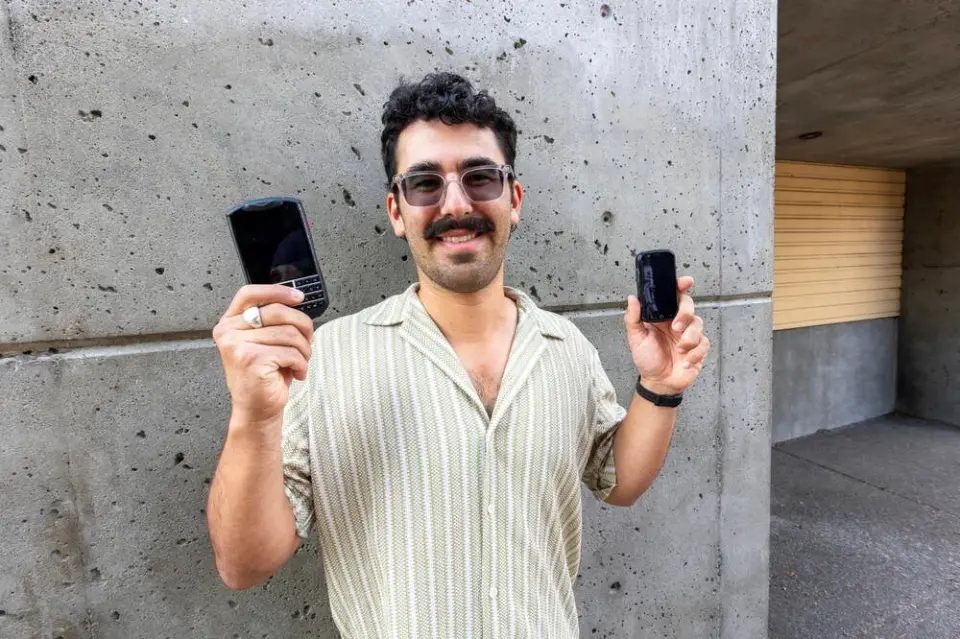
A growing number of residents in Greater Victoria are actively reducing smartphone reliance through mini-devices, flip phones, and offline community events. University of Victoria professor Deborah Campbell launched an 'Offline Club' after observing that students reported improved mental health and reading habits when disconnecting. Local organizer Mary Lloyd hosts monthly 'unplugged' gatherings at Caffe Fantastico, attracting large crowds for in-person socializing without screens. Participants cite data surveillance fears and attention-grabbing algorithms as primary motivations for adopting these alternative lifestyles.
Key points
- Samuel Pavez, a Camosun College student, switched to a Unihertz Jelly Star mini-smartphone to limit screen time while retaining access to essential apps like Spotify and Google Maps.
- Finn Murphy, a recent high school graduate, abandoned smartphones entirely for a flip phone after deleting Instagram, citing an 'addiction' to AI-generated content and a desire for a 'digital cleanse'.
- University of Victoria writing professor Deborah Campbell founded the 'Offline Club' after assigning a smartphone-free project; students reported immediate improvements in reading ability and mental health.
- Campbell, who uses a flip phone and turns off Wi-Fi for most of the day, cites data surveillance risks, referencing a friend in Syria arrested for online activity, as a key reason for her unplugged lifestyle.
- Mary Lloyd hosts monthly 'unplugged' events at Caffe Fantastico in Quadra Village, where participants engage in card games and crafting without phones, fostering stronger social connections.
- Recent UVic graduate Elladee Kay uses screen-time limiting apps and physical separation from devices to combat 'fear of missing out,' finding that creating 'friction' for phone use is effective.
Background
This trend follows broader discussions about AI-generated software alternatives, such as the recent release of ArtCraft, which offers free, open-source replacements for Adobe Creative Cloud tools. While ArtCraft focuses on professional software independence, the Victoria-based movement highlights a parallel consumer desire to decouple from the attention-economy models of social media and smartphone ecosystems.
Why it matters
The shift toward analog or minimal-digital lifestyles indicates a significant cultural backlash against the pervasive integration of smartphones in daily life. As younger generations, who grew up with constant connectivity, seek to reclaim attention and mental health, they are driving demand for alternative technologies and community spaces that prioritize face-to-face interaction over digital engagement. This movement suggests that 'digital wellness' is evolving from simple screen-time limits to fundamental changes in how individuals structure their daily routines and social interactions.
What to watch
Expect continued growth in niche hardware markets for mini-smartphones and flip phones, as well as an increase in 'offline' community events and university-sponsored clubs. Local businesses may begin integrating 'phone-free' zones to accommodate this demographic, while tech developers might explore simpler, less addictive app interfaces to cater to users seeking reduced digital friction.
Want the full story? Read the original reporting
Read on Times Colonist