
Google Policy Update Links Gmail and Photos Data to AI-Driven Ad Targeting
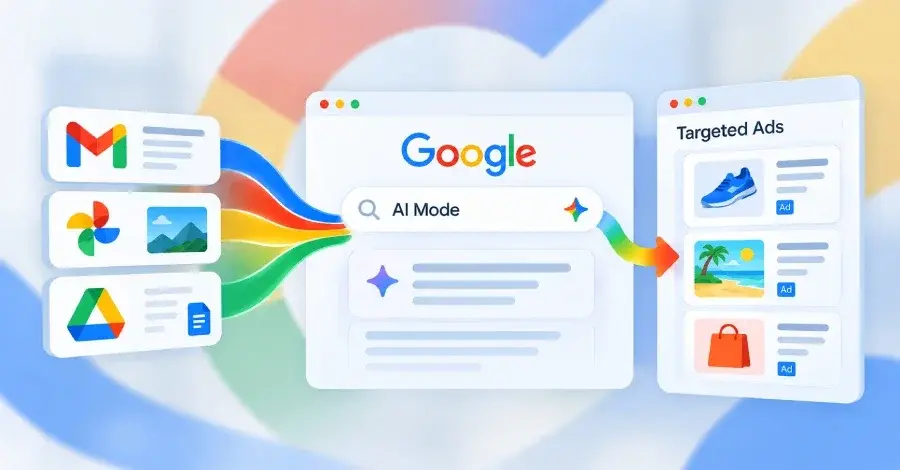
Google updated its privacy policy on October 16, 2026, clarifying that enabling the 'Personal Intelligence' feature allows data from Gmail, Drive, and Google Photos to be used for personalized ads in Search and Gemini. While Google maintains that such data is not used for ad targeting by default, opting into AI features creates an exception where connected content can serve as a signal for ad personalization. Users can opt out by disconnecting specific apps or disabling personalized recommendations. This move follows OpenAI's expansion of advertising to 89 countries, where the company asserts that ads do not influence chatbot responses or sell user data.
Key points
- Google's revised privacy policy, effective October 16, 2026, states that allowing Search or Gemini to access data from other Google services may result in personalized ads based on that activity.
- The 'Personal Intelligence' feature, launched in January 2026, enables users to connect Gmail, Photos, and YouTube to provide tailored AI answers, but this connection now permits ad personalization using that data.
- Google explicitly notes that content from Drive, Gmail, and Photos is not used for personalized ads unless the user actively chooses to make that data available to services supporting personalized ads.
- The Personal Intelligence feature is currently in beta for users over 18 globally, excluding the European Economic Area, Switzerland, the UK, and Nigeria.
- Users can opt out of this data sharing by disconnecting specific apps from Personal Intelligence or disabling personalized recommendations through Google's Search Services Personalization settings.
- OpenAI recently expanded its advertising to 89 countries, emphasizing that ads are separate from chatbot answers and that user data is not sold to advertisers, contrasting with Google's data-linked ad model.
Background
This development follows earlier reports in October 2026 regarding Google's privacy policy changes linking Gmail data to ad targeting via AI features. It also occurs amid broader concerns about ad platform security, including the 'AdFection' spyware campaign discovered in 2024-2025, which exploited targeted ads to deliver zero-click spyware to news organizations. Additionally, Google has faced scrutiny for using its ad platform to distribute browser-locking scams, highlighting ongoing tensions between ad monetization and user privacy.
Why it matters
The policy update highlights the growing intersection of AI personalization and advertising, where users trade privacy for tailored AI experiences. It underscores the need for users to understand the implications of connecting personal data to AI tools, as these connections can inadvertently enable ad targeting. The contrast with OpenAI's approach, which separates ads from data usage, illustrates differing industry strategies for balancing monetization and privacy in the AI era.
What to watch
Users should review their Personal Intelligence settings to determine which apps are connected and whether they wish to allow data sharing for AI personalization. Google may face increased scrutiny from privacy advocates and regulators, particularly in regions like the European Economic Area, where the feature is not available. OpenAI's expansion of advertising to more countries may prompt further debates about the ethical boundaries of AI-driven ad personalization.
Want the full story? Read the original reporting
Read on The Hacker News