
Motorola Signature 27 vs. Samsung Galaxy S26 Ultra: Newer Silicon vs. Established Ecosystem
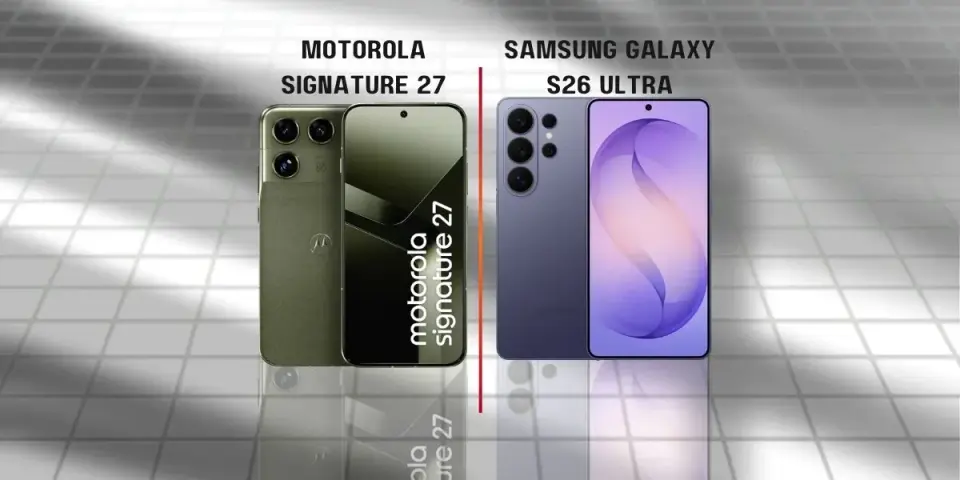
The Motorola Signature 27 and Samsung Galaxy S26 Ultra compete at the same $1,599 price point for 512GB storage, but offer distinct trade-offs. Motorola leads in raw performance, battery life, and charging speed, featuring the newer Snapdragon 8 Elite Extreme Gen 6 chip, a 7,000mAh battery, and 90W wired charging. Samsung counters with a higher-resolution display, a built-in S Pen, and a Privacy Display feature. While Samsung’s phone is lighter and has been discounted significantly, Motorola offers exclusive software options like GrapheneOS support and a larger 200MP periscope camera. The choice depends on whether users prioritize hardware specs and privacy software or Samsung’s ecosystem and display quality.
Key points
- Motorola Signature 27 uses Snapdragon 8 Elite Extreme Gen 6; Samsung uses Snapdragon 8 Elite Gen 5.
- Motorola offers 7,000mAh battery and 90W charging; Samsung offers 5,000mAh and 60W charging.
- Samsung’s display has higher resolution (1,440 x 3,120) and a Privacy Display feature.
- Motorola is the first non-Pixel phone to support GrapheneOS, a privacy-focused Android variant.
- Both phones cost $1,599 for 512GB, but Samsung’s price has dropped significantly at retailers.
Background
The 2026 flagship market has seen significant price volatility, particularly for Samsung devices. Recent archive data indicates that the Galaxy S26 Ultra faced price hikes in October but subsequently received substantial Black Friday discounts, with some retailers offering the 256GB model for as low as $1,000. This contrasts with the Motorola Signature 27, which launched in November 2026 at a fixed $1,599 price point. The rivalry also follows a broader trend of Android flagships competing on privacy and hardware specs, with Samsung’s Privacy Display and Motorola’s GrapheneOS support highlighting divergent approaches to user security.
How outlets are covering it
Gizmochina emphasizes Motorola’s hardware superiority, noting the 13% CPU and 44% GPU performance gains from the newer Snapdragon chip, as well as the 2,000mAh battery advantage. However, it acknowledges Samsung’s display sharpness and the utility of the S Pen. PhoneArena highlights a unique software advantage for Motorola: it is the first non-Pixel device to support GrapheneOS, a privacy-focused operating system, which 33% of its poll respondents cited as their favorite feature. Notebookcheck provides a hands-on camera review, finding that while Motorola’s 200MP periscope camera performs well in daylight, it struggles with noise reduction in low-light conditions. TechRepublic frames the comparison against the Google Pixel 11 Pro XL, noting that while Motorola has better battery specs, Google’s software integration and lower price ($1,299) offer strong value, suggesting that hardware specs alone do not guarantee a better user experience.
Why it matters
This comparison highlights the shifting dynamics in the Android flagship market, where hardware specifications are no longer the sole differentiator. Motorola’s move to support GrapheneOS signals a growing demand for privacy-centric software options beyond Google’s Pixel ecosystem. Meanwhile, Samsung’s ability to discount its flagship significantly challenges Motorola’s premium pricing strategy. For consumers, the decision is no longer just about which phone has the better camera or battery, but about which software ecosystem and privacy features align with their needs, especially as prices converge at the $1,599 mark for high-storage variants.
What to watch
Independent head-to-head camera tests are expected to provide a clearer picture of how Motorola’s 200MP periscope compares to Samsung’s dual-telephoto setup. The GrapheneOS team may release official installation resources for the Signature 27, potentially offering the phone with the OS pre-installed. Samsung’s pricing strategy will likely continue to fluctuate in response to holiday sales and competitor launches, potentially making the S26 Ultra significantly cheaper than the Signature 27. Motorola is also developing a Razr Flex, a competitor to the Galaxy Z Fold 8, which may further intensify the rivalry in the premium segment.
- Motorola Signature 27 vs Samsung Galaxy S26 Ultra: Head-to-Head Comparison Gizmochina
- Our poll shows the Motorola Signature 27 has an ace up its sleeve to challenge the Galaxy S27 PhoneArena
- Motorola Signature 27: Three cameras, challenging lighting conditions, and surprising results Notebookcheck
- Motorola Signature 27 vs Pixel 11 Pro XL: 7,000mAh Battery or $300 Savings? TechRepublic
- Motorola Signature 27 May Ship with Significantly Smaller Battery in Select Markets Beebom Gadgets
Want the full story? Read the original reporting
Read on Gizmochina