
Visual tests confirm Apple’s new MacBook Pro cooling design, though base model lacks OLED
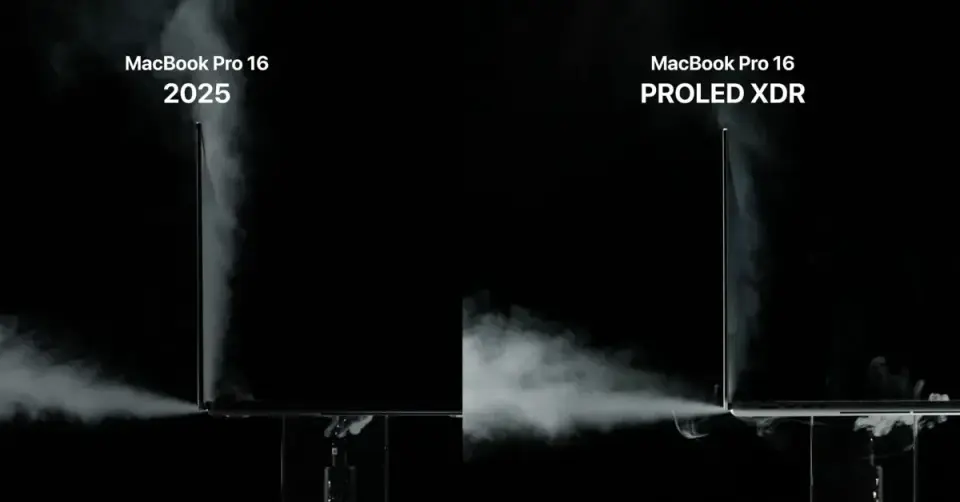
Apple’s new MacBook Pro with PROLED XDR display features a redesigned cooling system that directs heat away from the screen, verified by thermal imaging tests. While the flagship OLED models offer superior brightness and touch capabilities, the entry-level M6 MacBook Pro retains older design elements and lacks the new display technology, drawing criticism for its high price relative to its features.
Key points
- A YouTuber named Geekerwan used a fog machine to demonstrate that the new PROLED XDR MacBook Pro directs heat toward the rear hinge, unlike the previous mini-LED model which vented heat through the display.
- The new OLED MacBook Pro models are 14-15% lighter than their predecessors and feature a 2,000-nit tandem OLED display with touch support and a Dynamic Island interface.
- The entry-level 14-inch MacBook Pro with the M6 chip starts at $1,999 but retains the 2021-era design, lacking OLED, touch, and the glowing Apple logo found on the more expensive models.
- The M6 chip offers 12 CPU cores and 32 NPU cores, providing better single-core performance than the M5 Pro, but the OLED models use M5 Pro/Max chips which offer higher multi-core performance.
- Critics note the base model is $400 more expensive than the previous generation’s launch price, largely due to a mandatory 1TB storage upgrade and broader memory cost increases.
Background
Apple has historically reserved its most advanced display technologies, such as OLED and ProMotion, for its high-end MacBook Pro models, leaving entry-level versions with older designs. Recent industry trends have seen rising hardware costs due to memory shortages, impacting pricing across Apple’s lineup. The new PROLED XDR display represents a significant shift, introducing touch capabilities to the Mac ecosystem for the first time.
How outlets are covering it
9to5Mac highlights the visual evidence from Geekerwan’s fog test, emphasizing the effectiveness of the new thermal architecture in sustaining performance. Ars Technica criticizes the entry-level M6 MacBook Pro for lacking the 'exciting' features of the flagship OLED models, calling its positioning awkward and its price unjustified for the retained older design. The Guardian and CNN praise the OLED models for their brightness, weight reduction, and touch capabilities, though CNN notes the absence of Face ID and cellular connectivity as drawbacks. All sources agree that the OLED models represent a major leap, but disagree on the value proposition of the base M6 model.
Why it matters
The distinction between Apple’s new OLED and base MacBook Pro models highlights the company’s strategy of segmenting features by price point. The verified cooling improvements ensure sustained performance for high-end users, while the base model’s lack of new display technology may deter buyers seeking the latest innovations. This split reflects broader industry trends where premium features are increasingly reserved for top-tier devices, affecting consumer choice and upgrade cycles.
What to watch
Apple is expected to gradually trickle down OLED and touch technologies to lower-tier MacBook Pro models in future generations. The M6 chip may eventually appear in the MacBook Air, potentially narrowing the performance gap between the two lines. Consumers may wait for price adjustments or new chip generations before upgrading, particularly given the current high costs driven by memory shortages.
- This video lets you actually see the ‘incredible’ new MacBook Pro cooling system 9to5Mac
- Review: Apple’s M6 MacBook Pro is good, but it’s missing all the exciting stuff Ars Technica
- Apple MacBook Pro review: lighter, thinner and a stunning OLED touchscreen The Guardian
- I used Apple’s new touchscreen MacBook Pro for a week to see if it’s worth $2,899 | CNN Underscored CNN
- Can the Touchscreen MacBook Pro Replace an iPad Pro M5? What You Give Up TechRepublic
Want the full story? Read the original reporting
Read on 9to5Mac