
SS United States Sinks Off Florida to Become World's Largest Artificial Reef
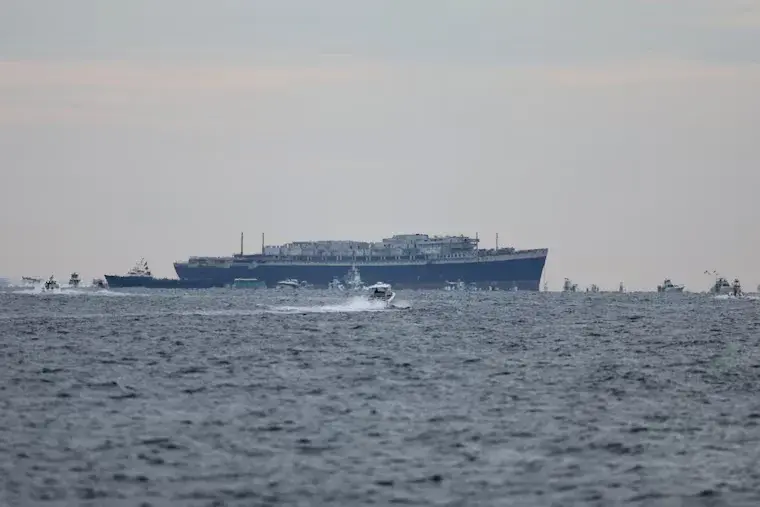
The 990-foot ocean liner SS United States was intentionally sunk off the Florida panhandle on November 11, 2026, to serve as the world's largest artificial reef. The vessel, which held the transatlantic speed record in 1952, was towed to a site 22 nautical miles southwest of Destin and submerged without explosives. Okaloosa County officials oversaw the operation, which was moved up by a day due to weather concerns. The ship's funnels were removed for a planned museum, and its hull was modified with large holes to ensure a controlled sinking. The project aims to create a habitat for marine life and attract divers, replacing previous failed attempts to redevelop the ship as a hotel or condo complex.
Key points
- The SS United States was sunk on Wednesday, November 11, 2026, beginning at 2 p.m. Eastern Time off the coast of Destin, Florida.
- The 990-foot vessel, which is 108 feet longer than the Titanic, will rest in approximately 180 feet of water, with its top deck about 60 feet below the surface.
- The sinking was a controlled operation without explosives, involving 10-by-10-foot holes cut into the hull and water-filled fuel tanks to stabilize the descent.
- The project cost $13.5 million and was undertaken by Okaloosa County after previous redevelopment plans, including a $400 million rehabilitation estimate, failed.
- The ship's 65-foot funnels were removed to anchor a new museum, while the SS United States Conservancy plans to preserve other artifacts.
- The vessel previously held the transatlantic speed record in 1952, averaging nearly 41 mph, and carried notable passengers including President John F. Kennedy and a young Bill Clinton.
Background
The SS United States had been docked in Philadelphia for nearly 30 years after being decommissioned in 1969. Various owners attempted to redevelop the ship as a hotel or condo complex, but these efforts failed due to the vessel's poor condition and high costs. The ship was moved to Mobile, Alabama, in 2025 for environmental remediation and cleaning before being towed to Florida. Okaloosa County purchased the vessel to prevent it from being scrapped, opting instead for the artificial reef project. The SS United States Conservancy, which had long advocated for preservation, eventually accepted the reefing plan as a way to save parts of the ship's legacy.
How outlets are covering it
Inquirer.com emphasized the logistical details of the sinking, including the timing, the presence of law enforcement to manage crowds, and the absence of 'never-reefers' who opposed the decision. KOMO focused on the ship's historical significance, noting its 1952 speed record and the removal of funnels for a museum. BBC highlighted the cultural impact, mentioning celebrities and presidents who traveled on the ship, and quoted Susan Gibbs, granddaughter of the ship's designer, on its symbolic value. WESH provided technical details, such as the removal of 400 portholes and the specific depth of the sinking site, while also noting the presence of other artificial reefs in the area. All sources agreed on the controlled nature of the sinking and the goal of creating a marine habitat, but differed in their emphasis on historical legacy versus practical conservation.
Why it matters
The sinking of the SS United States represents a significant milestone in marine conservation and artificial reef development. As the world's largest artificial reef, it is expected to attract divers, recreational fishers, and scientists, potentially boosting tourism and marine biodiversity in the Gulf of Mexico. The project also demonstrates a new approach to handling decommissioned vessels, prioritizing environmental and recreational benefits over failed commercial redevelopment. The creation of a museum and the preservation of artifacts ensure that the ship's historical legacy is maintained, while the reef provides a long-term habitat for marine life. This initiative may influence future decisions regarding the disposal of large vessels, setting a precedent for using them as artificial reefs rather than scrap metal.
What to watch
Divers and recreational fishers are expected to begin exploring the SS United States as early as Thursday, November 12, 2026, weather permitting. Scientists anticipate that smaller marine wildlife will flock to the ship quickly, with larger species like groupers, snappers, and amberjacks joining within the year. The SS United States Conservancy will work to preserve artifacts in a museum, and the funnels will anchor a new exhibit. Okaloosa County officials plan to promote the area as a premier diving destination, leveraging the presence of approximately 500 artificial reefs in the region. The long-term impact on marine biodiversity and tourism will be monitored in the coming months and years.
- SS United States to be sunk Wednesday off the coast of Florida; live updates Inquirer.com
- Once the fastest liner at sea, the SS United States now bound for the Florida seafloor KOMO
- Famed ship SS United States to be sunk off coast of Florida BBC
- World’s fastest ocean liner SS United States heads to final destination near Destin, Florida WESH
- The S.S. United States, a Historic Supership, Heads to the Ocean Floor The New York Times
Want the full story? Read the original reporting
Read on Inquirer.com