
Critics Pan Netflix’s 'The Last House' for Silly Premise and Weak Execution
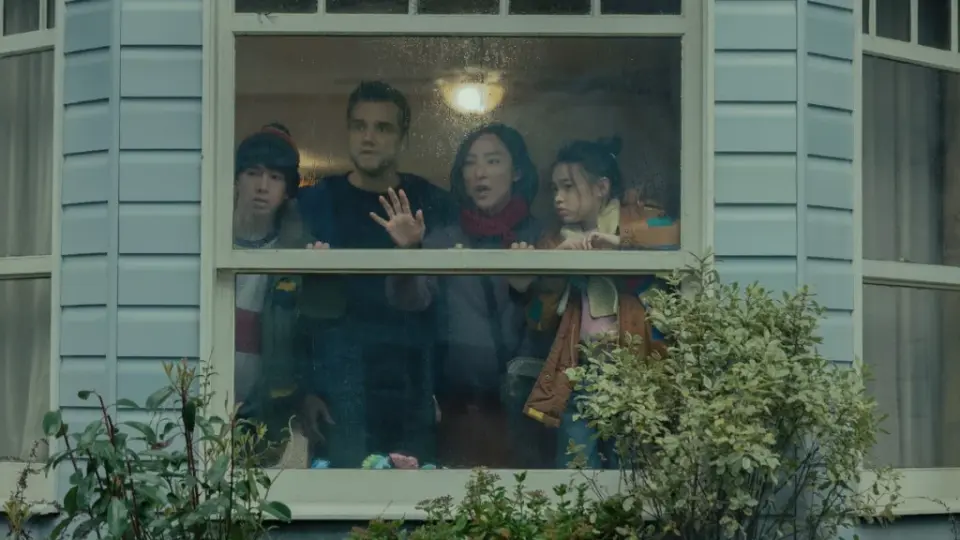
Netflix’s new horror thriller 'The Last House,' starring Wagner Moura and Greta Lee, has received largely negative reviews from critics. The film depicts a family trapped in their Seattle home by a sentient rainstorm that seals all exits. While the initial survival premise offers some tension, outlets criticize the movie for its illogical plot points, underdeveloped characters, and a disappointing, un-twisty conclusion. The film is described as a low-stakes, 'goofy' entry that fails to capitalize on its high-concept start, leaving audiences with a sense of anticlimax despite strong production values and performances from the lead actors.
Key points
- The film centers on Jason and Ann, played by Wagner Moura and Greta Lee, who are trapped in their home with their children after a strange rainstorm seals all doors and windows.
- The premise involves a mysterious force that prevents anyone from leaving their homes, forcing the family to survive with dwindling supplies over a period that extends from days to years.
- Critics note that the film shifts from a grounded survival thriller to a sci-fi horror involving monsters that hunt based on motion, similar to the concept in 'Bird Box.'
- The movie was released on Netflix on August 7, 2026, and was directed by Louis Leterrier, known for action films like 'The Transporter' and 'Now You See Me.'
- The narrative includes a time jump where the children grow into adolescents, developing rebellious streaks and secrets, while the parents struggle with the psychological toll of isolation.
- The film features a 'Cthulhu-octopus' monster and relies heavily on a heavy, ominous violin score by Yair Elazar Glotman to build dread.
Background
This release follows a trend of Netflix investing in high-concept genre films that often receive mixed critical reception. Our archive notes that 'The Last House' was previously described as a 'slick but hollow mystery' that prioritized mood over a satisfying payoff. The film’s release coincides with broader discussions about Netflix’s valuation and growth trajectory, where the platform’s reliance on continuous content replenishment is scrutinized. Additionally, the film’s themes of isolation and lockdown echo the cultural processing of the COVID-19 pandemic, a subject that has been difficult for narrative filmmakers to address directly, as seen in the underperformance of similar pandemic-themed films like 'Eddington.'
How outlets are covering it
AV Club’s Monica Castillo rates the film a D+, criticizing it for 'dwindling supplies and ideas' and noting that the characters make 'stupefyingly silly' decisions that break the tension. She highlights the mismatch between Greta Lee’s intense performance and Wagner Moura’s stoic approach, calling the monsters 'goofy.' The Guardian offers a more nuanced view, describing it as a 'solid night in' that works best as a grounded survival thriller but fails when it shifts to 'gloopier sci-fi horror.' The outlet praises the production design but criticizes the 'unmemorable' creature design and the 'half-assed follow-through' of the plot. IndieWire is the harshest, calling the film 'asinine' and comparing its premise to the 1999 comedy 'Bowfinger.' The review argues that the 'chubby rain' concept is too silly to take seriously and that the film lacks the patience to develop its characters, resulting in a 'thimble of pandemic PTSD' spread across 100 minutes. All three outlets agree that while the initial premise is intriguing, the execution is flawed, with the Guardian and IndieWire specifically criticizing the dialogue and the unsatisfying ending.
Why it matters
The reception of 'The Last House' highlights the challenges streaming platforms face in producing original horror content that balances high-concept premises with coherent storytelling. The film’s poor critical reception, despite a high production value and star power, suggests that audiences and critics are increasingly skeptical of 'mockbuster' style genre films that rely on gimmicks over substance. It also reflects the ongoing difficulty in translating pandemic-era anxieties into compelling narrative fiction, as the film’s attempt to use lockdown as a horror device is seen as underdeveloped and illogical. For Netflix, this may indicate a need to refine its approach to original content, focusing on stronger scripts and character development to avoid the 'slop' label often attached to its rapid-release catalog.
What to watch
The film is currently available on Netflix, and its open-ended conclusion suggests that a sequel may be in development, though no official announcement has been made. Critics and audiences will likely watch for how the platform markets the film, given the mixed reviews. The performance of Wagner Moura and Greta Lee in this project may influence their future casting choices, as both actors are associated with weightier material. Additionally, the film’s reception may impact the careers of director Louis Leterrier and writer Matthew Robinson, who are known for other genre projects. The broader industry will watch how Netflix responds to the critical backlash, potentially adjusting its strategy for future horror and thriller releases to avoid similar pitfalls.
- Take a rain check on checking out the goofy Netflix horror The Last House A.V. Club
- ‘The Last House’ review: Netflix sci-fi thriller feels unmoored The Seattle Times
- 'The Last House' Ending, Explained: What Are the Creatures and What Do They Want? IMDb
- The Last House review – post-Covid apocalyptic lockdown thriller is a solid night in The Guardian
- ‘The Last House’ Review: Wagner Moura and Greta Lee Are Locked Inside by the Rain in Ridiculous Netflix Thriller IndieWire
Want the full story? Read the original reporting
Read on A.V. Club