
Bessent’s Bond Intervention Fails as Iran Sanctions Escalate
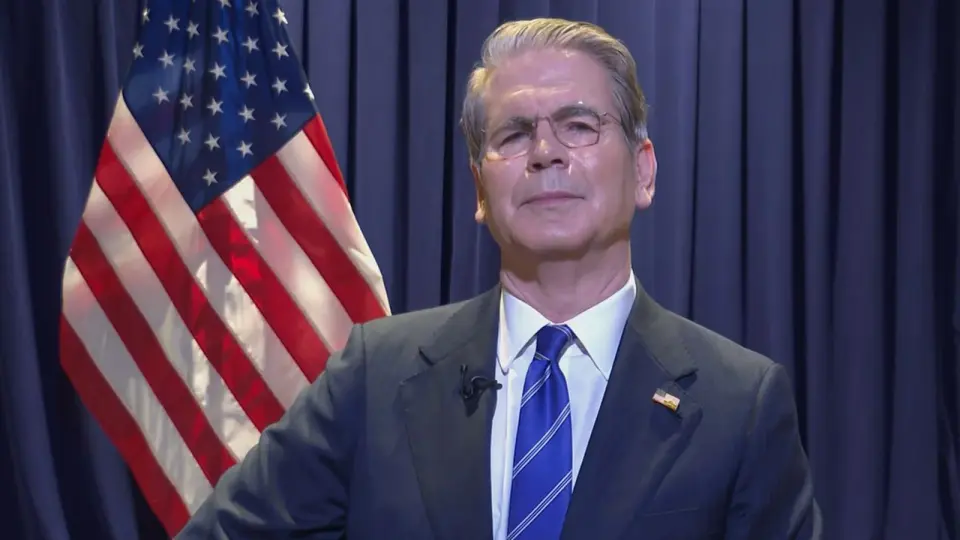
Treasury Secretary Scott Bessent attempted to stabilize US bond markets with a $4 billion buyback and claims that the budget deficit has peaked, but yields rebounded, causing the S&P 500 to drop 0.9%. Simultaneously, the US administration escalated economic pressure on Iran through a naval blockade and sanctions, with Bessent asserting that large-scale combat is unlikely. While Trump claims Iran’s economy is collapsing, Tehran dismisses the threats, and a former Iranian central bank adviser disputes the severity of the economic damage, though UAE trade cutoffs may still cause significant harm.
Key points
- Bessent pledged to 'make a market' with a Treasury buyback exceeding $4 billion, arguing the US budget deficit has likely peaked after hitting a record $432 billion in July.
- Despite the intervention, bond yields rebounded, erasing the initial decline and sending the S&P 500 down 0.9%, indicating traders remain skeptical of the Treasury’s ability to control long-term debt costs.
- The US is pursuing 'maximum economic pressure' on Iran via a naval blockade in the Gulf of Oman and sanctions, with Bessent stating that large-scale combat is unlikely to resume.
- Trump declared 'economic D-Day' against Tehran, claiming Iran’s economy is collapsing due to 350% inflation and lack of naval power, while Iranian officials dismissed the threats as doomed to fail.
- A former adviser to Iran’s central bank disputed the claim that the economy is on the verge of collapse, though acknowledged that the UAE’s decision to sever trade ties could deal a serious blow to Tehran.
- Japan’s headline inflation reached its highest level this year due to energy costs, complicating the Bank of Japan’s rate path, while Japanese investors increased foreign asset purchases following a recent currency intervention.
Background
This development follows the US federal debt reaching a record $40 trillion in August 2026, with interest payments expected to exceed $1 trillion. Previous coverage noted that Bessent had already doubled the Treasury buyback from $2 billion to $4 billion in an attempt to stabilize long-term yields, but concerns remained that such measures were insufficient to counteract growing deficits and geopolitical risks. The current escalation in Iran sanctions represents a shift from military engagement to economic isolation, following six months of prior conflict.
How outlets are covering it
CNBC emphasizes the failure of Bessent’s bond intervention, highlighting that yields rebounded and wiped out the effects of the buyback, suggesting a potential showdown between the Treasury and the bond market. The New York Times frames the Iran situation as a strategic signal from Trump that he does not want to return to large-scale war, noting that the combination of wartime destruction, naval blockade, and sanctions has placed unprecedented pressure on the Iranian economy. Al Jazeera provides the Iranian perspective, reporting that Foreign Minister Abbas Araghchi called the US economic warfare 'doomed to fail' and that Tehran is engaging in talks with Oman regarding the Strait of Hormuz. While Trump claims Iran’s economy is 'hanging by a thread,' a former central bank adviser cited by CNBC disputes this, arguing the economy is not as close to collapse as Washington claims, though the UAE’s trade cutoff remains a significant threat. Al Jazeera also notes that Trump characterized the Strait of Hormuz as 'American territory,' a stance that contrasts with the diplomatic efforts reported by Iran’s foreign ministry.
Why it matters
The failure of the Treasury’s bond buyback to stabilize yields signals deepening investor anxiety about US fiscal sustainability, particularly as the deficit remains at historic highs. This market volatility could have broader implications for global capital flows and interest rates. Simultaneously, the shift to 'economic D-Day' against Iran tests the efficacy of sanctions and blockades as tools of statecraft without direct military engagement. If the economic pressure fails to force a deal or collapse the regime, it may lead to renewed conflict or prolonged instability in the Strait of Hormuz, a critical global energy chokepoint. The divergence between US claims of Iranian economic collapse and Iranian official dismissals highlights the uncertainty surrounding the effectiveness of non-military coercion in modern geopolitics.
What to watch
Bessent is scheduled to hold a news conference on Monday to detail the specifics of the coordinated economic isolation strategy against Iran. Investors will closely watch whether bond yields continue to rise or if the Treasury introduces additional tools beyond the $4 billion buyback to manage long-term debt. In the Middle East, the outcome of talks between Iran and Oman regarding the Strait of Hormuz will be a key indicator of whether diplomatic channels remain open despite the US blockade. The US budget deficit trajectory will also be monitored to determine if Bessent’s claim that the deficit has peaked holds true, which could influence future fiscal policy and market confidence.
- CNBC Daily Open: Watching Iran's economy; a losing game for bonds CNBC
- The Message Behind Trump’s Threats of ‘Economic Warfare’ Against Iran The New York Times
- Trump says U.S. will impose 'economic D Day' against Iran NPR
- Iran war live: US vows toughest-ever sanctions, Tehran slams the move Al Jazeera
- Bessent says US to impose 'toughest' ever sanctions on Iran, urges China to cooperate Reuters
Want the full story? Read the original reporting
Read on CNBC