
Trump, Xi, and Putin issue joint peace declaration after historic Shenzhen summit
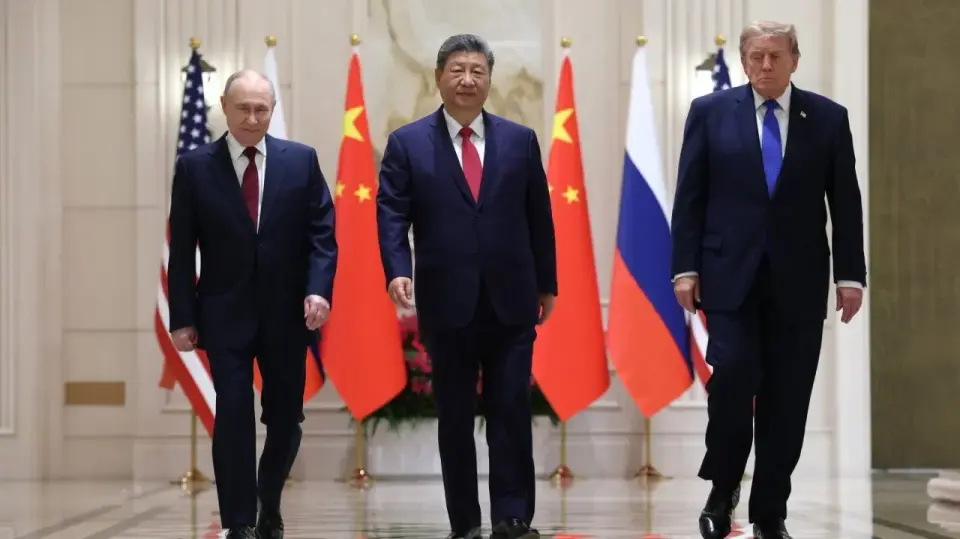
US President Donald Trump, Chinese President Xi Jinping, and Russian President Vladimir Putin held an unprecedented 90-minute trilateral meeting in Shenzhen, China, on November 19, 2026, on the sidelines of the APEC summit. The leaders issued a four-point 'peace declaration' committing to UN reform, increased petroleum supply, and dialogue on nuclear risk reduction. While the meeting marked a historic diplomatic engagement, no concrete agreements were reached on the wars in Ukraine or Iran, and the leaders emphasized the importance of dialogue over confrontation.
Key points
- The trilateral summit took place at the Kylin Villa in Shenzhen, lasting approximately 90 minutes, with brief opening remarks followed by closed-door discussions.
- The joint declaration includes four points: commitment to UN reform, increased production and supply of refined petroleum, a stance against the 'abuse of jurisdiction' by the International Criminal Court (ICC), and a pledge to prevent nuclear war.
- Trump described the meeting as 'historic' and stated that the US, China, and Russia are 'uniquely positioned' to discuss reducing nuclear stockpiles, though no new arms control treaty was announced.
- Xi Jinping called for nuclear weapons to be 'comprehensively banned and thoroughly destroyed,' while Putin described the talks as 'open' and 'very useful,' noting shared interests in resolving conflicts.
- The meeting occurred amid ongoing tensions, including the war in Ukraine, the conflict in Iran, and disputes over AI chip exports, with no Ukrainian or Iranian representatives present.
Background
This summit follows a period of heightened tensions and diplomatic maneuvering. In late 2025, US-China tariffs exceeded 100%, though a truce is set to expire in January 2026. The New START nuclear arms treaty expired in February 2026, with Trump rejecting a voluntary extension proposed by Putin in favor of a new pact including China. Additionally, the summit was overshadowed by allegations that former Nvidia CEO Jensen Huang had ties to a suspected Chinese intelligence asset, raising concerns about AI chip security. The meeting also comes after a significant midterm election defeat for Republicans in the US, marking the start of Trump's lame-duck period.
How outlets are covering it
The Hill and CNN emphasize the historic nature of the meeting and the issuance of the joint peace declaration, highlighting the leaders' commitment to dialogue. CBS News notes the lack of concrete breakthroughs, particularly regarding the war in Ukraine, and highlights the personal rapport between Trump and Putin, including Trump's remark that Putin is 'my friend.' The Guardian points out the criticism of the ICC in the declaration, noting that Putin is subject to an arrest warrant from the court, and highlights the absence of Ukrainian representatives. CNN also notes the differing objectives of the leaders, with Putin seeking to reemerge on the global stage, Xi positioning China as a diplomatic power player, and Trump aiming to project strength despite domestic political setbacks.
Why it matters
The summit represents a significant shift in global diplomacy, as the leaders of the world's three most powerful nuclear states engaged in direct, high-level dialogue. The peace declaration signals a potential move toward greater cooperation on global issues, including UN reform and energy supply. However, the lack of concrete agreements on major conflicts, such as the war in Ukraine, suggests that deep-seated tensions remain. The meeting also highlights the complex dynamics of US-China-Russia relations, with each leader seeking to leverage the summit for their own strategic and diplomatic goals.
What to watch
The leaders are expected to continue dialogue on nuclear risk reduction and UN reform, though no specific timelines or follow-up meetings have been announced. Trump is set to return to Washington, where he will focus on domestic issues, including the farm bill and AI policy. Putin has indicated he may attend the December G20 meeting in Miami, depending on the situation in Russia. The US and China are also expected to continue negotiations on trade and AI chip restrictions, with the tariff truce set to expire in January 2026.
- Trump, Xi, Putin issue 4-point ‘declaration toward peace’ after summit The Hill
- Trump, Xi and Putin sit down for a rare three-way meeting in China CBS News
- Apec summit live: Trump, Xi and Putin make ‘peace declaration’ but talks end without clear breakthrough The Guardian
- Strongmen ‘friends,’ AI’s potential and other takeaways from Trump’s China trip and sit-down with Putin and Xi CNN
- Trump, Xi and Putin hold rare 3-way talks on nuclear risks but emerge with no major breakthroughs AP News
Want the full story? Read the original reporting
Read on The Hill