
Israel Election Deadlock: Netanyahu Leads but Lacks Majority as Arab Parties Gain Record Influence
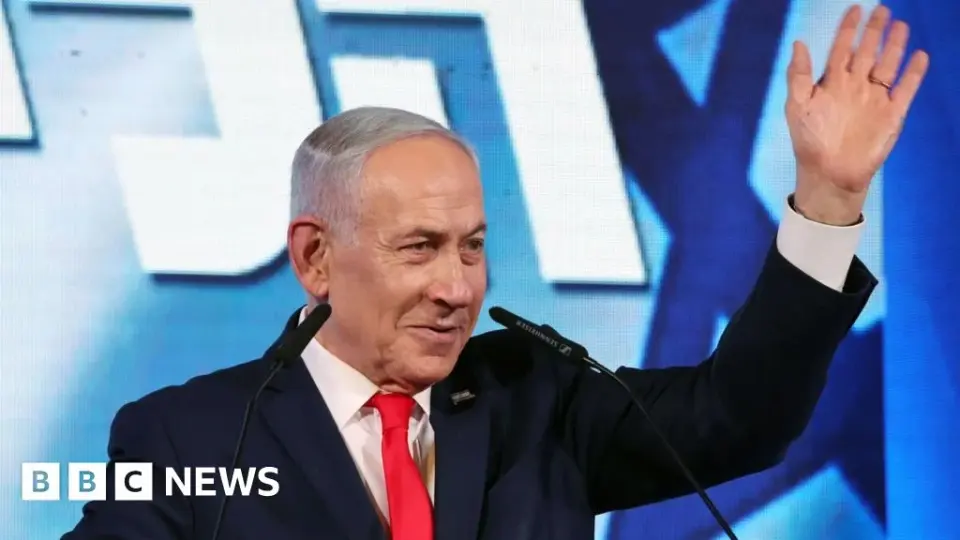
Partial results from Israel's 2026 general election show Benjamin Netanyahu's right-wing bloc leading with 53 seats, but falling short of the 61 needed for a majority. Gadi Eisenkot's opposition bloc holds 48 seats, while Arab-led parties have won a record 19 seats, potentially making them kingmakers. President Isaac Herzog will begin coalition consultations next week after final results are confirmed, with 430,000 to 480,000 absentee ballots still pending. Neither leader has secured a clear path to power, raising the risk of a prolonged political deadlock or a second election.
Key points
- Netanyahu's Likud party and allies are projected to win 53 seats, down from 68 in the previous Knesset, while Eisenkot's bloc holds 48 seats.
- Arab-led parties, including the Joint List and Raam, are on track to win 19 seats, a historic high driven by record turnout among Arab Israelis.
- Both Netanyahu and Eisenkot have claimed victory and intend to form a government, but neither can secure a majority without Arab party support, which most Jewish parties have refused.
- President Isaac Herzog praised the 77.7% turnout, the highest in over two decades, and urged parties to negotiate in good faith to avoid a repeat election.
- Final results may take days due to 430,000 to 480,000 absentee ballots from soldiers, diplomats, and hospital patients, with the Central Elections Committee expected to complete counting by Thursday.
Background
This election is the first since the October 7, 2023, Hamas-led attacks and subsequent wars in Gaza, Lebanon, and Iran. It was widely viewed as a referendum on Netanyahu's leadership and Israel's hard-line, religious-nationalist trajectory. Key campaign issues included accountability for security failures, military conscription of ultra-Orthodox men, judicial reforms, and Israel's international standing. Previous coverage noted that exit polls initially showed Eisenkot's bloc slightly ahead, but final counts shifted the balance to Netanyahu, though neither side secured a majority.
How outlets are covering it
BBC and CNN agree that Netanyahu's bloc leads but lacks a majority, with CNN emphasizing Netanyahu's potential to use security crises or external pressure to block coalition formation. The New York Times highlights the tension between Israel's identity as a Jewish state and a liberal democracy, noting the reluctance of Jewish parties to ally with Arab parties despite their record turnout. Al Jazeera argues that Arab parties are not true kingmakers due to a 'political veto' rooted in exclusionary structures, with analysts like Ahmed Najar stating that Eisenkot's refusal to partner with Arab parties is ideological rather than practical. CNN also notes that Netanyahu's Likud accused Arab parties of 'stealing the election' through fraud, a claim the Central Elections Committee is reviewing.
Why it matters
The outcome will determine whether Israel continues its current hard-line, religious-nationalist trajectory or shifts toward a more centrist or inclusive government. A prolonged deadlock could lead to a second election, further destabilizing the country. The record Arab turnout signals a potential shift in Israeli politics, with Arab citizens demanding greater influence, but the refusal of Jewish parties to ally with them may entrench existing divisions. The election also has implications for regional conflicts, as Netanyahu's coalition includes far-right figures like Itamar Ben-Gvir, who has called for West Bank annexation and Palestinian 'voluntary emigration.'
What to watch
President Isaac Herzog will hold consultations with all political factions next week to decide who to task with forming a government. The chosen candidate has 28 days, with a possible 14-day extension, to negotiate a coalition. If they fail, the mandate passes to another candidate, and if that also fails, Israel may face a second election. Netanyahu, as caretaker prime minister, has a built-in advantage, as he can remain in power if coalition talks fail. The Central Elections Committee will finalize results by Thursday, with 430,000 to 480,000 absentee ballots still pending.
- Netanyahu's bloc leading Israel election but short of majority, partial results show BBC
- Netanyahu is the ultimate survivor. But can he survive this time? CNN
- What to Make of Israel’s Ambiguous Election The New York Times
- Why Arab parties may not be the ‘kingmakers’ in this Israeli election Al Jazeera
- Netanyahu and top rival face postelection choices that could redefine Israeli politics AP News
Want the full story? Read the original reporting
Read on BBC