
Obama and Trump Clash in Dueling Midterm Rallies Across Swing States
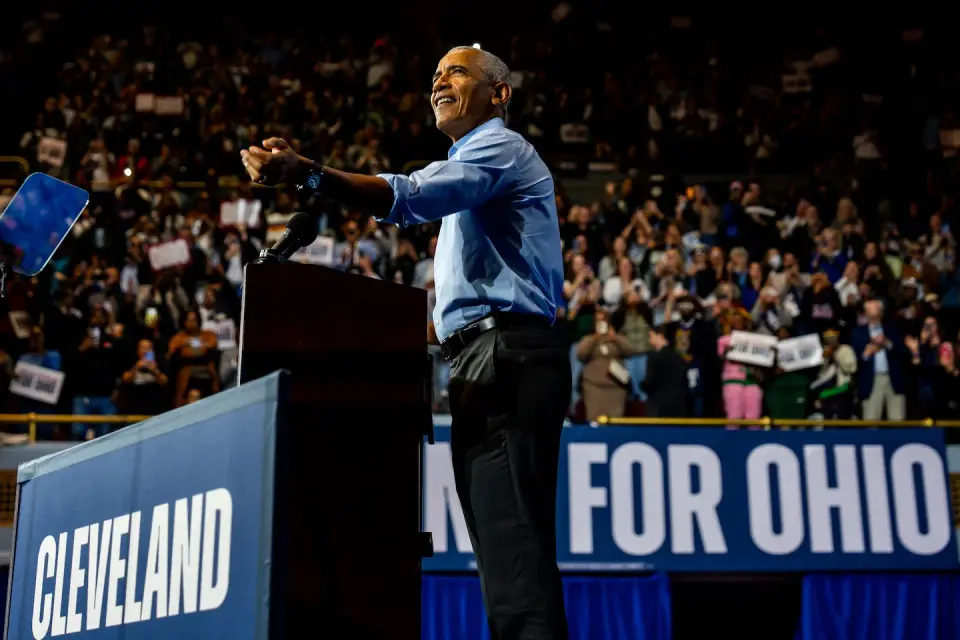
Former President Barack Obama returned to the campaign trail on Saturday, October 24, 2026, to support Democratic candidates in Ohio and Michigan, directly countering President Donald Trump’s rally in Georgia. Obama criticized the current administration for corruption, incompetence, and poor handling of the Iran conflict, framing the November 3 midterms as a critical opportunity to restore accountability. While Trump focused on economic promises and immigration restrictions, Obama highlighted the need for regulatory oversight on artificial intelligence and condemned tariffs on Canada. The dueling appearances underscore the intense competition for control of Congress and statehouses in key battleground states.
Key points
- Obama held rallies in Cleveland, Ohio, and Detroit, Michigan, supporting candidates Sherrod Brown, Amy Acton, and Abdul El-Sayed.
- Trump held a rally in Perry, Georgia, announcing a $4.2 billion Audi investment in Macon and criticizing Democratic candidates as extremists.
- Obama described the Trump administration as two years of 'chaos, cruelty, and corruption,' calling the midterms a 'circuit breaker' for accountability.
- Trump’s approval ratings have dropped, and Republicans are facing challenges in Georgia and Michigan due to high prices and controversial policies.
- Obama criticized the administration’s approach to AI, Iran, and Canada tariffs, while Trump focused on immigration and economic incentives.
Background
This event follows Obama’s recent defense of Representative Ilhan Omar against federal probes, which he called 'appalling' political intimidation. The current midterms are particularly contentious, with both parties vying for control of a closely divided Congress. Obama’s return to the trail marks his first major campaign appearances since the spring, signaling a strategic shift to maximize impact in pivotal states like Ohio and Michigan, which have historically been swing states but have recently leaned Republican.
How outlets are covering it
The Washington Post emphasized Obama’s call for accountability and his critique of the administration’s 'foolishness.' The New York Times highlighted the strategic contrast between Obama’s focus on public servants and Trump’s message of fear regarding Democratic extremism. U.S. News & World Report focused on Obama’s specific criticisms of corruption, the Iran war, and White House renovations, noting public skepticism of Trump’s business dealings. CNN detailed Obama’s remarks on Canada tariffs and his support for Abdul El-Sayed, while also covering Trump’s announcement of the Audi plant and his comments on immigration. Outlets agreed on the high stakes of the midterms but differed in emphasis: some focused on the personal attacks between the two presidents, while others highlighted the policy disagreements and economic impacts.
Why it matters
The dueling rallies signal the intensity of the midterm campaign, with both parties mobilizing their bases in key battleground states. Obama’s return to the trail may energize Democratic voters, while Trump’s focus on economic promises and immigration aims to consolidate Republican support. The outcomes in Ohio, Michigan, and Georgia could determine control of Congress and statehouses, influencing the balance of power in the coming years. The debates over AI, tariffs, and corruption reflect broader national concerns that will shape the political landscape post-midterms.
What to watch
Obama is expected to visit Georgia later in the week, while Trump plans to campaign in Michigan on Sunday. Both candidates will continue to emphasize their respective platforms in the final days before the November 3 election. The focus will remain on key Senate races in Michigan, Ohio, and Georgia, as well as statehouse contests. Public opinion on economic policies, AI regulation, and immigration will likely influence voter turnout and decisions in these pivotal states.
- In first midterm rally, Obama blasts Trump administration The Washington Post
- Obama Issues Searing Attacks on Trump, Ramaswamy in Return to Campaign Trail The New York Times
- Obama Unloads on Trump While Stumping for Democrats Ahead of Midterms U.S. News & World Report
- Obama slams Trump for years of ‘chaos and cruelty’ while stumping for Democrats in Michigan, Ohio CNN
- In Ohio rally, Obama blasts Ramaswamy, GOP over controversial Acton ad: "No low he will not sink to" CBS News
Want the full story? Read the original reporting
Read on The Washington Post