
Apple M5 Ultra Benchmarks: 80-Core GPU Nearly Matches RTX 5090
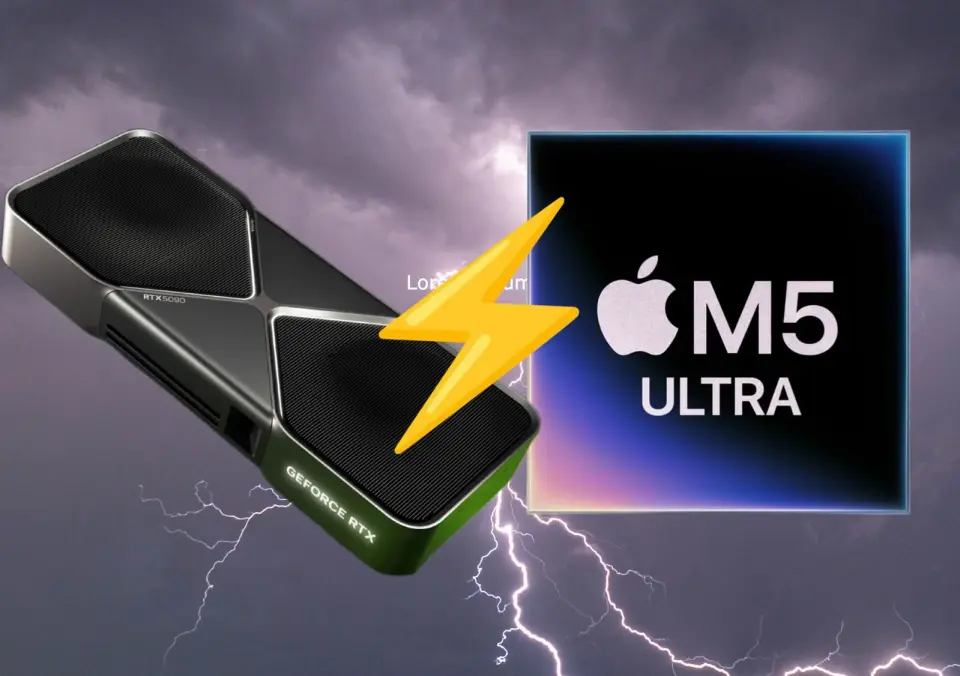
Apple’s M5 Ultra chip, featuring an 80-core GPU, has entered benchmark databases with performance nearly matching Nvidia’s RTX 5090. While it significantly outperforms the RTX 5080, it trails the 5090 by less than 5% in Blender tests. The chip powers the new Mac Studio, offering massive memory bandwidth and unified memory, though at a premium price point.
Key points
- The M5 Ultra features an 80-core GPU and 36-core CPU, scoring 15,350 points in Blender benchmarks, compared to 16,000 for the RTX 5090 and 9,100 for the RTX 5080.
- The M5 Ultra’s memory bandwidth reaches 1.2TB/s, a significant increase over the M3 Ultra’s 813GB/s, supporting large AI models and complex 3D rendering.
- The base M5 Ultra Mac Studio costs $5,499, while a high-end configuration with 256GB RAM and 4TB storage reaches $12,300, reflecting current memory price surges.
- The M5 Ultra supports clustering up to four Macs via Thunderbolt 5, pooling resources for AI development and heavy creative workloads.
- Apple’s M6 chip, debuting in the Mac mini, offers improved single-core performance but lacks the massive core counts of the M5 Ultra, focusing on efficiency and entry-level power.
Background
Recent archive articles highlight the severe GPU shortage and price inflation in 2026, with RTX 5090s selling for over $7,500 due to AI server demand. This context underscores the value proposition of Apple’s integrated approach, where high memory capacity is bundled without the extreme volatility of discrete GPU pricing. The M5 Ultra’s arrival coincides with Apple’s shift to a new chip architecture that decouples GPU scaling from the rest of the chip, a change not present in the previous M3 Ultra generation.
How outlets are covering it
Notebookcheck emphasizes the M5 Ultra’s raw benchmark performance, noting it crushes the RTX 5080 and trails the RTX 5090 by less than 5% in Blender tests. CNET highlights the practical implications of the M5 Ultra’s massive memory bandwidth and the ability to cluster Macs, positioning it as a unique workstation for AI developers. The Verge focuses on the extreme pricing, noting the $12,300 cost of the top-tier Mac Studio and its target audience of AI developers and VFX houses. Ars Technica, while reviewing the M6 Mac mini, notes that the M6’s performance gains are substantial but that the M5 Ultra remains the pinnacle for heavy multi-core tasks, with the M6 lacking the core density needed for such workloads. All sources agree on the M5 Ultra’s dominance in Apple’s lineup but differ on its value proposition relative to the inflated prices of discrete GPUs.
Why it matters
The M5 Ultra’s performance closes the gap between Apple Silicon and Nvidia’s top-tier discrete GPUs, challenging the assumption that discrete GPUs are necessary for high-end creative and AI workloads. The chip’s massive memory bandwidth and unified memory architecture offer a compelling alternative for users who need large memory pools without the extreme cost and volatility of discrete GPU markets. This shift may influence the future of workstation design, favoring integrated solutions with high memory capacity over traditional discrete GPU setups.
What to watch
Apple is expected to release the 512GB RAM configuration for the M5 Ultra Mac Studio by the end of October 2026. The M6 chip, debuting in the Mac mini, will likely be followed by M6 Pro, Max, and Ultra variants, though Bloomberg reports Apple may skip a full M6 generation and move directly to M7 for higher-end chips. The performance and pricing of these upcoming chips will determine whether Apple can sustain its momentum in the high-end workstation market against Nvidia and AMD.
- M5 Ultra vs RTX 5090: 80-core M5 Ultra GPU crushes RTX 5080, trails 5090 by less than 5% Notebookcheck
- Apple Mac Studio With M5 Ultra Review: There’s Simply Nothing Else Like It CNET
- The M5 Ultra Mac Studio tears through our benchmark tests The Verge
- Apple M6 Mac mini review: $300 price hike spoils a nice upgrade Ars Technica
- Mac Studio With M5 Max Review: The Best Mac for Photo and Video We’ve Tested petapixel.com
Want the full story? Read the original reporting
Read on Notebookcheck