
France Unrest Escalates as 550,000 Protesters Clash with Police in Nationwide Cost-of-Living Uprising
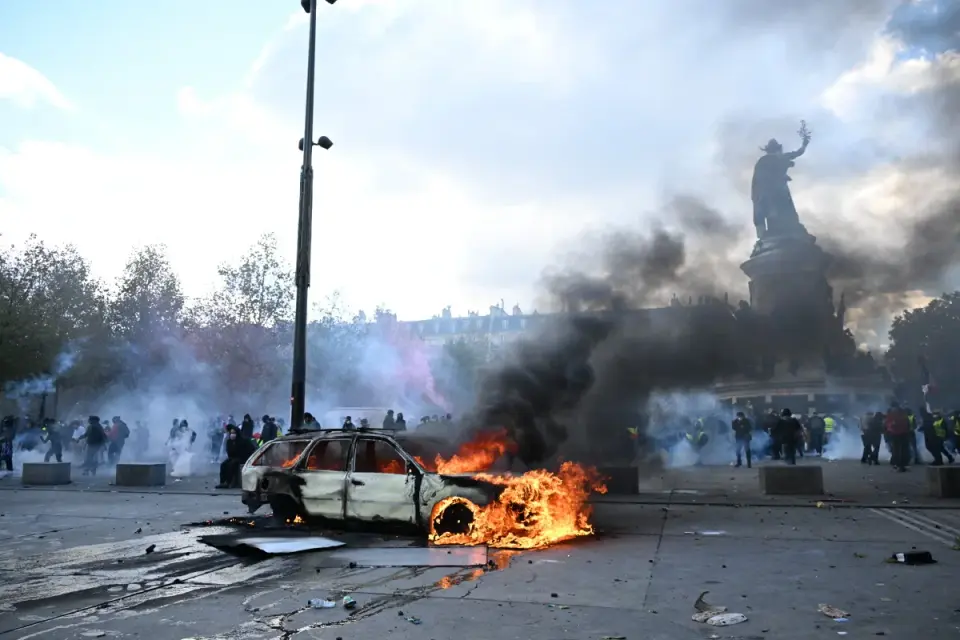
On October 17, 2026, approximately 550,000 people demonstrated across France against rising living costs and educational neglect, with 110,000 in Paris alone. The protests, which began with student strikes in September, have escalated into a broad coalition involving unions, yellow vests, and far-left figures. Violence has intensified, including a protester losing a hand in Saint-Etienne and hundreds of arrests. President Macron has vowed to prosecute those who damaged public buildings, while critics condemn police brutality against minors.
Key points
- Interior Minister Laurent Nuñez reported 550,000 protesters nationwide, including 110,000 in Paris, with organizers estimating higher numbers.
- Protests expanded beyond students to include the CGT union, yellow vests, and far-left candidate Jean-Luc Mélenchon, who joined demonstrations in Paris.
- A protester lost a hand in Saint-Etienne, renewing scrutiny of police use of stun grenades; authorities had suspended one type of grenade after a similar incident in Lens but rescinded the ban for general protests.
- At least 195 people were detained, with over 6,000 arrests reported since the movement began in September, most involving minors.
- President Macron condemned 'sowers of chaos' and promised prosecution for those who looted or attacked police prefectures and town halls.
Background
The current unrest follows a series of student-led protests that began in mid-September 2026, initially focused on school conditions and teacher shortages. These demonstrations have evolved into a broader movement against economic inequality and perceived government inaction. France faces significant economic challenges, including a public debt of 119.3% of GDP and stagnating growth, which has fueled intergenerational anger. The protests occur ahead of the April 2027 presidential election, where far-right and far-left candidates are leading polls, reflecting a deep crisis of political confidence.
How outlets are covering it
AP News and CNN emphasize the scale of the protests and the violent clashes, noting the injury of a protester in Saint-Etienne and the suspension of certain police grenades. CNN highlights the involvement of diverse groups, including unions and yellow vests, and quotes protesters criticizing wealth concentration. The Guardian focuses on the visual chaos, including looting and fires, and the arrests of over 400 people. Time Magazine provides a broader analysis, linking the unrest to France's long-term economic decline, inequality, and the failure of the postwar welfare state. It notes that the protests reflect a crisis of confidence in democracy and the political establishment, with both far-right and far-left parties gaining support. All sources agree on the severity of the situation but differ in emphasis: AP and CNN focus on immediate events and police response, while Time contextualizes the unrest within deeper structural issues.
Why it matters
The protests signal a potential shift in France's political landscape, with the April 2027 presidential election approaching. The unrest could influence the outcome, as far-right and far-left candidates capitalize on public dissatisfaction. Additionally, the situation highlights the fragility of Europe's political stability, with France and Germany accounting for 40% of the EU economy. A politically paralyzed France could weaken Europe's ability to address global challenges, including climate change, AI, and geopolitical tensions.
What to watch
The government is expected to continue its crackdown on violent protesters, with Macron vowing to prosecute those who damaged public buildings. The Education Minister, Edouard Geffray, has met with student protesters multiple times, but no agreement has been reached. The political landscape may shift further as the April 2027 presidential election approaches, with far-right and far-left candidates gaining support. The situation could also influence Europe's political stability, as France and Germany are key players in the EU.
- Clashes, fires and looting break out as protesters rally across France, joining students AP News
- Half a million protesters sweep France in major show of youth unrest CNN
- Unrest Mars Day of Protest in France, as Student Movement Turns National The New York Times
- Why is France Burning? Time Magazine
- ‘If we burn, you burn’: hundreds arrested at protests across France – in pictures The Guardian
Want the full story? Read the original reporting
Read on AP News