
Spain declares national mourning after 68 die in second high-speed rail disaster this year
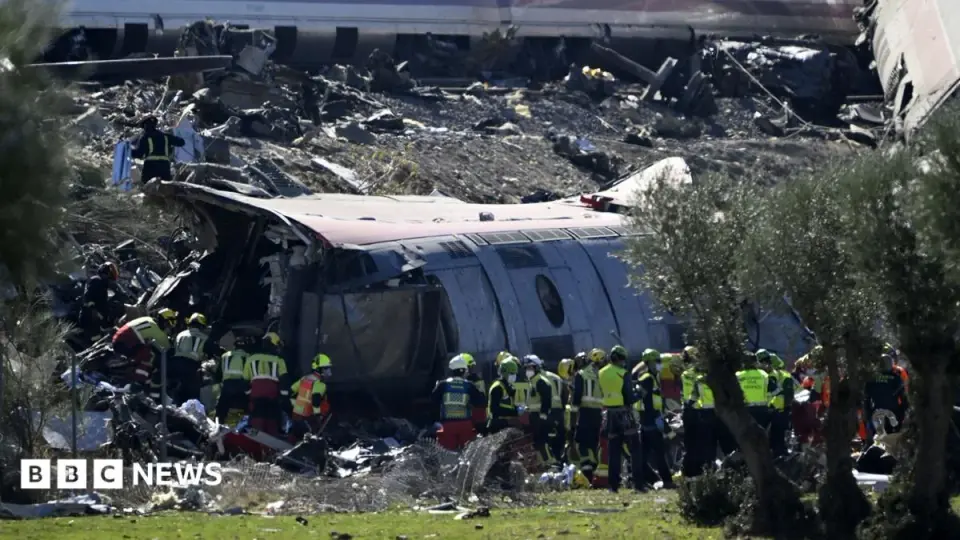
At least 68 people were killed and over 50 injured when a Renfe high-speed train collided with a stationary Iryo train near Toledo, Spain, on October 28. Prime Minister Pedro Sánchez declared three days of national mourning, calling the incident a tragedy that has shattered families. Transport Minister Óscar Puente attributed the crash to a computer failure that halted six trains, followed by a control center decision to resume movement without speed restrictions. This is the second fatal high-speed rail disaster in Spain this year, following the January crash near Adamuz that killed 46. The incident has suspended the Madrid-Seville rail line and intensified scrutiny of Spain’s rail safety systems ahead of the November 29 general election.
Key points
- At least 68 people died and 77 were hospitalized, with 15 suffering serious injuries, after a Renfe train rear-ended a stationary Iryo train near Urda, Toledo, on October 28.
- Prime Minister Pedro Sánchez declared three days of national mourning and stated that any negligence or safety system failures would be investigated and addressed with firmness.
- Transport Minister Óscar Puente said a computer failure initially stopped six trains, but the control center later allowed them to move without speed restrictions, a decision described as made under 'inexplicable circumstances.'
- The crash is the second fatal high-speed rail incident in Spain this year, following the January disaster near Adamuz that killed 46 people on the same Madrid-Andalusia line.
- Rail operator Iryo confirmed its train carried 147 passengers and three crew members, while local news reports suggest the Renfe train had 397 passengers; all traffic on the Madrid-Andalusia route has been suspended.
Background
This incident follows the January 2026 crash near Adamuz, Córdoba, where 46 people died when an Iryo train derailed and was struck by a Renfe train. That disaster was Spain’s worst rail tragedy since 2013, when 80 people died in a high-speed crash near Santiago de Compostela. The October 28 crash is the third rail fatality in Spain this year, after a commuter train near Barcelona struck a collapsed retaining wall in January, killing one person. Spain’s high-speed rail network, once considered among the safest in Europe, has faced growing scrutiny over infrastructure and signaling reliability.
How outlets are covering it
BBC News and The New York Times both report the death toll at 68, with the NYT specifying 24 deaths on the Renfe train and the remainder on the Iryo train. Both outlets emphasize the political impact, noting that Prime Minister Pedro Sánchez and opposition leader Alberto Núñez Feijóo suspended campaign activities, while far-right Vox leader Santiago Abascal continued campaigning and blamed the government for infrastructure neglect. BBC News highlights the railway union Semaf’s decision to proceed with a strike on October 29 in defense of railway safety, despite the tragedy. The New York Times notes that Madrid hospitals were overwhelmed by blood donations, prompting authorities to request donors wait until later days. ESPN’s source was inaccessible, providing no additional perspective.
Why it matters
The crash underscores persistent safety concerns in Spain’s high-speed rail network, which has experienced two fatal incidents in nine months. It has triggered a national mourning period, suspended major rail routes, and intensified political debate over infrastructure maintenance and regulatory oversight. With general elections approaching on November 29, the incident is likely to shape public discourse on government competence and rail safety, potentially influencing voter sentiment and policy priorities.
What to watch
An investigation into the cause of the crash is underway, with Spanish authorities examining the control center’s decision to resume train movement without speed restrictions. The Madrid-Andalusia rail line remains suspended, and emergency services are continuing to treat injured passengers in hospitals. The railway union Semaf is scheduled to strike on October 29, and the government has pledged to address any safety system failures. The November 29 general election is expected to feature rail safety as a key issue, particularly given the timing of the crash and the political response from major parties.
- At least 68 killed in Spanish high-speed train crash, as prime minister says 'whole country is grieving' BBC
- Live Updates: At Least 68 Killed in Train Crash in Spain, Officials Say The New York Times
- Wednesday's Copa Del Rey matches postponed after fatal Toledo train crash ESPN
- At least 64 killed in train collision on high-speed line in Spain ABC News - Breaking News, Latest News and Videos
- Spain: High-speed train crash kills dozens, rescue operations ongoing DW.com
Want the full story? Read the original reporting
Read on BBC