
Trump and Xi Meet in Washington Amid Tariff Truce and AI Chip Tensions
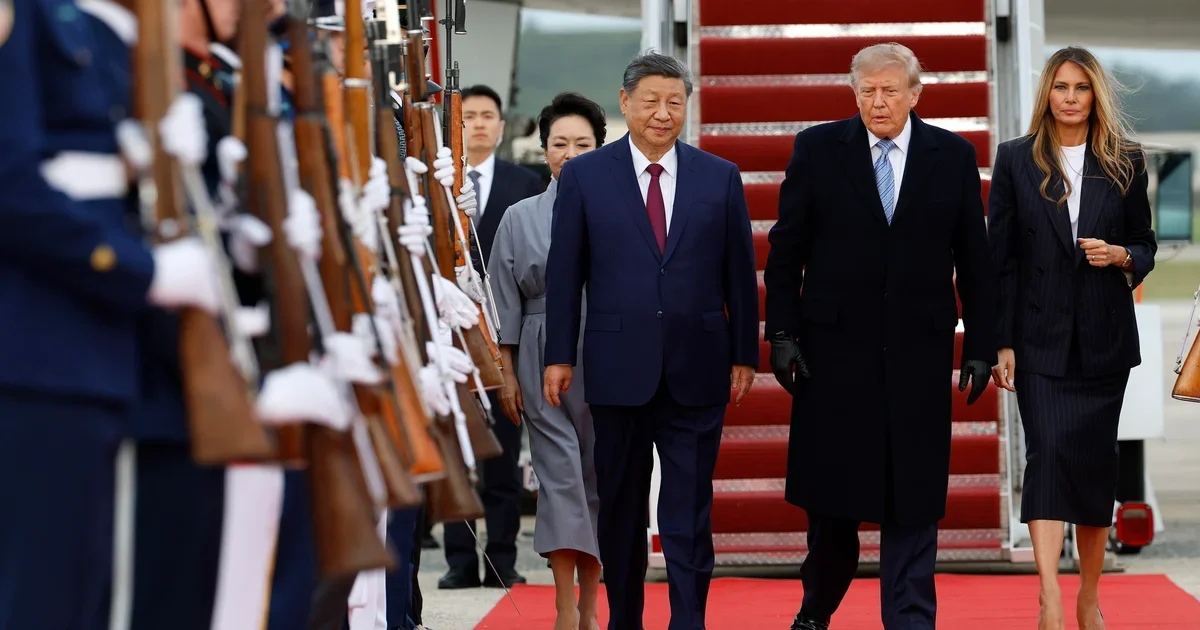
Chinese President Xi Jinping arrived in Washington for a state visit, receiving a rare tarmac welcome from President Trump at Joint Base Andrews. The summit, the first in over a decade, features a state dinner and formal meetings, but experts doubt major policy breakthroughs. Key issues include extending the tariff truce, AI chip restrictions, and Taiwan.
Key points
- Xi and Trump met at Joint Base Andrews on Sept. 23, with a military band and B-1 bomber flyover; Xi's wife Peng Liyuan accompanied him.
- A formal White House arrival ceremony and state dinner are scheduled for Thursday, followed by tea and a visit to the National Archives on Friday.
- The U.S. and China must decide whether to extend a tariff truce expiring Nov. 10, which paused rare earth export restrictions and lowered tariffs from over 100%.
- Treasury Secretary Bessent proposed a new AI 'notification system' for national security incidents, though Trump has resisted slowing AI research.
- Nvidia is barred from selling advanced chips to China, though Trump allowed sales of H200 chips to 'approved customers'; concerns exist over Chinese 'distillation' of U.S. AI models.
- Taiwan remains a flashpoint, with Xi warning of 'clashes' if the U.S. sells arms to the island, the world's largest semiconductor producer.
Background
This visit follows Trump's May 2026 trip to Beijing, where he praised Xi as a 'great leader.' Earlier this month, Xi conducted a multi-country diplomacy blitz to position China as a stable counterweight to U.S. policy. In September, Trump signaled openness to Chinese automakers building U.S. plants, reversing earlier hardlines, while U.S. automakers lobbied to limit Chinese brands. The current visit tests whether personal diplomacy can offset persistent competition in trade, AI, and alliances.
How outlets are covering it
CBS News and USA Today both highlight the ceremonial nature of the visit but diverge on its substance. CBS emphasizes expert skepticism, with James Lewis and Jake Werner noting 'no formal agenda' and 'no hope for policy achievements,' framing the summit as a 'show' for Trump. USA Today focuses on the 'friend or foe' tension, noting Trump's anti-China origins versus current cooperation. Both outlets report on the tariff truce and AI chip restrictions, but CBS details Bessent's 'notification system' proposal and Greer's 'Board of Trade' announcement, while USA Today stresses AI warnings. CBS notes congressional criticism from Wicker and Blumenthal, while USA Today highlights public opinion favoring cooperation over conflict. Neither outlet reports major policy breakthroughs, but CBS frames the visit as largely symbolic, while USA Today questions whether it signals a shift in U.S.-China dynamics.
Why it matters
The summit tests whether U.S.-China tensions can be managed through personal diplomacy amid critical issues: AI chip restrictions, tariff truces, and Taiwan. Outcomes could affect global supply chains, AI development, and U.S. alliances. Congressional criticism and public opinion suggest the visit may not resolve deep-seated distrust, but it could prevent escalation into conflict or economic war.
What to watch
Watch for announcements on extending the tariff truce beyond Nov. 10, any new AI chip licenses, and statements on Taiwan. The 'Board of Trade' may define protected goods. Congressional hearings on AI safety and potential House control in November could shape future U.S.-China policy.
- Trump rolls out the red carpet for Chinese President Xi Jinping despite U.S.-China tensions CBS News
- The Behind-the-Scenes Push to Get Xi a Red Carpet Welcome in America WSJ
- Five crucial issues lawmakers want Trump to address with China The Hill
- Trump Greets Xi for State Visit Amid U.S.-China Tensions: Live Updates The New York Times
- Friend or foe? Trump rolls out the red carpet for China's Xi Jinping USA Today
Want the full story? Read the original reporting
Read on CBS News