
Genomic reshaping of the Roman frontier in Germany, 400–700 CE
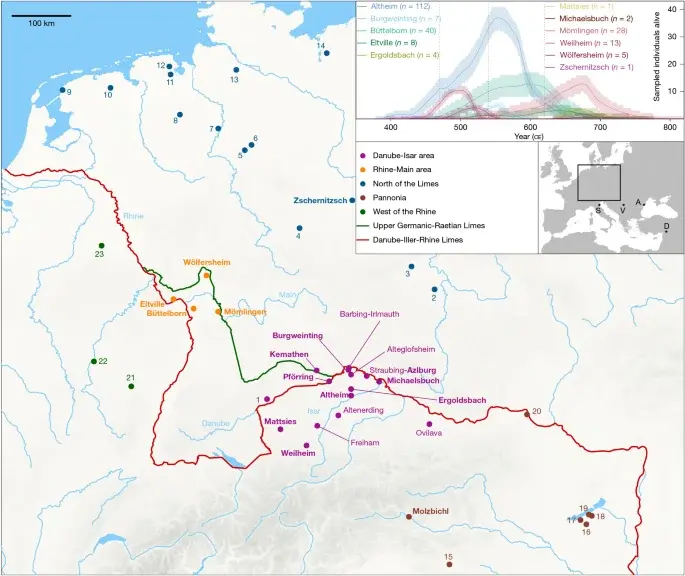
A large-scale ancient genomics study from southern Germany’s former Roman frontier shows a major demographic shift after the late Roman period, with northern-European ancestry mixing with diverse Roman populations between 470–620 CE, and persistence of genetic structure into the sixth century before forming a population resembling modern Central Europeans by the early seventh century. Using Chronograph, a Bayesian method that integrates grave dating, radiocarbon and kinship, the researchers estimate a 28-year generation time, life expectancy around 40 years for women and 43 years for men, and high infant mortality, with roughly a quarter of children losing a parent by age 10. The social system appears to center on nuclear, monogamous families with strict incest avoidance and no levirate, echoing Late Roman practices. Despite a Frankish takeover around 540 CE, population structure remained largely stable, though long-distance migrations and nonlocal individuals were evident in pre- and post-Roman contexts. The findings challenge a simple “barbarian migration” narrative, highlighting gradual demographic reorganization driven by mobility and local integration across a broad region.
- Demography and life histories across the Roman frontier in Germany 400–700 ce Nature
- What happened after the fall of Rome? Ancient genomes offer new clues Scientific American
- Genome study reveals what happened after the Roman Empire fell Reuters
- Genetics reveals that the fall of the Roman Empire shaped Europe’s population EL PAÍS English
- 'Lifelong monogamy' and 'half orphans': DNA analysis reveals clues about life on the Roman frontier after the fall of Rome Live Science
Want the full story? Read the original reporting
Read on Nature