New York’s post-9/11 era has remade its population and politics: generations have moved in and out, knowledge‑economy neighborhoods cluster around Manhattan, and immigrant communities have become politically dominant, reshaping the electoral map beyond the old Italian‑American base and culminating in the rise of the city’s first Muslim mayor.
About 117 billion people have ever been born; with roughly 8 billion alive today, that’s ~7% of everyone who has ever lived. The figure comes from a model by demographers Haub and Kaneda and is inherently uncertain due to sparse historical data, relying on assumptions about how long humanity has existed, past populations, and birth rates. Because life expectancy was very low for most of history, recent population growth has made the living share larger, with estimates for those who reached 65 ranging roughly from 5.5% to 9.5% of all who ever lived.
A Voronoi-style visualization of fertility rates across 236 countries shows about 71% of the global population lives in countries with below-replacement fertility (2.1 births per woman). India (~1.94) and China (~1.02) sit below replacement, while Sub-Saharan Africa has the highest rates (Chad 5.94, Somalia 5.91, DR Congo 5.90). Fertility has fallen from about five births per woman in the 1960s to a 2024 global average of roughly 2.2, with future growth increasingly concentrated in high-fertility regions, shaping aging populations, labor markets, and long-term demographics. The data come from the UN World Population Prospects 2024 Revision, using 2025 estimates.
A large-scale ancient genomics study from southern Germany’s former Roman frontier shows a major demographic shift after the late Roman period, with northern-European ancestry mixing with diverse Roman populations between 470–620 CE, and persistence of genetic structure into the sixth century before forming a population resembling modern Central Europeans by the early seventh century. Using Chronograph, a Bayesian method that integrates grave dating, radiocarbon and kinship, the researchers estimate a 28-year generation time, life expectancy around 40 years for women and 43 years for men, and high infant mortality, with roughly a quarter of children losing a parent by age 10. The social system appears to center on nuclear, monogamous families with strict incest avoidance and no levirate, echoing Late Roman practices. Despite a Frankish takeover around 540 CE, population structure remained largely stable, though long-distance migrations and nonlocal individuals were evident in pre- and post-Roman contexts. The findings challenge a simple “barbarian migration” narrative, highlighting gradual demographic reorganization driven by mobility and local integration across a broad region.
A new PNAS study argues Neanderthals did not have cognitively inferior brains; by comparing brain anatomy across living populations (Han Chinese vs. Americans of European descent) with Neanderthal anatomy, researchers found modern-human brain variation dwarfs the differences between Neanderthals and Homo sapiens, suggesting demography and genetic swamping, not brain power, likely drove Neanderthal replacement.
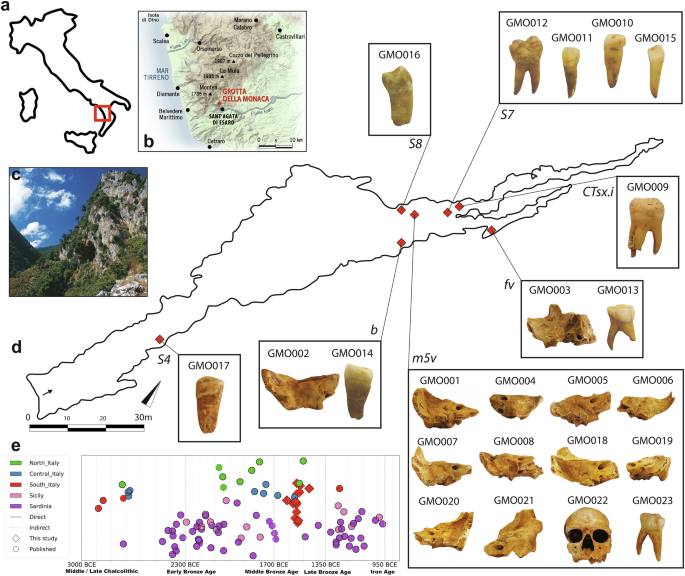
The study reconstructs the demography and social structure of a Middle Bronze Age community from Calabria, Southern Italy, revealing genetic continuity with Mediterranean populations, evidence of kinship and inbreeding, including a rare case of parent-offspring mating, and highlighting complex migration and interaction patterns in prehistoric Italy.
Fears of population collapse in the US due to declining birth rates are based on misconceptions; demographic trends are more complex, and population decline is neither imminent nor necessarily problematic, especially with economic policies and technological advances that can mitigate potential issues.
Russia's upcoming presidential election is set to affirm Vladimir Putin's hold on power, following the disqualification of antiwar candidate Boris Nadezhdin and the widely blamed death of opposition leader Alexei Navalny. Putin's regime has led to an abnormal state of affairs, with the economy increasingly dependent on military investment, diminishing returns from oil and gas exports, and a looming demographic crisis. The government's focus on military-industrial complex has led to a decline in labor productivity, while efforts to boost the birth rate and rural living are unlikely to address the demographic challenges. Putin's war in Ukraine reflects a fight against the future, as he prioritizes maintaining power and an imperialist ideology over the country's long-term well-being.
India is set to surpass China as the world's most populous nation, but demographers are unsure exactly when it will happen due to the fuzzy nature of population estimates. Mathematical calculations suggest it could occur in the middle of April, but the numbers could be revised. India's younger population and higher fertility rate have contributed to its population growth, while China's aging population and low fertility rate have slowed its growth. The shift in population has social and economic consequences for both countries, with India's growing labor force sparking economic activity and China facing a challenge in supporting its aging population.
India is set to surpass China as the world's most populous nation, but demographers are unsure exactly when it will happen due to the use of estimates. Both countries have over 1.4 billion people, making up more than a third of the world's population. Mathematical calculations suggest India will overtake China in the middle of April, but demographers warn that the numbers are fuzzy and could be revised. The shift is due to a drop in China's fertility rate, while India has a younger population and higher fertility rate. The change has social and economic consequences for both countries.