
Tag

Population Genomics

All articles tagged with #population genomics

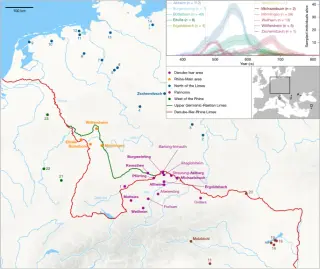
Genomic reshaping of the Roman frontier in Germany, 400–700 CE
archaeogenomics1 month ago

Genomic reshaping of the Roman frontier in Germany, 400–700 CE

A large-scale ancient genomics study from southern Germany’s former Roman frontier shows a major demographic shift after the late Roman period, with northern-European ancestry mixing with diverse Roman populations between 470–620 CE, and persistence of genetic structure into the sixth century before forming a population resembling modern Central Europeans by the early seventh century. Using Chronograph, a Bayesian method that integrates grave dating, radiocarbon and kinship, the researchers estimate a 28-year generation time, life expectancy around 40 years for women and 43 years for men, and high infant mortality, with roughly a quarter of children losing a parent by age 10. The social system appears to center on nuclear, monogamous families with strict incest avoidance and no levirate, echoing Late Roman practices. Despite a Frankish takeover around 540 CE, population structure remained largely stable, though long-distance migrations and nonlocal individuals were evident in pre- and post-Roman contexts. The findings challenge a simple “barbarian migration” narrative, highlighting gradual demographic reorganization driven by mobility and local integration across a broad region.


Monogenic diseases aren’t deterministic: context shapes genetic risk
health3 months ago

Monogenic diseases aren’t deterministic: context shapes genetic risk

New population-genomics research shows that many so-called monogenic diseases do not have 100% penetrance; a person carrying a disease-associated variant may remain healthy depending on other genetic factors and environment. Large datasets reveal that variants once believed to almost always cause conditions like inherited retinal degenerations, thyroid cancer, ovarian insufficiency, and even Huntington's disease do not guarantee disease in the general population, highlighting the need for nuanced genetic counseling and individualized risk assessments and potentially informing advances in gene therapies and embryo selection.

Uncovering the Ancient Origins of Multiple Sclerosis in Western Europe
anthropologyarchaeology2 years ago

Uncovering the Ancient Origins of Multiple Sclerosis in Western Europe

A new study published in Nature sheds light on the Neolithization process in western Eurasia, revealing distinct differences in the spread of farming between eastern and western populations. The ancestry of western Europeans was shaped by three major migrations, with the Yamnaya culture's expansion eradicating an invisible boundary. Additionally, genetic analysis suggests that the elevated risk for multiple sclerosis among northern Europeans originated from the Yamnaya nomads, possibly due to environmental and lifestyle factors.