
UK Judge Rules Barclays Bank Vandalism by Palestine Action Activists Not Terrorism
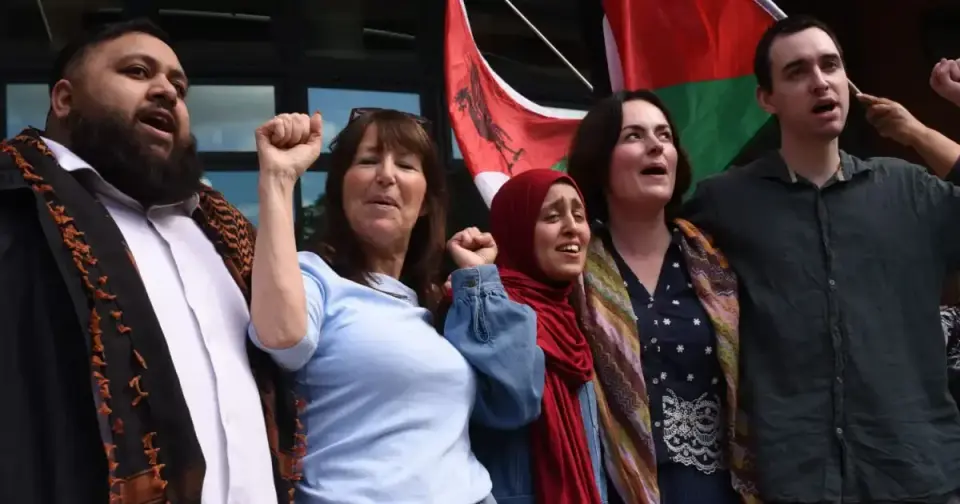
A UK judge ruled that the vandalism of a Barclays branch by five Palestine Action activists does not meet the legal threshold for a terrorism sentence, despite the group’s subsequent proscription. The activists, convicted in June 2026 for causing £212,000 in damage, will face standard criminal damage sentences in September rather than enhanced terrorism penalties. This decision follows a controversial post-verdict move by the trial judge to consider a 'terrorist connection,' which neither the defendants nor the jury were aware of during the trial. The ruling highlights tensions between counter-terrorism laws and direct action protests, with rights groups calling for the proscription of Palestine Action to be lifted.
Key points
- Judge Robert Altham ruled at Preston Crown Court that the August 2024 attack on a Barclays branch in Burnley did not constitute 'serious damage' under Section 69 of the Sentencing Act, thus excluding a terrorism classification.
- The five defendants—Brendon O’Hagan, Amanda Kelly, Hmeera Atiqnisar, Mohammed Malik, and Alma Yaniv—were convicted in June 2026 of causing £212,000 in damage but will not face terrorism-related sentencing enhancements.
- The trial judge, Philip Parry, initially signaled an intent to consider a 'terrorist connection' after the verdict, a move that surprised the defendants and jury, who were unaware of this possibility during the trial.
- The activists targeted the bank in protest against its shareholdings in Israeli weapons manufacturer Elbit Systems, though Barclays reportedly sold all such shares in October 2024.
- Sentencing for the five is scheduled for September 4, 2026, where they will face shorter jail terms than if classified as terrorists, avoiding 15-year post-release monitoring requirements.
Background
This ruling occurs amid ongoing legal challenges to the UK government’s July 2025 proscription of Palestine Action as a terrorist organization. Previous archive coverage notes that the UK Supreme Court is set to hear an appeal against this ban, with co-founder Huda Ammori arguing it breaches human rights. Additionally, over 3,500 people have been arrested for supporting the group since the ban, including mass sit-ins in London’s Parliament Square. A prior case in May 2026 saw activists sentenced as terrorists for causing £1.2m in damage to an Elbit Systems factory, setting a precedent that this case sought to challenge.
How outlets are covering it
Al Jazeera and The Guardian emphasize the activists’ relief and the procedural unfairness of introducing terrorism considerations post-verdict, noting that the jury and defendants were unaware of this possibility. The BBC provides a more neutral legal analysis, highlighting Judge Altham’s specific reasoning that the damage, while significant, did not meet the 'high threshold' of 'serious damage' required for a terrorism link, especially compared to attacks on sensitive properties like arms factories. Legal experts cited by Al Jazeera, such as Raj Chada, describe the application of these laws as 'very unusual' and targeted specifically at Palestine Action. Amnesty International UK, quoted by both Al Jazeera and The Guardian, frames the ruling as a partial victory but calls for the complete lifting of the proscription and an end to the misuse of counter-terrorism powers against protesters.
Why it matters
This ruling sets a significant precedent for the application of UK counter-terrorism laws against direct action protesters. It clarifies the threshold for 'serious damage' under Section 69 of the Sentencing Act, potentially limiting the government’s ability to classify property damage as terrorism in similar cases. The outcome also underscores the broader debate over the proscription of Palestine Action and the balance between national security and the right to protest, with implications for future cases involving political activism and criminal damage.
What to watch
The five activists are scheduled to be sentenced on September 4, 2026, at Preston Crown Court. They will face standard criminal damage sentences, which are expected to be shorter than terrorism-related penalties. The UK Supreme Court is also set to hear an appeal against the proscription of Palestine Action, which could further impact the legal landscape for the group and its supporters. Rights groups will likely continue to campaign for the lifting of the proscription and the release of those arrested under the Terrorism Act for supporting the group.
- Palestine Action activists will not be sentenced as terrorists, judge rules Al Jazeera
- Palestine Action ‘Barclays five’ will not be sentenced as terrorists The Guardian
- Pro-Palestinian activists who vandalized UK bank won’t be sentenced as terrorists The Times of Israel
- Palestine Action's bank attack 'not terrorism-linked', says judge BBC
- Protesters gather outside Preston Crown Court ahead of Palestine Action sentencing Lancashire Telegraph
Want the full story? Read the original reporting
Read on Al Jazeera