
Rome Unveils 2,000-Year-Old Mosaic and Fresco Beneath Trajan’s Baths
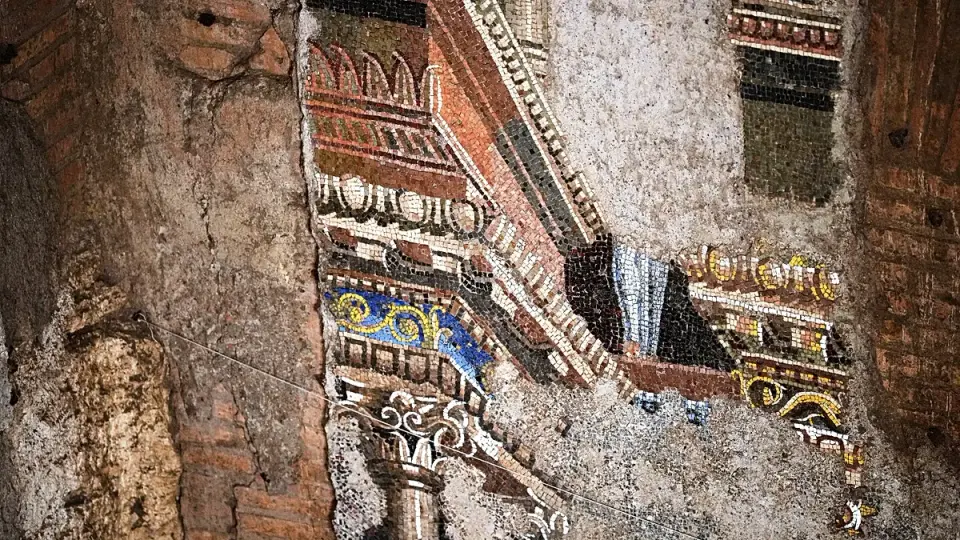
Rome has opened a new museum beneath the Oppian Hill, revealing a massive 1st-century AD mosaic and a 'Painted City' fresco. Discovered in the 1990s and restored over 14 years, the artworks depict a mysterious port city and were hidden under the Trajan Baths. The site, near the Colosseum, now offers limited public access.
Key points
- The 'Great Mosaic' and 'Painted City' fresco, dating to the 1st century AD, were discovered in the 1990s during excavations of the Trajan Baths.
- The mosaic, measuring 10 meters high and 16 meters wide, features a bird's-eye view of a port city with life-sized figures, including a philosopher and a poet.
- The site, located beneath the Oppian Hill near the Colosseum, was part of the largest bath complex in the ancient world, built by Emperor Trajan in 109 AD.
- A 14-year restoration project has preserved the blue and terracotta colors of the artworks, which are now accessible through a new museum.
- Public access is restricted to small groups, with free guided tours starting in September and regular visits beginning in October.
Background
This discovery follows other recent archaeological finds, such as the Roman mosaic in Adramytteion, Turkey, which depicted household pets, and the Rubin Observatory's deep-sky mosaic. These events highlight ongoing efforts to uncover and preserve ancient artifacts and historical sites.
How outlets are covering it
Euronews emphasizes the artistic and historical significance of the mosaic, calling it a 'best kept secret' in Rome. CNN focuses on the scale of the mosaic, noting it is the largest ever found in the Roman world, and questions whether the depicted port city is real or imaginary. AP News highlights the detailed restoration and the new museum's role in preserving the site. The Daily Beast underscores the rarity of the find, describing it as a 'mind-blowing discovery' that was buried for 2,000 years.
Why it matters
The unveiling of the Great Mosaic and Painted City fresco provides a rare glimpse into 1st-century Roman art and architecture. The site's integration into a new museum enhances public access to ancient history, while the restricted visitation ensures the preservation of these fragile artworks. This discovery also sheds light on the evolution of Rome's urban landscape, from Nero's Domus Aurea to Trajan's Baths.
What to watch
The site will open to the public in stages, with free guided tours starting in September and regular visits beginning in October. Archaeologists continue to excavate additional areas of the mosaic, including a scene depicting a grape harvest. The museum will also host cultural events, such as book launches, reflecting the site's historical use as a library.
- 'Back to the city': Italy unveils biggest frescoe from ancient Rome Euronews.com
- Biggest-ever Roman wall mosaic, featuring mysterious port city, revealed CNN
- Ancient Rome's biggest fresco and mosaic open to public for first time since discovery 3 decades ago AP News
- Archeologists Make Mind-Blowing Discovery That Was Buried for 2,000 Years The Daily Beast
- Archaeologists discover largest Roman mosaic wall The Telegraph
Want the full story? Read the original reporting
Read on Euronews.com