
US, Japan Finalize Deal for Japanese AMRAAM Production Facility Amid Regional Tensions
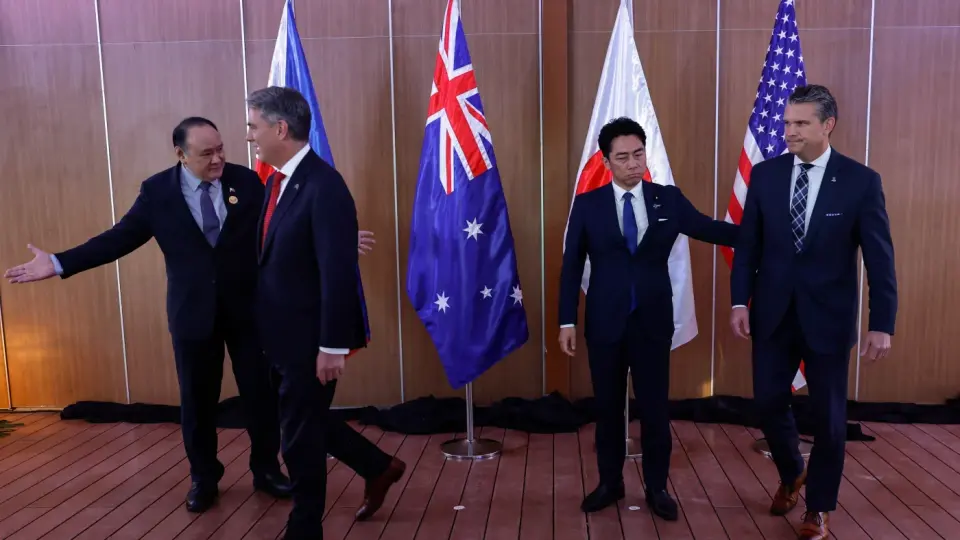
US and Japan agreed to build a facility in Japan for joint production of AMRAAM missiles, a move aimed at securing F-35 supply chains and strengthening regional deterrence. The agreement, announced at the ASEAN Defense Ministers' Meeting in Cebu, follows a $20.7 billion Pentagon contract to expand US production. Officials also discussed boosting cybersecurity cooperation and expressed concerns over Chinese naval activity in the region.
Key points
- Japanese Defense Minister Shinjiro Koizumi and US Secretary of Defense Pete Hegseth agreed to establish a final assembly and inspection plant for the AIM-120 Advanced Medium-Range Air-to-Air Missile (AMRAAM) in Japan.
- The agreement, dubbed 'Operation Supercharge,' is designed to ensure the acquisition of essential munitions for F-35 fighter jets and strengthen Japan's defense industrial base.
- The deal follows a $20.7 billion Pentagon contract with RTX to expand AMRAAM production over seven years, with annual output targeted at at least 1,900 missiles.
- Koizumi and Hegseth also agreed to strengthen cooperation to prevent cyberattacks, citing recent large-scale leaks of personal information in Japan.
- Koizumi raised concerns about Chinese naval activity, noting that three Chinese destroyers and a coast guard ship crossed the Osumi Strait near Kyushu this week.
- Hegseth assured ASEAN defense ministers of US commitment to deter aggression in the region, describing the approach as 'strong, quiet and clear.'
Background
The US and Japan have been accelerating military cooperation in response to perceived Chinese assertiveness in Asia. Previous agreements, including a February framework deal for AMRAAM and other munitions, laid the groundwork for this latest facility. Japan's historical constitutional restrictions on co-producing offensive weapons have slowed such agreements, but recent efforts aim to diversify the industrial base and build regional stockpiles. The broader context includes ongoing tensions in the South China Sea and East China Sea, where multiple nations, including the Philippines, Vietnam, and Taiwan, have overlapping claims with China.
How outlets are covering it
NPR and Air & Space Forces Magazine emphasize the strategic importance of the AMRAAM facility for securing F-35 supply chains and strengthening deterrence against China. The Japan Times highlights the cybersecurity aspect of the US-Japan agreement, noting Japan's recent struggles with cyberattacks. Japan Today's comments section reflects public skepticism, with some users criticizing the deal as 'war mongering' and questioning the lack of public consultation, while others support the move as necessary for national defense. The sources generally agree on the facts but differ in emphasis, with some focusing on military hardware and others on broader security cooperation.
Why it matters
The establishment of a Japanese AMRAAM production facility marks a significant shift in US-Japan defense cooperation, addressing supply chain vulnerabilities and enhancing regional deterrence. It reflects the Trump administration's push for allies to invest more in their own defenses and could influence future defense industrial policies in Asia. The agreement also signals a deeper integration of US and Japanese defense industries, potentially affecting regional security dynamics and China's strategic calculations.
What to watch
The location of the AMRAAM facility has not yet been announced, and the approval process may face further delays due to Japan's constitutional restrictions on weapon co-production. The Pentagon's $20.7 billion contract with RTX is expected to ramp up production to at least 1,900 missiles annually, with new rocket motor production lines coming online in 2027. Continued US-Japan cooperation on cybersecurity and defense industrial capacity is likely to be a focus in future bilateral discussions.
- US and Japan agree to establish a Japanese facility for joint missile production NPR
- U.S. and Japan agree to establish missile-production facility Japan Today
- U.S. and Japan defense chiefs agree to boost cooperation to prevent cyberattacks The Japan Times
- US and Japan Finalize Agreement for AMRAAM Facility Air & Space Forces Magazine
- US, Japan reach agreements for AMRAAM assembly, SM-3 production boost: Japanese MoD Breaking Defense
Want the full story? Read the original reporting
Read on NPR