
China Confirms First Catapult Launch of GJ-21 Stealth Drone from Type 076 Amphibious Ship
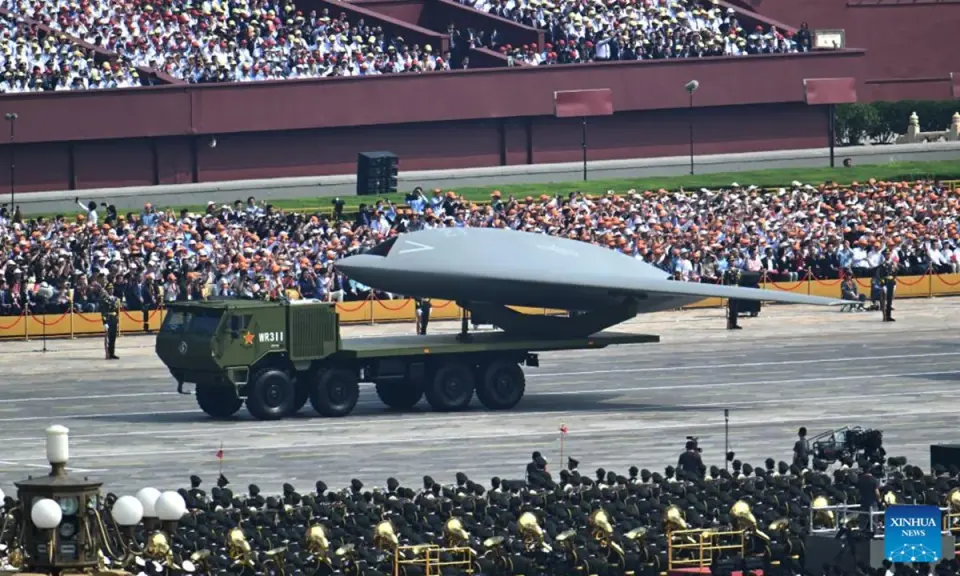
China’s People’s Liberation Army Navy confirmed on October 30, 2026, that the GJ-21 stealth unmanned combat aerial vehicle successfully completed its first takeoff and landing aboard the Type 076 amphibious assault ship, the Sichuan. This marks the world’s first operational deployment of a large, fixed-wing stealth strike and reconnaissance drone from an amphibious platform. The Sichuan, launched in December 2024, features electromagnetic catapult and arresting systems, enabling the GJ-21 to operate with a combat radius comparable to manned fighters like the J-20. Analysts highlight the drone’s low cost, reusability, and superior stealth as key advantages over traditional hypersonic missiles, potentially transforming amphibious warfare by allowing non-contact suppression of enemy defenses before ground troops land.
Key points
- The GJ-21 is the world’s first large stealth strike and reconnaissance drone capable of operating from an amphibious assault ship, specifically the Type 076 Sichuan.
- The Sichuan, hull number 51, was launched on December 27, 2024, and features electromagnetic catapult-assisted takeoff and arrested landing technology.
- The GJ-21 utilizes a flying-wing configuration and S-shaped air intake to achieve stealth performance superior to in-service stealth fighters.
- Unlike single-use hypersonic missiles, the GJ-21 is reusable and can deploy low-cost glide-guided bombs, offering better cost control in high-tempo operations.
- The drone can coordinate with manned fighters like the J-35 to clear aerial corridors for ground targets, enhancing carrier strike group capabilities.
- The Sichuan has been conducting sea trials since November 2025, successfully testing equipment and operational stability.
Background
Previous open-source speculation and imagery from late 2025 and early 2026 suggested the Type 076 Sichuan was being fitted with electromagnetic catapult systems for drone operations. The GJ-11, a land-based variant of the GJ-21, was officially confirmed in flight in November 2025. The current announcement provides the first official confirmation of the GJ-21’s operational capability from a maritime platform, following earlier tests at land-based facilities like Huangdicun.
How outlets are covering it
Global Times and Xinhua emphasize the GJ-21’s strategic breakthrough, highlighting its stealth, combat radius, and cost-effectiveness as superior to hypersonic missiles. Chinese military expert Zhang Xuefeng describes it as a 'door-kicking' asset for suppressing heavily defended targets. The Aviationist notes that while China claims a 'global first,' the U.S. Navy’s X-47B program previously achieved similar carrier-aviation milestones before being cancelled in 2015, though the U.S. shifted focus to the MQ-25 Stingray refueler. Aviation Week confirms the operational tests but notes the story is behind a paywall, limiting detailed analysis. The Aviationist also points out that no official video or images of the actual flight operations were released by Chinese state media, despite the announcement.
Why it matters
This development signals a shift in amphibious warfare doctrine, moving from traditional manned beach assaults to non-contact, stealth-based suppression of enemy air defenses and anti-ship systems. The GJ-21’s ability to operate from amphibious ships like the Type 076, which can carry up to 30 drones, allows for high launch rates and extended reach without risking pilots. This capability could significantly alter power projection in contested maritime environments, particularly in the South China Sea, by enabling China to neutralize threats before ground forces engage.
What to watch
China may integrate the GJ-21 with its Type 076 amphibious assault ships and potentially its Fujian aircraft carrier, which also features electromagnetic catapult systems. Future operations could involve manned-unmanned teaming with fighters like the J-35, expanding the operational modes of carrier strike groups. The PLA Navy is expected to continue testing the GJ-21’s capabilities in various maritime environments, potentially leading to wider deployment in the coming years.
- China's GJ-21, world's first operational large armed reconnaissance stealth UAV on amphibious assault ship, boasts three core strengths: expert Global Times
- China says stealth attack drone makes first takeoff, landing on amphibious ship Reuters
- Type 076 amphibious assault ship becomes world’s 1st catapult-capable drone carrier after China’s 1st carrier-borne armed reconnaissance stealth drone completes takeoff & landing Global Times
- China Claims GJ-21 Naval UCAV has Flown from Type 076 Sichuan LHD The Aviationist
- China Confirms GJ-21 UCAS Operations From Helicopter Carrier Aviation Week
Want the full story? Read the original reporting
Read on Global Times