
Italian study links early social media adoption to significant academic decline
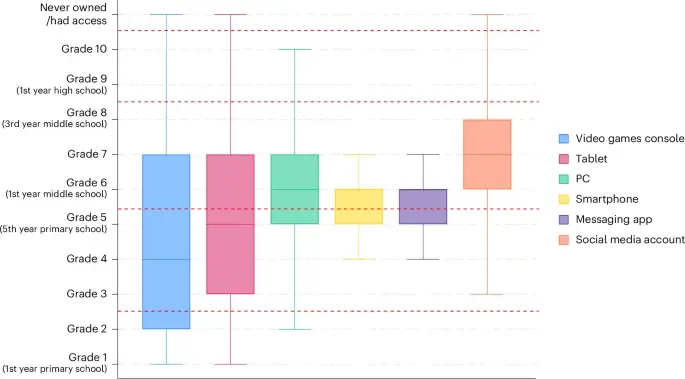
A longitudinal study of 5,227 students in northern Italy finds that opening a social media account in grades 6 or 7 leads to significantly lower scores in mathematics and Italian by grade 10, equivalent to a six-month learning deficit. The gap widens over time, while English scores remain unaffected, likely due to incidental language exposure. Researchers attribute the decline to smartphone pervasiveness and attentional disruption, supporting calls for delayed access policies.
Key points
- Students who created social media accounts in 6th grade scored 0.22 standard deviations lower in Italian and 0.18 in math by 8th grade, widening to 0.27 in math by 10th grade compared to late adopters.
- The negative impact on academic performance persists and intensifies over time, even after late adopters eventually join social media, suggesting a cumulative effect of early exposure.
- No significant negative impact was found on English proficiency, which researchers attribute to the prevalence of English-language content providing informal practice.
- Smartphone pervasiveness, defined as frequent use during key daily moments, mediates 33-47% of the negative effect on math scores, indicating attentional disruption is a key mechanism.
- Early adopters were more likely to repeat grades and report lower academic self-efficacy, though the study notes limitations in generalizability beyond the Italian context.
Background
This study follows a 2026 report linking early screen exposure in infancy to later learning gaps, reinforcing concerns about developmental timing. It also aligns with recent UCSF findings on addictive social media use fueling ADHD symptoms in teens. The research arrives as the EU debates age-gate regulations and several countries, including Australia and France, implement social media bans for minors.
How outlets are covering it
Nature presents the findings as robust causal evidence using difference-in-differences models, emphasizing the magnitude of the learning loss. The Guardian highlights the 'complex problem' of platform design and quotes researchers on the need for safer platforms rather than just bans. Gizmodo focuses on the correlation and the growing global trend of age restrictions, noting the lack of impact on English. The Portugal News emphasizes the observational nature of the study, cautioning that it does not prove direct causation but supports the need for parental supervision and further research on appropriate access ages.
Why it matters
The study provides concrete evidence that early social media access correlates with measurable academic deficits, influencing policy debates on age restrictions and digital literacy. It suggests that delaying access until age 14, as recommended by many experts, could mitigate these negative effects, offering a data-driven basis for parental and governmental decisions.
What to watch
Policymakers in the EU and other regions may use this evidence to support age-gate legislation or phased access models. Researchers will likely investigate whether the negative effects are driven by content or time displacement, and how different platform features impact learning outcomes. Parents and educators may adopt stricter digital boundaries based on the findings.
- Longitudinal effect of early social media use on standardized learning outcomes during school career nature.com
- Children using social media at younger age appear to do worse in school tests The Guardian
- Early Social Media Use Linked to Lower Grades Years Later, Study Finds Gizmodo
- Early social media use among children linked to lower grades The Times
- Study reveals that early use of social media leads to poorer academic results The Portugal News
Want the full story? Read the original reporting
Read on nature.com