
India Leads Global Births While China Faces Natural Population Decline
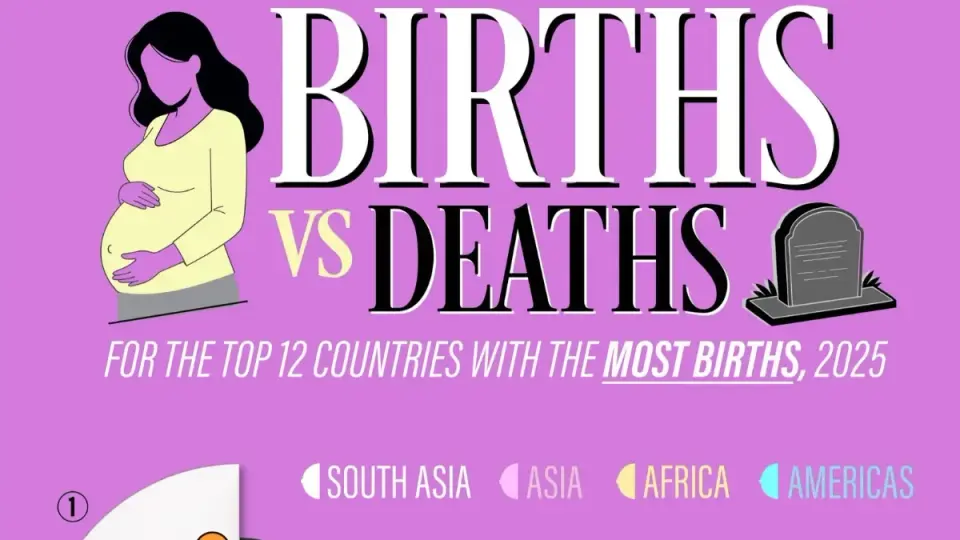
A new visualization based on United Nations data reveals that India is projected to have 23.07 million births in 2025, far exceeding China's 8.71 million. China is the only major country where deaths (11.72 million) exceed births, signaling a demographic shift. Five African nations dominate the top 12 birth lists, reflecting high fertility rates, while the United States shows the narrowest positive gap between births and deaths among the top 12.
Key points
- India leads the world with 23.07 million projected births in 2025, compared to 9.72 million deaths.
- China is the only country among the top 12 where deaths (11.72 million) exceed births (8.71 million) by approximately 3 million.
- Five African countries (Nigeria, DRC, Ethiopia, Egypt, Tanzania) rank in the top 12, accounting for roughly 21.25 million births.
- The United States has the smallest positive gap between births and deaths among the top 12, at just 570,000.
- Global fertility rates are declining, with many countries falling below the 2.1 replacement level, though population momentum may sustain growth for decades.
Background
Recent coverage has highlighted various health and demographic shifts, such as the impact of new cancer treatments on mortality rates and the rising costs of property taxes in the US. However, this briefing focuses on broader global population trends rather than specific health or economic policy changes. The data presented here aligns with long-term trends of aging populations in developed nations and high fertility in sub-Saharan Africa.
Why it matters
The diverging birth and death rates between Asia and Africa highlight a fundamental shift in global population dynamics. While East Asia faces aging populations and potential economic strain due to shrinking workforces, Africa’s high fertility rates suggest it will increasingly dominate global birth statistics. This demographic imbalance has significant implications for future global labor markets, migration patterns, and international aid distribution. Understanding these trends is crucial for policymakers and economists forecasting long-term economic growth and resource allocation.
What to watch
As fertility rates continue to decline globally, more countries may eventually experience deaths exceeding births, similar to China’s current trajectory. However, population momentum means that global population growth may continue for decades despite shrinking family sizes. Monitoring these shifts will be essential for anticipating future challenges related to healthcare, pensions, and infrastructure in aging societies.
Want the full story? Read the original reporting
Read on Visual Capitalist