
Pew projects Islam will surpass Christianity by 2035, driven by fertility and youth
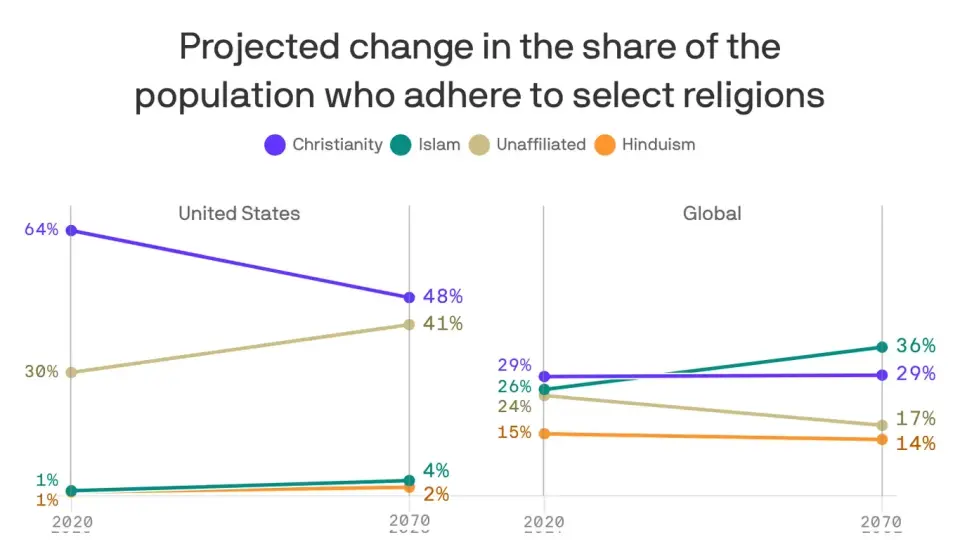
A new Pew Research Center report projects that Islam will become the world's largest religion by 2035, overtaking Christianity. This shift is attributed primarily to higher fertility rates and younger age structures among Muslims, rather than mass conversions. By 2070, the global Muslim population is expected to reach 3.6 billion, while Christians will number just under 3 billion. The report highlights a significant geographic shift, with sub-Saharan Africa becoming the center of Christianity and the United States losing its Christian majority.
Key points
- Pew Research Center projects Muslims will outnumber Christians globally by 2035.
- The shift is driven by demographics: Muslim women have an average fertility rate of 3.1 children, compared to 2.5 for Christian women.
- By 2070, the global Muslim population is expected to reach 3.6 billion, while Christians will number just under 3 billion.
- The Democratic Republic of the Congo is projected to surpass the United States as the country with the most Christians by 2070.
- In the U.S., Christians are projected to fall below 50% of the population by 2070, while the religiously unaffiliated will rise to 41%.
Background
This projection builds on earlier Pew analyses that have tracked religious trends since 2017. Recent global events, such as the October 2026 attack on a Greek Orthodox church in Jordan, have highlighted ongoing tensions in the Middle East, though the Pew report focuses on long-term demographic shifts rather than political conflicts. The data reflects a broader trend of population growth in Africa and decline in Europe and East Asia.
How outlets are covering it
Axios emphasizes that the shift is a demographic inevitability driven by birth rates, not conversions, and notes that this does not necessarily translate into a change in global political power. Pew Research Center provides the detailed methodology, highlighting that Muslims are the only major group with growing birth numbers, while Buddhists and the unaffiliated are projected to decline due to population shrinkage in China and East Asia. Fox News focuses on the U.S. implications, noting that while Muslims will become the third-largest group in the U.S. by 2070, Christians will still vastly outnumber them. Religion News Service (RNS) underscores the geographic shift, noting that the center of Christianity is moving to sub-Saharan Africa, while the U.S. and Europe see relative declines.
Why it matters
The changing religious landscape will influence global cultural, political, and economic dynamics. The rise of sub-Saharan Africa as the center of Christianity may shift the focus of Christian institutions and aid organizations. In the U.S., the decline of the Christian majority and the rise of the religiously unaffiliated could impact social policies and political alignments. Understanding these demographic shifts is crucial for predicting future global power balances and cultural influences.
What to watch
Researchers will continue to monitor fertility rates and migration patterns to update these projections. The Pew report suggests that while the numbers will change, the actual political and cultural impact may be gradual. Future studies may focus on how religious switching and migration patterns evolve in response to economic and social changes.
- Islam will overtake Christianity as world's largest religion by 2035: Pew Axios
- Muslims to outnumber Christians worldwide by 2035, study finds The Washington Post
- The Future of World Religions: Population Growth Projections, 2020-2070 Pew Research Center
- Muslims projected to become world's largest faith group by 2070, Pew says Religion News Service
- Muslims poised to outnumber Christians globally by 2035 amid demographic shifts Fox News
Want the full story? Read the original reporting
Read on Axios