
BRICS leaders in New Delhi push for trade stability amid Middle East war and US tariffs
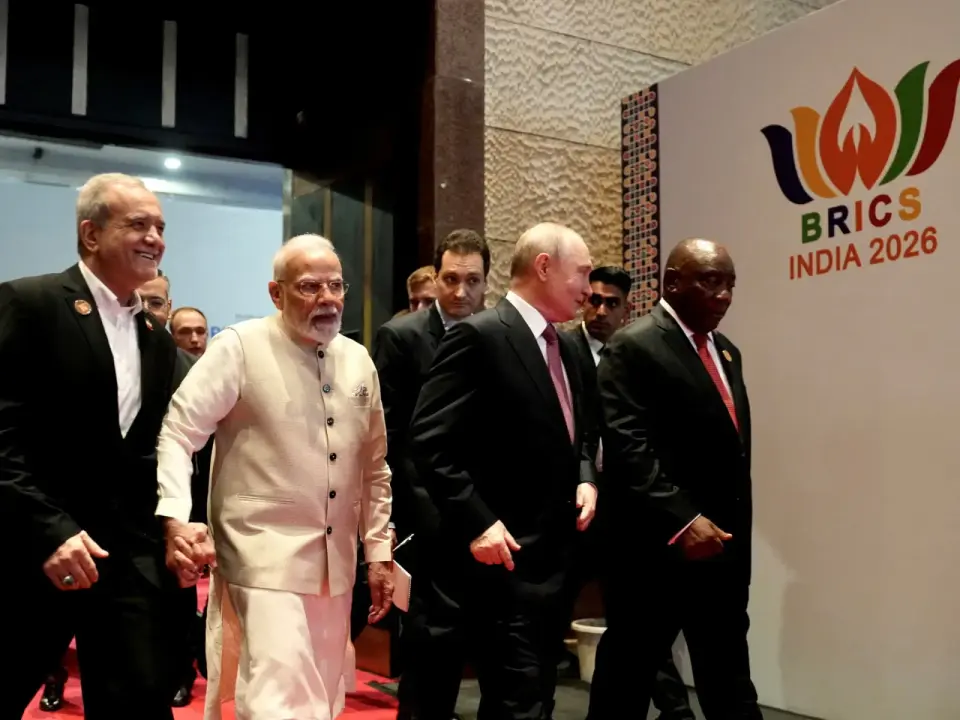
The BRICS bloc adopted a joint declaration in New Delhi calling for the smooth flow of global trade, supply chains, and energy. The summit, hosted by India, brought together leaders from China, Russia, and Iran, but internal divisions over the Middle East war and US tariffs limited the strength of the final statement.
Key points
- BRICS members unanimously adopted a declaration urging cooperation to maintain global trade, supply chains, and energy flows.
- India’s Prime Minister Narendra Modi hosted the two-day summit in New Delhi, marking the bloc’s 20th anniversary.
- China’s President Xi Jinping, Russia’s President Vladimir Putin, and Iran’s President Masoud Pezeshkian attended the event.
- The summit agenda included expanding non-Western cross-border payment channels and cooperation on artificial intelligence.
- BRICS finance ministers and central bank governors objected to US tariffs and non-tariff measures, arguing they distort trade and violate WTO rules.
Background
The BRICS summit occurs amid ongoing disruptions to global energy and shipping, including wars in the Middle East and Ukraine. Earlier in 2026, diverging maritime rules and sanctions-evasion networks were reported to be fragmenting global shipping markets, while Europe’s severe drought strained river shipping and energy security. Additionally, China blocked consensus at a G20 finance ministers’ summit in September 2026 over language addressing non-market policies, highlighting ongoing tensions in global trade governance.
How outlets are covering it
Al Jazeera emphasized the unanimous adoption of the joint declaration and the focus on trade and energy flows. The New York Times highlighted the internal divisions within BRICS, noting that the bloc called for 'maximum restraint' in the Middle East without blaming any specific country, reflecting the split between Iran and the UAE. AP News reported that BRICS leaders voiced concern over the Middle East conflict and US sanctions, while UPI noted that India is close to finalizing a trade deal with the US, complicating its stance at the summit. Michael Kugelman of the Atlantic Council, cited by UPI, suggested that any criticism of US policies would likely be 'vague and indirect' due to the diverse interests of BRICS members.
Why it matters
The BRICS summit underscores the bloc’s attempt to project unity and influence global trade and energy policies amid rising geopolitical tensions. However, internal divisions over the Middle East war and US tariffs reveal the challenges of maintaining a cohesive stance, particularly as members like India and the UAE have differing relationships with the US and Iran. The outcome of the summit could impact global trade dynamics, energy security, and the balance of power between Western and non-Western economic blocs.
What to watch
BRICS members will continue to negotiate on expanding non-Western payment channels and AI cooperation. The bloc may face further challenges in aligning its stance on the Middle East conflict and US tariffs, particularly as India finalizes a trade deal with the US. Future summits will likely test the bloc’s ability to maintain unity amid diverging national interests.
- BRICS summit opens in New Delhi amid wars, global tensions, tariffs Al Jazeera
- As Oil Prices Rise, BRICS Leaders Have What U.S. Doesn’t: Iran at the Table The New York Times
- BRICS leaders meet in India as wars and US tensions test the bloc AP News
- BRICS agrees to joint declaration in test of unity despite Mideast tensions Reuters
- Modi hosts leaders of Russia, Iran and China at BRICS summit upi.com
Want the full story? Read the original reporting
Read on Al Jazeera