
New York Magazine's 'Habibi City' Issue Sparks Controversy Over Jewish Representation
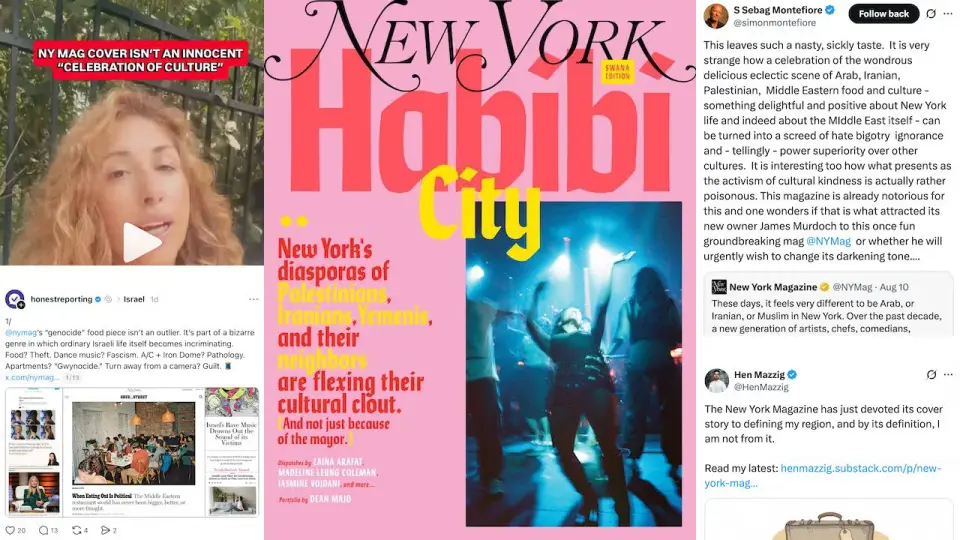
New York Magazine faces significant backlash for its 'Habibi City' issue, which celebrates the rising cultural influence of Southwest Asian and North African (SWANA) communities in New York. Critics, including pro-Israel advocacy groups and some Jewish voices, accuse the publication of erasing Jewish identity by grouping Zionism with xenophobia and Islamophobia, and by referring to Israel as 'the land mass currently called Israel.' The magazine’s editorial team defended the coverage as an exploration of a growing subculture and its political dimensions, stating they welcome good-faith criticism. The controversy highlights deep divisions over how to represent Middle Eastern and Jewish identities in media, particularly in the context of the ongoing conflict in Gaza and the political rise of Mayor Zohran Mamdani.
Key points
- New York Magazine's 'Habibi City' issue, featuring a centerpiece article by Zaina Arafat, was criticized for allegedly erasing Jewish identity and conflating Zionism with xenophobia and Islamophobia.
- A Grub Street feature by Madeline Leung Coleman drew specific criticism for describing Israel as 'the land mass currently called Israel,' which pro-Israel group HonestReporting argued treated the country's identity as provisional.
- The magazine's editorial leadership responded by stating they are aware of the criticism and welcome good-faith discussion, emphasizing that the issue explores a cultural subculture with an 'irreducible political dimension.'
- The centerpiece article highlighted the cultural 'SWANA-ssance' in New York, linking it to the rise of Mayor Zohran Mamdani and the post-Oct. 7, 2023, political landscape.
- Critics, including Hen Mazzig and Simon Sebag Montefiore, argued the coverage excluded Mizrahi Jews and turned a cultural celebration into a 'screed of hate bigotry ignorance.'
- The article also noted that the SWANA community includes Jewish participants, such as Arab Jewish singer Laura Elkeslassy, and acknowledged tensions over how Israelis and Jews fit within the framework.
Background
This controversy occurs amid a broader national and local debate over the representation of Middle Eastern and Jewish identities in media and politics. In New York, Mayor Zohran Mamdani, a Ugandan-born Indian American Muslim, has been a central figure in discussions about pro-Palestinian politics and has faced criticism from Jewish leaders for his rhetoric on Israel. The 'Habibi City' issue is part of a larger cultural shift in New York, where SWANA communities have gained increased visibility and political influence, particularly after the Oct. 7, 2023, attacks and the subsequent war in Gaza. The magazine's coverage reflects the complex and often contentious relationship between cultural celebration and political identity in the city.
How outlets are covering it
TheWrap reported the backlash as a significant controversy, highlighting the specific criticisms from advocacy groups and individuals like Hen Mazzig and Simon Sebag Montefiore. The magazine's own editorial statement, as reported by TheWrap, framed the issue as a legitimate exploration of a cultural subculture with political dimensions, emphasizing their commitment to capturing tensions and live debates. The Grub Street article by Madeline Leung Coleman, which was part of the 'Habibi City' issue, provided a detailed historical and cultural context for the rise of Middle Eastern restaurants in New York, but its specific phrasing regarding Israel drew sharp criticism from pro-Israel groups. The perspectives diverge on whether the coverage was a fair representation of a growing cultural scene or an erasure of Jewish identity and a political statement against Israel.
Why it matters
The controversy over New York Magazine's 'Habibi City' issue underscores the deep and often polarized debates surrounding the representation of Middle Eastern and Jewish identities in media, particularly in the context of the ongoing conflict in Gaza. It highlights the challenges of balancing cultural celebration with political sensitivity and the potential for media coverage to be perceived as taking a political stance. The backlash also reflects the broader tensions in New York City, where the political rise of Mayor Zohran Mamdani and the growing influence of SWANA communities have become central to discussions about identity, representation, and political power. The incident may influence future media coverage of Middle Eastern and Jewish communities and contribute to ongoing debates about antisemitism and political loyalty in public discourse.
What to watch
The magazine's editorial team has stated they are aware of the criticism and welcome good-faith discussion, suggesting that the debate may continue in public forums and media. The controversy could lead to further discussions about the representation of Middle Eastern and Jewish identities in media and the role of political identity in cultural coverage. It may also influence the political landscape in New York, where the relationship between SWANA communities and Jewish communities remains a contentious issue, particularly in the context of Mayor Zohran Mamdani's administration and the ongoing conflict in Gaza.
- New York Mag Draws Ire for 'Erased' Jewish Identity in ‘Habibi City’ Feature on Mideast Communities TheWrap
- When Eating Out Is Political grubstreet.com
- Habibi City New York Magazine
- New York Is Not, and Should Not Be, ‘Habibi City’ The Free Press
- 'Habibi City' and 'Mamdanistan': NY Magazine celebrates Palestinian takeover of New York Ynetnews
Want the full story? Read the original reporting
Read on TheWrap