
Ukraine’s Ground Robots Evolve to Counter Drones, Aiming to Reclaim the 'Kill Zone'
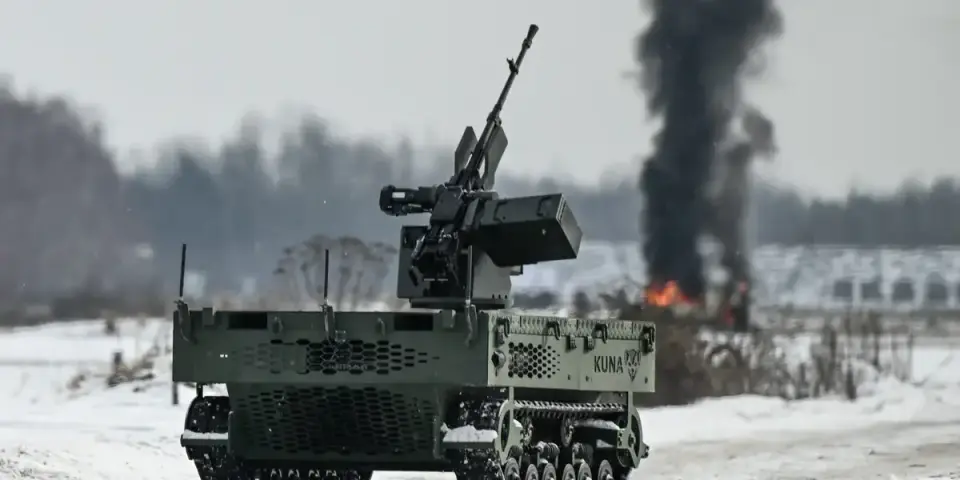
Ukrainian military units are increasingly equipping ground robots with anti-drone capabilities to mitigate the threat posed by Russian aerial drones in the 'kill zone.' While these systems are currently in limited testing, officials believe they could eventually allow infantry to move more safely in high-risk areas. Concurrently, the use of unmanned ground vehicles (UGVs) for logistics and casualty evacuation has surged, with October 2026 marking a record 31,398 missions.
Key points
- Ukrainian companies like Frontline Robotics and UFORCE are developing systems that use sensors, AI, and weaponry (including machine guns and net launchers) to detect and destroy hostile FPV drones.
- Oleksandr Yabchanka of the Da Vinci Wolves Battalion stated that countering drones is a key challenge, and successful robot-based air defense could substantially change combat operations along the line of contact.
- The 100th Separate Mechanized Brigade recently deployed a robot with a net launcher that successfully stopped an approaching drone, marking a practical application of active protection systems.
- Ukrainian forces recorded 31,398 UGV missions in October 2026, a fourfold increase from January, primarily for logistics and casualty evacuation to reduce personnel exposure.
- The National Guard of Ukraine has delivered nearly 6,200 tons of cargo via unmanned systems since the start of the invasion, with 70% transported by ground robots.
Background
This development follows a broader shift in Ukrainian warfare where the traditional frontline has dissolved into a miles-wide 'kill zone' dominated by drone surveillance and strikes. Recent innovations, such as the use of heavy-lift aerial drones for medical evacuations in late 2026, have highlighted the need for new methods to bypass lethal terrain. The current focus on ground-based counter-drone systems represents an evolution from purely logistical roles to active defensive capabilities.
How outlets are covering it
Business Insider emphasizes the strategic potential of ground robots to alter the nature of combat by providing mobile air defense, noting that while technology is still being tested, it offers a path to safer movement. Zona Militar highlights the quantitative surge in UGV usage, framing the October record as a sign of rapid integration into standard operations. Ukrainian National News (UNN) provides a tactical example of the offensive use of ground robots, detailing a marine operation where a kamikaze ground vehicle was air-dropped to destroy Russian drone operators. Mezha.net focuses on the logistical impact, citing National Guard commander Oleksandr Pivnenko on the massive tonnage of cargo moved by robots, which reduces the need for personnel to travel under fire.
Why it matters
The ability to neutralize drones with ground robots could reduce the reliance on short-range air defense units, which are often pinned down and vulnerable. This shift may allow infantry to move and fight in previously inaccessible areas, potentially changing the tactical balance in the kill zone. Furthermore, the massive increase in UGV missions indicates a fundamental change in how Ukrainian forces sustain their frontlines, reducing casualties and improving supply chain efficiency in high-threat environments.
What to watch
Ukrainian robotics firms are expected to introduce more sophisticated anti-drone solutions, including AI-assisted detection and various engagement methods like nets and shrapnel. Brave1, Ukraine’s state-backed innovation platform, has identified anti-aircraft weaponry as a priority for future development. As these systems move from limited testing to broader deployment, they may significantly influence the survivability of both robots and human soldiers in the kill zone.
- Ukraine's war robots are starting to down Russia's drones. It could eventually change the fight in the kill zone. Business Insider
- Twenty-eight robots, but no soldiers - does this attack show the future of warfare? Forces News
- Ukrainian forces record more than 31,000 ground drone missions in October Zona Militar
- Marines deployed a ground robot on the occupied left bank of the Dnipro for the first time Українські Національні Новини (УНН)
- Unmanned systems of the National Guard delivered nearly 6.2 thousand tons of cargo Mezha.net
Want the full story? Read the original reporting
Read on Business Insider