
Belgrade’s Military Funeral for Mladić Sparks EU Crisis
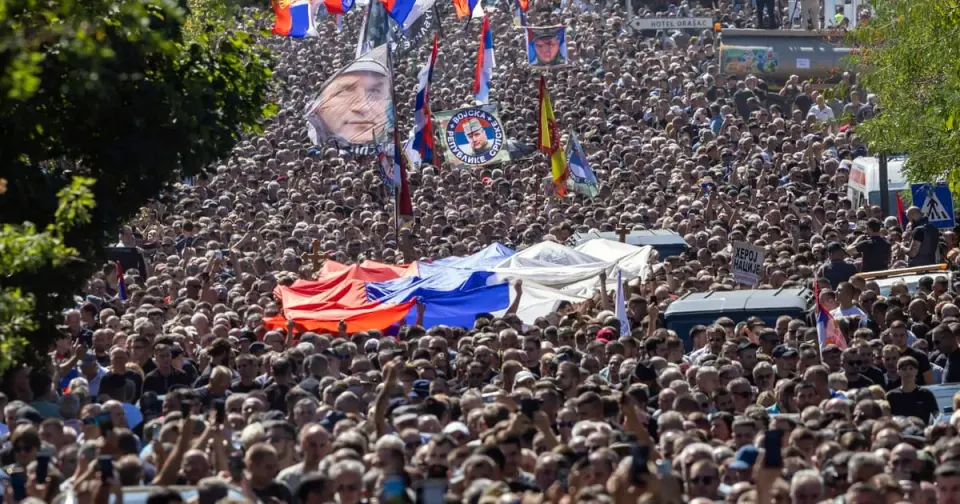
Thousands gathered in Belgrade for a state-attended funeral of Ratko Mladić, the convicted war criminal responsible for the Srebrenica genocide. The ceremony, which featured military honors and senior Serbian ministers, drew sharp condemnation from EU leaders who called it a violation of core European values. While the Serbian government denied organizing the event, the use of a government plane and military escort has stalled Serbia’s EU accession talks, which are already frozen due to rule-of-law and foreign policy disputes.
Key points
- Ratko Mladić, who died at 84 while serving a life sentence for genocide, was buried in Belgrade with military honors, including a government plane and armed guards.
- Senior Serbian officials, including Defence Minister Bratislav Gašić and Justice Minister Nenad Vujić, attended the service led by Patriarch Porfirije.
- EU Commission President Ursula von der Leyen called the funeral 'shocking' and a failure to confront Europe’s dark history, while Council President António Costa condemned the glorification of a war criminal.
- Serbia’s EU accession process has been stalled since December 2021, with eight member states blocking new chapters over rule-of-law issues and Serbia’s refusal to sanction Russia.
- The funeral drew thousands of mourners, including veterans and football fans, reflecting Mladić’s status as a national hero among many Serbs despite his conviction.
Background
Serbia has been an EU candidate country since 2012, but accession negotiations have been frozen since late 2021. The bloc’s expansion commissioner, Marta Kos, cancelled a planned visit to Serbia following the funeral, citing the event as incompatible with EU values. This incident adds to existing tensions between Brussels and Belgrade, which are already strained by Serbia’s refusal to align with EU sanctions against Russia and its rule-of-law record.
How outlets are covering it
The EU, represented by von der Leyen, Costa, and Kaja Kallas, viewed the funeral as a direct affront to European values and a rejection of historical truth. They emphasized that glorifying war criminals and denying genocide is incompatible with EU membership. In contrast, Serbian officials and many citizens viewed Mladić as a national hero and defender of the state. The Serbian government claimed it did not organize the funeral, yet the use of state resources, including a government plane and military escort, suggested official support. Al Jazeera framed the event as a failure of international justice to deter future conflicts, while BBC highlighted the deep divide in Serbian society, with some viewing Mladić as a butcher and others as a symbol of defiance. The Guardian noted the military pomp and the presence of senior ministers as evidence of state endorsement, despite official denials.
Why it matters
The funeral underscores the deep rift between Serbia and the EU over historical memory and reconciliation. It risks further delaying Serbia’s accession, which is already stalled, and highlights the challenges of integrating a country that has not fully confronted its past. The event also serves as a cautionary tale for the EU’s approach to enlargement, showing that formal criteria may not suffice if a candidate country’s leadership and public sentiment remain at odds with core European values. It may also influence future EU policies on historical accountability and reconciliation in other candidate countries.
What to watch
The EU is likely to reassess its engagement with Serbia, potentially freezing or slowing down accession talks further. Serbia may face increased diplomatic pressure to address the funeral and its implications for its EU path. The event could also spark renewed debates within the EU about the criteria for membership and the role of historical reconciliation in the enlargement process. Serbia’s government may attempt to distance itself from the funeral, but the use of state resources makes this difficult. The incident may also influence public opinion in Serbia, with some segments of society continuing to view Mladić as a hero while others condemn the glorification.
- Ursula von der Leyen condemns ‘shocking’ Ratko Mladić funeral in Serbia politico.eu
- Thousands turn out in Serbia for funeral of 'Butcher of Bosnia' Ratko Mladić BBC
- EU leaders condemn Serbia’s funeral honors for Ratko Mladic, raising doubts over membership bid The Hill
- Ratko Mladić, the ‘Butcher of Bosnia’, given hero’s funeral in Serbia The Guardian
- Mladic’s funeral: Were no lessons learned? Al Jazeera
Want the full story? Read the original reporting
Read on politico.eu