
Gen Z Anger Ignites Cross-Border European Protests Over Housing and Education
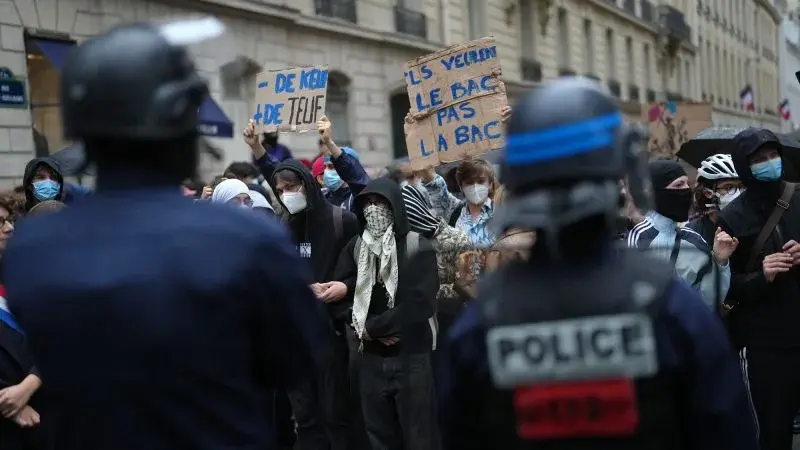
Young people across Europe are protesting over housing costs, education funding, and job insecurity, with movements in France, Italy, Spain, and Portugal influencing one another. While catalysts vary by country, from evictions in Spain to school strikes in France, the unrest reflects a shared fear that the next generation will be worse off than their parents. French authorities are deploying 70,000 police officers to control demonstrations, while governments in Italy and Albania face intense pressure to address these grievances.
Key points
- Protests in France, Italy, Spain, Portugal, Greece, and Albania are driven by distinct local issues but share common themes of housing affordability and education underfunding.
- French President Emmanuel Macron banned non-union protests on Saturday to prevent violence, while deploying 70,000 police officers.
- In Spain, the eviction of an 87-year-old woman sparked housing protests that spilled into Portugal, where 55 people were arrested in Lisbon.
- Italian student unions referenced French protests, and Greek demonstrators chanted slogans echoing French complaints about public education.
- Economic factors, including high national debt and rising bond yields in France, limit governments' ability to increase public spending.
Background
Recent archive coverage from October 2026 noted that while these protests lack a unified command structure, they are fueled by similar economic anxieties. Earlier reports highlighted that framing these events as a single 'pan-European revolt' may obscure localized grievances, but the current wave shows increasing cross-border coordination among student unions.
How outlets are covering it
CNN emphasizes the interconnected nature of the protests, noting that student unions are sharing advice and that movements in Italy and Greece have explicitly referenced French actions. The outlet highlights the role of AI in job market uncertainty and the climate crisis as underlying drivers. The Guardian, however, cautions against eliding distinct national causes, pointing out that German students are protesting compulsory military service, not just housing. The Guardian also stresses the breakdown of the social contract and the threat of far-right parties capitalizing on the unrest, whereas CNN focuses more on the generational frustration and the specific economic constraints like bond yields.
Why it matters
These protests represent a significant challenge to European governments, threatening to shift political power toward the radical right in upcoming elections in Spain, France, Poland, and Italy. The unrest highlights a deepening crisis of confidence in liberal democracy's promise of generational improvement, potentially leading to long-term instability if governments fail to address housing and education costs.
What to watch
France expects further demonstrations on Saturday, with trade unions joining student groups. General strikes are planned for November 5 in France and November 11 in Spain. In Germany, a group called 'Gen Z regelt' is organizing nationwide protests for October 31, while student unions in Britain and Italy plan a day of action on November 20.
- Gen Z are leading the European protests. Here’s why they’re angry CNN
- France is looking ungovernable. And it’s going to get worse Financial Times
- The agony of liberal Europe The Economist
- The Guardian view on Europe’s protests: the social contract has broken – and young people want solutions | Editorial The Guardian
- Student Protests Mushroom Across Europe, Exposing Bleak Views of the Future The New York Times
Want the full story? Read the original reporting
Read on CNN