
Israeli judges urge prosecutors to drop key charges against Netanyahu
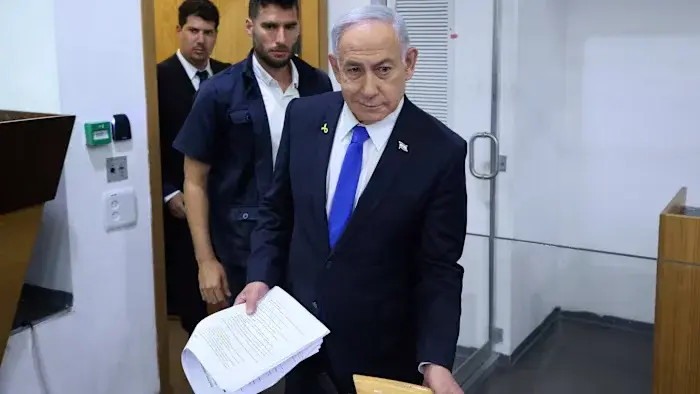
Israeli judges have recommended that prosecutors drop the most serious bribery charges against Prime Minister Benjamin Netanyahu, citing low chances of conviction. The court also questioned the criminal nature of a second case and suggested a plea deal for a third, marking a significant procedural shift in the years-long trial. Netanyahu called for the trial to end immediately, while his political rival Gadi Eisenkot continues coalition negotiations to form a new government.
Key points
- Judges in the Jerusalem District Court summoned Attorney General Gali Baharav-Miara on Wednesday to advise her to drop charges in Case 4000, which alleges Netanyahu granted regulatory favors to telecom executive Shaul Elovitch in exchange for favorable media coverage. The court stated that the chances of conviction in this case are low.
- The panel also recommended that prosecutors reconsider Case 2000, which involves allegations that Netanyahu sought a deal with newspaper publisher Arnon Mozes for favorable coverage in exchange for actions to weaken a rival publication. The judges expressed doubt that the alleged actions constituted a criminal offense.
- For Case 1000, which concerns gifts from wealthy businessmen, the judges left the path open but suggested a procedural route to conclude the case, potentially through a plea agreement. The court emphasized that its comments were not a final verdict but a recommendation for the Attorney General to consider.
- Netanyahu, who has denied all charges and called the trial a political witch hunt, seized on the judges' recommendations to call for the trial to be halted immediately. He also called on his political rivals, led by Gadi Eisenkot, to form a unity government with him.
- The recommendations come amid political horse-trading following an inconclusive election last month, where neither Netanyahu's coalition nor Eisenkot's bloc won a majority. Israel's President Isaac Herzog gave Eisenkot the first opportunity to form a government, with some members of his bloc considering an alliance with ultra-Orthodox parties or Arab parties to break the deadlock.
Background
Netanyahu has been on trial since 2020 on charges of fraud, bribery, and breach of trust in three complex cases focused on his relationships with wealthy business people. The trial began in May 2020 after he was indicted in November 2019. The cases have loomed over Israeli politics for more than half a decade, with Netanyahu repeatedly denying any wrongdoing. The trial has coincided with controversial judiciary reforms by Netanyahu's government and has fueled deep divisions in Israeli society. The current political deadlock follows an inconclusive election in late October, where Netanyahu's coalition dropped to 53 seats and Eisenkot's bloc had 48 seats, with both sides seeking to build a majority through coalition negotiations.
How outlets are covering it
The Financial Times and BBC both report that judges recommended dropping charges in Case 4000 and reconsidering Case 2000, with the BBC noting that the judges suggested a plea deal for Case 1000. The Jerusalem Post provides more detail on the judges' reasoning, noting that their doubts extended beyond the bribery charge and that they emphasized their comments were not a verdict. CNN highlights Netanyahu's reaction, quoting his call for the trial to end immediately and his statement about the 'truth' being revealed. All sources agree on the core recommendations but differ in emphasis: the FT and BBC focus on the political implications, while the Jerusalem Post details the legal reasoning, and CNN highlights Netanyahu's response and the broader political context.
Why it matters
The judges' recommendations could significantly impact Netanyahu's political survival, as he faces an inconclusive election and coalition negotiations. A drop in the most serious charges could strengthen his position in coalition talks and potentially lead to a unity government with his rivals. The recommendations also highlight the deep divisions in Israeli society over the trial and the role of the judiciary in politics. The outcome could influence the formation of a new government and the future of Netanyahu's far-right coalition.
What to watch
Attorney General Gali Baharav-Miara has said she will consider the judges' recommendations. The next steps could include a decision on whether to drop or reconsider the charges, potentially leading to a plea agreement or a verdict. The political negotiations between Netanyahu's coalition and Gadi Eisenkot's bloc will continue, with the possibility of a unity government or a new administration. The trial's outcome could also influence the broader political landscape in Israel, including the role of the judiciary and the future of Netanyahu's far-right coalition.
- Israeli judges advise prosecutors to drop some charges against Netanyahu Financial Times
- Israeli judges recommend dropping most serious charges against Netanyahu BBC
- Judges in Israel Suggest Dropping Key Corruption Case Against Netanyahu The New York Times
- Benjamin Netanyahu trial judges suggest dropping Case 4000 with Attorney-General in attendance The Jerusalem Post
- Netanyahu gets major legal boost as court casts doubt on corruption case CNN
Want the full story? Read the original reporting
Read on Financial Times