
Poland’s Constitutional Tribunal Seized in Disputed Power Grab as President Returns from Senegal
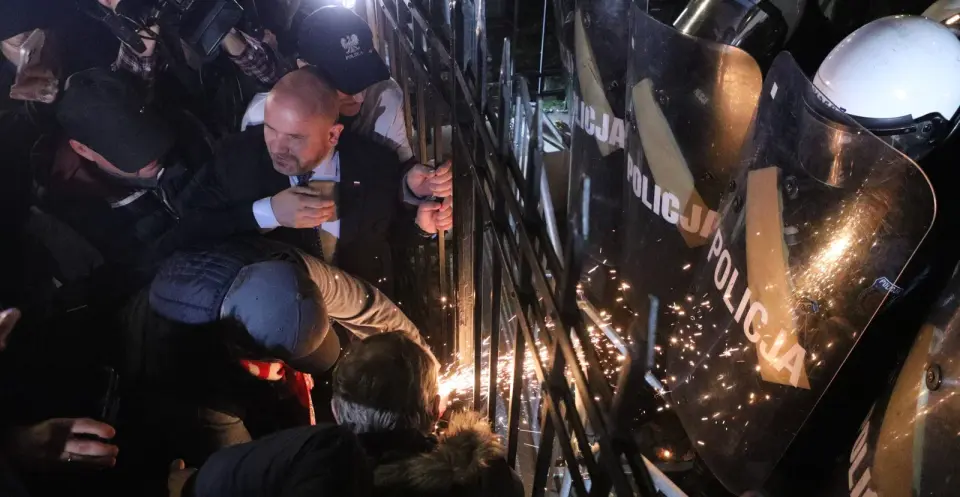
On October 30, 2026, Poland’s Constitutional Tribunal (TK) descended into chaos after government-backed judges suspended Chief Justice Bogdan Święczkowski. Riot police secured the building, blocking Święczkowski’s entry, while President Karol Nawrocki aborted a state visit to Senegal to return to Warsaw. The crisis stems from a years-long dispute over the legitimacy of TK judges appointed during the previous PiS government versus those nominated by the current Tusk administration. While the government frames the move as restoring rule of law, opposition leaders and legal scholars condemn it as an illegal coup, highlighting a deepening constitutional standoff.
Key points
- Anna Korwin-Piotrowska, a judge not sworn in by President Nawrocki, claimed authority to suspend Chief Justice Święczkowski and his deputy, Bartłomiej Sochański, citing Article 130 of the law on common courts.
- Riot police surrounded the TK, preventing Święczkowski from entering after his supporters cut through the fence; police detained three protesters who breached the perimeter.
- President Nawrocki turned his plane around mid-air to return from Senegal, stating the president must be present during such a crisis.
- Prime Minister Donald Tusk defended the action as a necessary, albeit painful, step to restore judicial independence after years of PiS-led 'lawlessness.'
- Justice Minister Waldemar Żurek submitted motions to waive the immunity of Święczkowski and Sochański to bring criminal charges against them.
- The TK’s official social media account declared the takeover unlawful, affirming Święczkowski’s status as chief justice and labeling the actions a 'coup d’état.'
Background
The current crisis follows a years-long dispute over the TK’s legitimacy. Since 2023, the Tusk government has refused to recognize the court, citing three judges appointed under the previous PiS government that European courts deemed illegitimate. In March 2026, parliament began filling vacancies, but President Nawrocki refused to swear in five of the eight new judges, citing procedural flaws. Święczkowski, aligned with the opposition, refused to accept these judges, defying a European Court of Human Rights ruling. The Venice Commission had recently advised Nawrocki to swear in the judges to resolve the deadlock.
How outlets are covering it
Outlets diverge sharply on the legitimacy of the takeover. Notes From Poland and CNN present the event as a chaotic power grab, noting the suspension was ordered by a judge not sworn in by the president. Fox News emphasizes the protest intensity and the political dispute, quoting former PM Mateusz Morawiecki, who called the action 'Belarusian methods' and a forceful takeover. BBC highlights the legal ambiguity, noting that while the justice minister can oversee common courts, his authority over the TK is contested. All sources agree on the physical confrontation: police secured the building, protesters clashed, and Nawrocki returned from Senegal. Tusk’s government frames the action as restoring rule of law, while PiS leaders, including Jarosław Kaczyński and Zbigniew Ziobro, denounce it as a criminal attack on the constitutional order and a path to authoritarianism. Legal experts like Marcin Matczak, despite criticizing Święczkowski, argue the suspension has no legal basis and will harm Poland’s rule of law reputation.
Why it matters
This incident represents a critical test of Poland’s democratic institutions and rule of law. The confrontation between the executive, judiciary, and presidency threatens to destabilize the country ahead of next year’s parliamentary elections. The involvement of state police and the suspension of the court’s chief justice without clear legal authority could set a dangerous precedent for political interference in the judiciary. International observers, including the U.S. Ambassador, have expressed concern over the stability of Poland, a key NATO ally. The outcome will determine whether Poland can resolve its judicial crisis through legal means or if it risks further polarization and institutional breakdown.
What to watch
President Nawrocki is expected to address the situation upon his return to Warsaw, potentially intervening to resolve the standoff. The government may proceed with criminal charges against Święczkowski and Sochański, while the opposition is likely to escalate protests and legal challenges. The Venice Commission and European courts may issue further rulings on the legitimacy of the TK’s leadership. The crisis could influence voter sentiment ahead of the 2027 parliamentary elections, with Tusk’s government facing pressure to act decisively and PiS positioning itself as the defender of constitutional order.
- Chaos at Poland's constitutional court as government-backed judges seek to oust chief justice Notes From Poland
- Polish president turns plane around to return home as court chief’s suspension sparks protest CNN
- Police deployed during stand-off over control of top Poland court BBC
- Polish president turns plane around after 'coup' at nation’s top court Fox News
- Polish president turns back from Senegal trip after top court chief suspended Reuters
Want the full story? Read the original reporting
Read on Notes From Poland