
Teddy Riner's Presidential Bid Tests France's Polarized Election Landscape
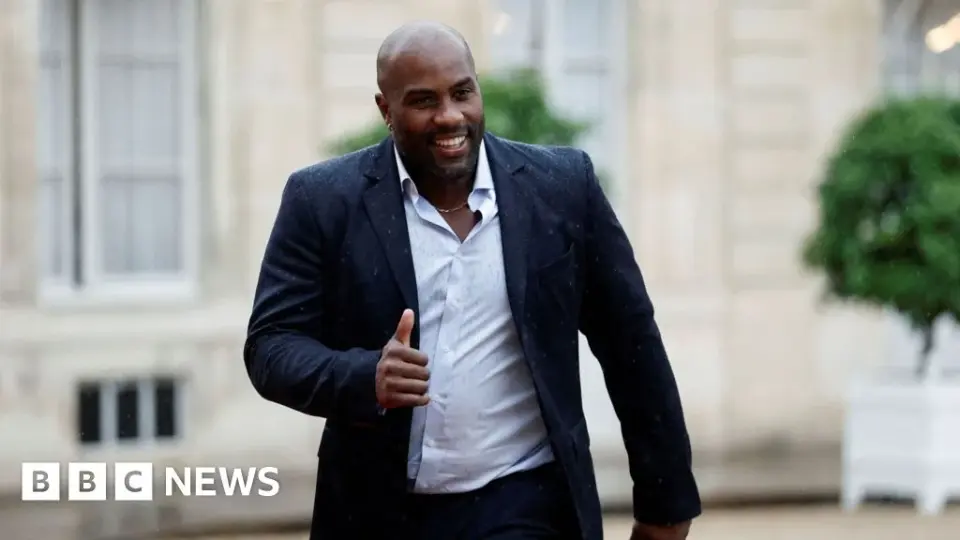
Judo champion Teddy Riner has launched a surprise presidential campaign for the 2027 French election, positioning himself as a centrist alternative to far-right and far-left leaders. Despite lacking political experience and a detailed manifesto, his high popularity and anti-establishment rhetoric have forced the political establishment to take his candidacy seriously, potentially fragmenting the center-ground vote.
Key points
- Riner, a five-time Olympic gold medalist, announced his candidacy with the slogan 'La France qu'on aime' and a social media video that garnered over 28 million views.
- An Ifop poll conducted within 24 hours of his announcement indicated that 22% of respondents said they 'could' vote for him.
- To appear on the ballot, Riner must secure 500 signatures from elected officials, a significant hurdle for non-establishment candidates.
- Riner describes himself as 'neither left nor right,' focusing on economic issues, law and order, and anti-racism, while criticizing both Marine Le Pen and Jean-Luc Mélenchon.
- President Emmanuel Macron praised Riner as a 'great champion,' while Le Pen and Mélenchon expressed skepticism about his lack of policy substance.
Background
This development follows a period of intense social unrest in France, including nationwide protests and riots in October 2026, which have heightened political polarization. The center-ground political space has fragmented, with former prime ministers Edouard Philippe and Gabriel Attal failing to gain traction. Riner's entry into the race occurs against the backdrop of a potential runoff between Le Pen and Mélenchon, a scenario that many centrists hope to disrupt.
How outlets are covering it
BBC and The New York Times highlight the 'diversion' nature of Riner's campaign, noting that while he is unlikely to win, his popularity forces the political class to engage with him. AP News emphasizes the structural barriers, such as the 500-signature requirement, and the historical difficulty for celebrities to transition into top office in France. Le Monde focuses on Riner's explicit distancing from President Macron, whom he calls a 'poisoned chalice,' rejecting the notion that he is a proxy for the current administration. While BBC and NYT view his impact as potentially diluting the center vote, AP notes that his lack of policy detail may limit his long-term viability.
Why it matters
Riner's candidacy exposes the deep dissatisfaction of French voters with the traditional political establishment and the perceived inevitability of a far-right or far-left victory. His ability to attract significant public attention without a party or manifesto suggests a growing appetite for non-traditional leadership, potentially altering the arithmetic of the 2027 election and forcing established candidates to adapt their strategies.
What to watch
Riner must now secure the 500 signatures from elected officials required to appear on the ballot. He will need to develop a concrete policy platform and assemble a campaign team to translate his popularity into a viable political mandate. The coming weeks will determine whether his candidacy remains a symbolic gesture or evolves into a serious contender capable of influencing the second-round dynamics.
- Judo champion shakes up French presidential race with surprise candidacy BBC
- One of France’s Most Popular Athletes Is Running for President The New York Times
- A judo champion enters the presidential race in France The Economist
- France presidential hopeful Riner distances himself from Macron Le Monde.fr
- Judo star Teddy Riner is taking on what may be his toughest battle in the French presidential race AP News
Want the full story? Read the original reporting
Read on BBC