
China launches first foreign astronaut, signaling new space diplomacy
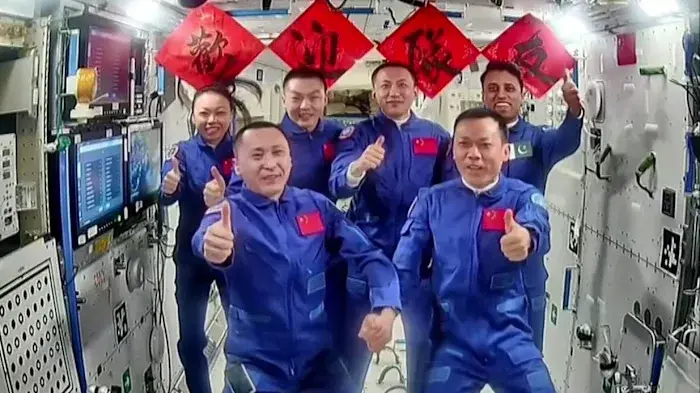
China launched the Shenzhou-24 spacecraft on November 25, 2026, carrying Pakistani fighter pilot Muhammad Zeeshan Ali, the first foreigner to visit the Tiangong space station. Ali will conduct experiments for one week before returning to Earth, while Chinese crew members Tang Hongbo and Wu Yi remain for a longer duration. The mission, part of a 2025 agreement, highlights Beijing's strategy of using space cooperation to strengthen ties with developing nations in the Global South.
Key points
- The Shenzhou-24 mission launched from the Jiuquan Satellite Launch Center in northwestern China on November 25, 2026, and successfully docked with the Tiangong space station.
- The crew consists of Pakistani astronaut Muhammad Zeeshan Ali, Chinese commander Tang Hongbo, and flight engineer Wu Yi; this is the first joint flight involving a foreign crew member in China's manned space program.
- Ali, a 40-year-old former fighter pilot, trained in China for seven months, focusing on Mandarin language proficiency and operational commands, to prepare for his one-week mission.
- The crew will conduct over 90 scientific experiments, including a photosynthetic cyanobacteria test by Ali, before he returns to Earth aboard the Shenzhou-23 spacecraft.
- China views this mission as a demonstration of soft power and technological partnership, aiming to position itself as a leader in space exploration alongside its goal of a crewed lunar landing by 2030.
Background
China's space program has accelerated recently, including a 2024 sample return from the Moon's far side. The current mission follows a February 2025 agreement between China and Pakistan. Meanwhile, the United States is preparing for its own lunar return in 2028, with NASA opening applications for its 25th astronaut class in November 2026 to support these goals.
How outlets are covering it
The Financial Times emphasizes China's strategic use of space missions as soft power to engage developing nations in the Global South, highlighting the diplomatic significance of the China-Pakistan relationship. AP News focuses on the technical details of the launch and the reactions in Pakistan, noting the national pride and the hope for future independent space capabilities. Al Jazeera provides a human-centric view, detailing the emotional response of Pakistani students and amateur astronomers, and highlighting Pakistan's long-term ambitions, such as a lunar rover by 2028 and a moon mission by 2035, as discussed by SUPARCO officials.
Why it matters
This mission marks a significant shift in China's space diplomacy, moving from bilateral cooperation to a broader international platform. It demonstrates Beijing's intent to use its space infrastructure to build alliances with developing countries, potentially challenging the traditional dominance of the United States and Russia in international space cooperation. For Pakistan, it represents a major technological and diplomatic achievement, boosting national pride and inspiring future generations in science and technology.
What to watch
China plans to continue expanding international cooperation on the Tiangong station, with Ali expressing hope for future joint missions to the Moon and Mars. Pakistan aims to develop its own space capabilities, with SUPARCO targeting a lunar rover launch in 2028 and a manned moon mission by 2035, leveraging its collaboration with China.
- China launches first space mission with foreign astronaut Financial Times
- Pakistani astronaut becomes first foreigner to board China's Tiangong space station Reuters
- China launches Shenzhou 24 spacecraft carrying 2 Chinese and a Pakistani astronaut AP News
- From stargazing to space: Pakistan watches its first astronaut take flight Al Jazeera
- China launches Shenzhou-24 crew, setting up a year-long orbital stay for one astronaut DW.com
Want the full story? Read the original reporting
Read on Financial Times