
Dutch authorities dismantle violent anti-immigration rally in The Hague after 24 arrests
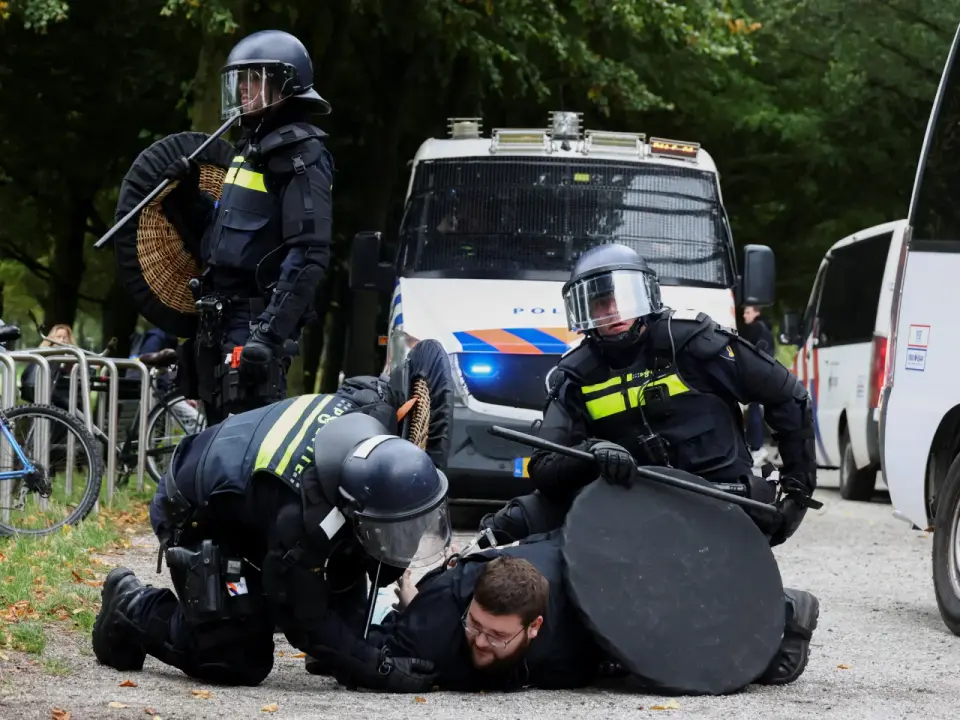
Dutch riot police forcibly dispersed approximately 500 far-right demonstrators in The Hague on September 19, 2026, after the group threw projectiles and fireworks at officers. The 'We are the people' rally, which opposed government immigration policies, was banned by local authorities due to escalating violence. Police arrested 24 individuals and used water cannons to clear Malieveld park. Prime Minister Rob Jetten and Justice Minister David van Weel condemned the event, citing antisemitic slogans and Nazi salutes, while noting that the unrest mirrors violent clashes seen in the same location one year prior.
Key points
- Dutch riot police used baton charges, dogs, and water cannons to break up a demonstration of about 500 people in The Hague’s Malieveld park on September 19, 2026.
- Local authorities banned the planned march and ordered the demonstration to end after protesters threw projectiles and fireworks at police, resulting in 24 arrests.
- Prime Minister Rob Jetten described the slogans as 'abhorrent' and antisemitic, while Justice Minister David van Weel condemned 'Hitler salutes' and violence against the riot squad.
- The 'Wij zijn het volk' rally was organized to protest immigration and asylum policies, with a stage truck displaying the slogan 'The Netherlands is for the Dutch.'
- The incident occurred exactly one year after a similar anti-immigration rally in The Hague, which also involved water cannons, a burned police car, and an attack on the D66 party headquarters.
Background
This event follows a broader pattern of far-right unrest in Europe, including masked protests in the UK and mass demonstrations in Germany against the AfD party earlier in 2026. The current incident in the Netherlands echoes violent clashes in The Hague from September 2025, where police also used water cannons to disperse anti-immigration protesters, highlighting a recurring cycle of political polarization and public order challenges in the region.
Why it matters
The violent disruption of a public demonstration in the Dutch capital signals a deepening polarization regarding immigration and asylum policies. The explicit use of extremist iconography and antisemitic rhetoric, combined with physical violence against state authorities, raises concerns about the erosion of democratic norms and the potential for further escalation in public spaces. The government’s decisive response, including mass arrests and the use of force, underscores the tension between free expression and public safety in the context of rising far-right activism.
What to watch
Police are conducting further investigations into the 24 individuals arrested during the dispersal of the rally. Authorities may pursue legal action against those responsible for the violence and the use of extremist symbols. The incident is likely to intensify political debate in the Netherlands regarding immigration policy and the handling of far-right demonstrations, potentially influencing upcoming legislative discussions and public discourse on civil liberties and public order.
Want the full story? Read the original reporting
Read on Al Jazeera