
Australia Clinches Fourth Consecutive Rugby League World Cup with Dominant 32-12 Victory Over New Zealand
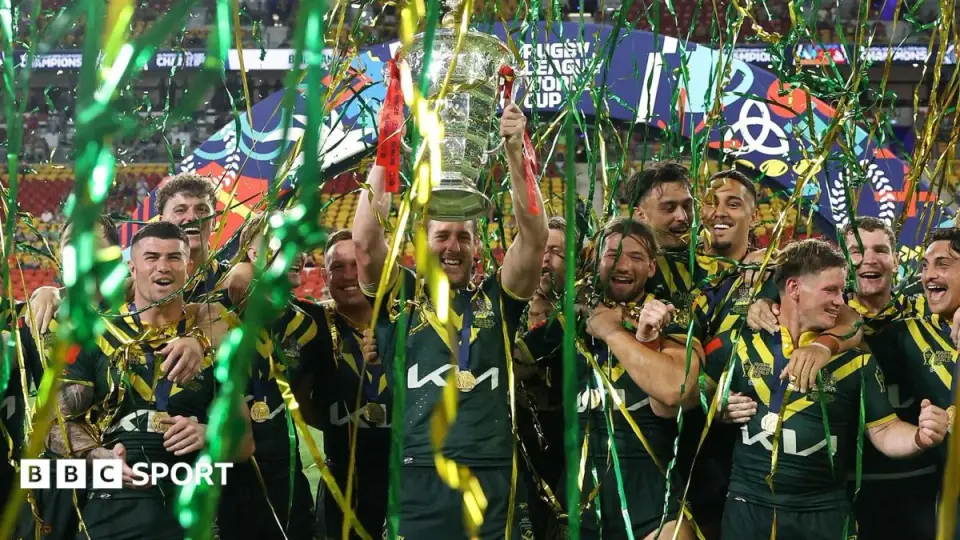
Australia defeated New Zealand 32-12 in the 2026 Rugby League World Cup final at Suncorp Stadium, Brisbane, securing their fourth consecutive title and 13th overall. The Kangaroos, coached by Kevin Walters, dominated the match, leading 24-6 at halftime after a rapid start that included the fastest try in World Cup final history. New Zealand, coached by Stacey Jones, struggled with handling errors and failed to match Australia's pace, scoring only two tries. The victory extends Australia's winning streak in World Cup matches to 23 games, ending a 18-year drought of losses that began with New Zealand's 2008 triumph on the same ground.
Key points
- Australia won the 2026 Rugby League World Cup final 32-12 against New Zealand at Suncorp Stadium, Brisbane, on November 15, 2026.
- The victory marks Australia's fourth consecutive World Cup title and their 13th overall, extending their winning streak in World Cup matches to 23 games.
- Liam Martin scored the fastest try in World Cup final history, crossing after just 88 seconds following a New Zealand kick-off error.
- Jack Bostock scored two tries, including a key aerial duel try, while Reece Walsh provided crucial assists and scored a try in the second half.
- New Zealand's performance was marred by numerous handling errors, including lost balls in contact and fumbled passes, which Australia exploited to maintain control.
- Cameron Munster and Harry Grant were highlighted as key organizers for Australia, controlling the game's tempo and exploiting New Zealand's defensive weaknesses.
Background
Australia and New Zealand met in the 2026 Rugby League World Cup opener on October 15, where Australia won 24-22 in a close contest that saw Reece Walsh vomit during play and Kalyn Ponga play through a suspected arm fracture. Australia then defeated Samoa 44-12 in the semi-final on November 8, with Walsh scoring three tries. New Zealand had previously defeated Australia in the 2008 World Cup final at the same venue, a result that had not been repeated on Australian soil since 2015.
How outlets are covering it
BBC Sport emphasized Australia's ability to peak for major occasions, noting their dominance in the first half and the 23-game winning streak in World Cup matches. ABC News focused on Australia's speed and precision, contrasting it with New Zealand's 'fizzy' performance and numerous errors, particularly highlighting Cameron Munster's organizational role. The Guardian highlighted the disappointment of New Zealand's failure to meet the occasion, noting that Australia's dominance was expected but the gap in performance was significant. NRL.com provided detailed team lists and noted late changes, including Latrell Mitchell's replacement due to illness, and highlighted the return of Ronaldo Mulitalo for New Zealand after a suspension. All sources agreed on the final score and Australia's dominance but differed in emphasis: BBC on historical dominance, ABC on tactical execution, and Guardian on the broader context of Australian supremacy in the sport.
Why it matters
Australia's fourth consecutive World Cup title reinforces their status as the dominant force in international rugby league, extending their winning streak to 23 World Cup matches. The victory silences critics who questioned their credentials after a close opener against New Zealand and highlights the team's ability to perform under pressure. For New Zealand, the defeat marks a missed opportunity, particularly for aging players like Joseph Tapine and James Fisher-Harris, and underscores the gap between the two teams despite New Zealand's strong tournament performance. The result also sets the stage for future competitions, with England and other nations facing the challenge of competing against Australia's sustained excellence.
What to watch
Australia will be recognized as the 2026 Rugby League World Cup champions, with the Paul Barrière Trophy awarded to the team. New Zealand will undergo significant squad changes before the next World Cup, with aging players likely retiring. The next World Cup is expected in 2030, where emerging teams like Samoa and Tonga may pose greater challenges. Australia's coaching staff and players will likely reflect on their performance and prepare for future international competitions, including potential Test matches against New Zealand.
- Dominant Australia defeat New Zealand in Men's World Cup final BBC
- World Cup Late Mail: Kangaroos-Kiwis finalise teams NRL.com
- Australian speed kills as New Zealand fall flat in World Cup final fizzer on steamy November night ABC News & Headlines – Australian Broadcasting Corporation
- Australia overpower New Zealand to win fourth consecutive men’s Rugby League World Cup The Guardian
- Australia crush New Zealand to win fourth Women’s Rugby League World Cup Al Jazeera
Want the full story? Read the original reporting
Read on BBC