
Heatwave Linked to Two UK Train Derailments in 24 Hours
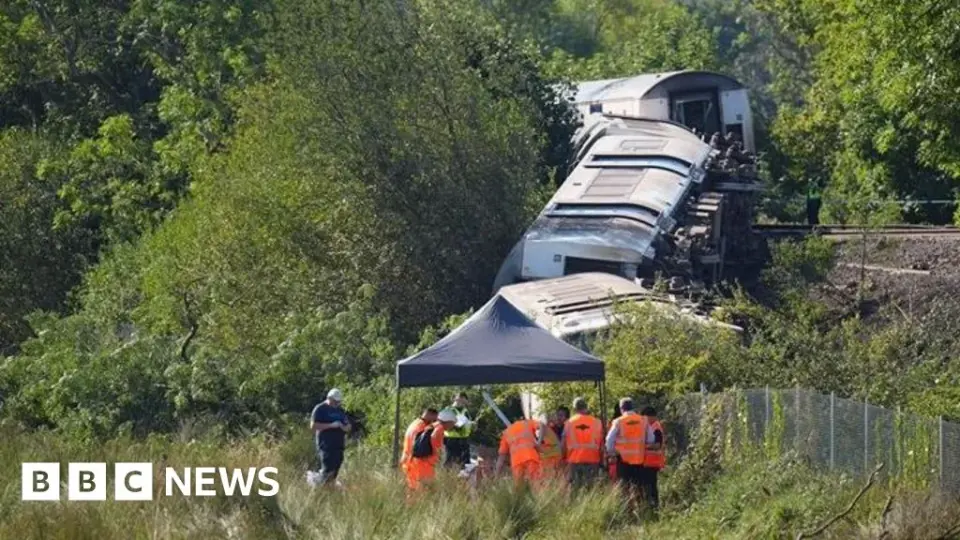
Two trains derailed in southeast England within 24 hours during a record heatwave. The first incident near Lewes, East Sussex, on Thursday injured 18 people, including two seriously, while the second near Wickford, Essex, on Friday resulted in no injuries. The Rail Accident Investigation Branch is examining both sites, with officials investigating whether extreme heat caused track buckling.
Key points
- A Southern train carrying 150 passengers derailed near Lewes on Thursday, causing 18 injuries, two of which were serious but not life-threatening.
- A Greater Anglia train derailed near Wickford on Friday with approximately 40 passengers on board; no injuries were reported.
- The Rail Accident Investigation Branch is reviewing CCTV, signalling data, and infrastructure at both sites, expecting an update next week.
- Network Rail confirmed that speed restrictions were not in place at either location at the time of the incidents.
- The line between Haywards Heath and Lewes remains closed indefinitely, with weekend services between London Victoria and Eastbourne cancelled.
Background
This incident follows a series of earlier reports from our archive regarding the Lewes derailment, which initially triggered a nationwide rail crisis response and significant service disruptions. The current events mark the second derailment in less than 24 hours, escalating concerns about railway safety during the UK's fifth heatwave of the summer.
How outlets are covering it
BBC and The Guardian emphasize the immediate operational impact, including indefinite line closures and the evacuation of passengers, while noting that no casualties were life-threatening. CNN highlights the temporal proximity of the two incidents, framing them as a potential systemic issue linked to the record heatwave. Network Rail and GTR executives, as cited by The Guardian, stress that derailments are 'incredibly rare' and that the railway remains among the safest in the world, while acknowledging that 'exceptional challenges' posed by the heat are being managed through proactive monitoring. Experts cited by The Guardian, such as Gareth Dennis and Xueyu Geng, suggest a high likelihood that heat-induced track buckling is the common cause, noting that steel rails expand significantly in extreme temperatures. Conversely, Network Rail's Martin Frobisher cautioned against speculation, stating it is 'too early' to determine the full findings, though he confirmed that internal investigations are underway to examine all possible factors, including the impact of heat on track alignment and ground stability.
Why it matters
The occurrence of two derailments in a short timeframe during a heatwave raises critical questions about the resilience of UK railway infrastructure under extreme weather conditions. The potential link to heat-induced track buckling could lead to broader policy changes in how railways monitor and maintain tracks during hot weather, impacting future safety standards and infrastructure investment across the network.
What to watch
The Rail Accident Investigation Branch is expected to provide an update on its findings next week. Network Rail will conduct internal investigations to determine the causes and factors of both derailments. Passengers are advised to check for updates on service disruptions, particularly for the London Victoria to Eastbourne route, and to allow extra time for journeys due to ongoing cancellations and rail replacement buses.
- Rail accident investigators at scene after train derails near Lewes BBC
- Second train derails in England in less than 24 hours amid record heatwave CNN
- 'The train swung wildly,' says passenger on board derailed service in Essex BBC
- National Rail says heat poses ‘exceptional challenges’ after two trains derail in 24 hours The Guardian
- Train Derails Near Town of Lewes in East Sussex, U.K. The New York Times
Want the full story? Read the original reporting
Read on BBC