
India releases Cockroach leader after massive Delhi crackdown
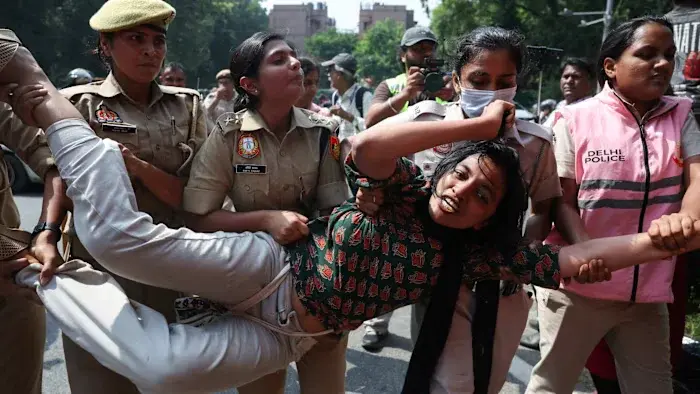
Indian authorities released Abhijeet Dipke, the leader of the youth-led Cockroach Janta Party (CJP), on Sunday after detaining him upon his arrival in New Delhi. The arrest followed a massive police crackdown on Saturday, where over 20,000 security personnel were deployed to prevent protests against Chief Election Commissioner Gyanesh Kumar. The CJP, which began as an online satire in May, is demanding Kumar’s resignation over a voter roll revision that removed 130 million names. While the government denies political motivation, critics argue the revisions disenfranchise eligible voters to favor the ruling party. The release came with a condition that Dipke not breach the peace for one year.
Key points
- Abhijeet Dipke and other CJP leaders were released by a Delhi court on Sunday, one day after being detained upon landing in New Delhi.
- The release was conditional on the leaders not breaching the peace for one year, according to the CJP’s legal head.
- On Saturday, authorities placed New Delhi under lockdown, deploying over 20,000 security personnel and shutting down mobile internet to prevent protests at Jantar Mantar.
- The CJP is demanding the resignation of Chief Election Commissioner Gyanesh Kumar over a voter roll revision that removed an estimated 130 million names, or 13% of the electorate.
- The government and Election Commission deny the revisions are politically motivated, stating they removed duplicates, deceased individuals, or those who relocated.
- The CJP, which started as a viral online satire in May, previously forced the resignation of the education minister in July.
Background
The Cockroach Janta Party (CJP) emerged in May 2026 as a Gen-Z-led online satire, gaining momentum by joining nationwide protests against the education minister over an exam leak scandal. The movement successfully forced the education minister’s resignation in July. The current crisis stems from a Special Intensive Revision (SIR) of voter rolls, which critics accuse of disenfranchising eligible voters to favor Prime Minister Narendra Modi’s ruling Bharatiya Janata Party (BJP). The CJP and opposition parties have been staging protests since early October, demanding the resignation of Chief Election Commissioner Gyanesh Kumar. The government has consistently denied any political motivation, maintaining that the revisions were necessary to clean up the electoral rolls.
How outlets are covering it
The Financial Times and CNN both report on the massive police crackdown and the detention of CJP leaders, but they differ in their emphasis. The Financial Times highlights the scale of the crackdown, noting the deployment of over 20,000 security personnel and the CJP’s claim that over 15,000 people were detained, a figure the FT could not independently verify. CNN, on the other hand, focuses on the release of Dipke and the conditions attached to it, as well as the CJP’s vow to continue protesting. Both outlets report on the government’s denial of political motivation, but the Financial Times notes the UN’s call for the release of all detainees, while CNN emphasizes the CJP’s resilience and the challenges of removing the election commissioner through parliamentary means. The Financial Times also notes the BJP’s accusation that the CJP is attempting to destabilize the country at the behest of foreign forces, a claim CNN does not mention.
Why it matters
The crackdown on the CJP and the detention of its leaders highlight the growing tensions between the Indian government and a new, youth-led political movement. The CJP’s ability to mobilize large numbers of protesters and force the resignation of a government minister in July demonstrates its potential to challenge the ruling party. The current dispute over voter rolls is particularly significant as it comes ahead of a series of key state elections, and any perception of electoral manipulation could have far-reaching consequences for India’s democracy. The government’s heavy-handed response, including the lockdown of New Delhi and the deployment of thousands of security personnel, raises concerns about the limits of free expression and assembly in India. The international community’s involvement, as seen in the UN’s call for the release of detainees, also underscores the global attention on India’s democratic processes.
What to watch
The CJP has vowed to continue its protests, despite the detention of its leaders and the heavy police presence. The next major protest is expected to take place in the coming days, with the CJP calling on its supporters to return to Jantar Mantar. The government has warned that it will deal with any further protests strictly, and the BJP has accused the CJP of attempting to destabilize the country. The outcome of the voter roll revision and the potential resignation of Chief Election Commissioner Gyanesh Kumar will be closely watched, as it could have significant implications for the upcoming state elections. The international community will also be watching the situation closely, with the UN and other organizations likely to continue calling for the release of all detainees and the protection of free expression and assembly.
- Police arrest leader of India’s ‘Cockroach’ movement before mass protest Financial Times
- Live Updates: Leaders of Protest Paralyzing New Delhi Say They’ve Been Detained by Police The New York Times
- Founder of India’s Gen-Z ‘Cockroach’ movement detained ahead of planned protest, party says CNN
- India cracks down on youth protests as anger grows against Modi and election chief NPR
- India detains youth protest leader to defuse rally against election chief Reuters
Want the full story? Read the original reporting
Read on Financial Times