
Pacific Islands Forum fractured by Chinese pressure and leadership absences
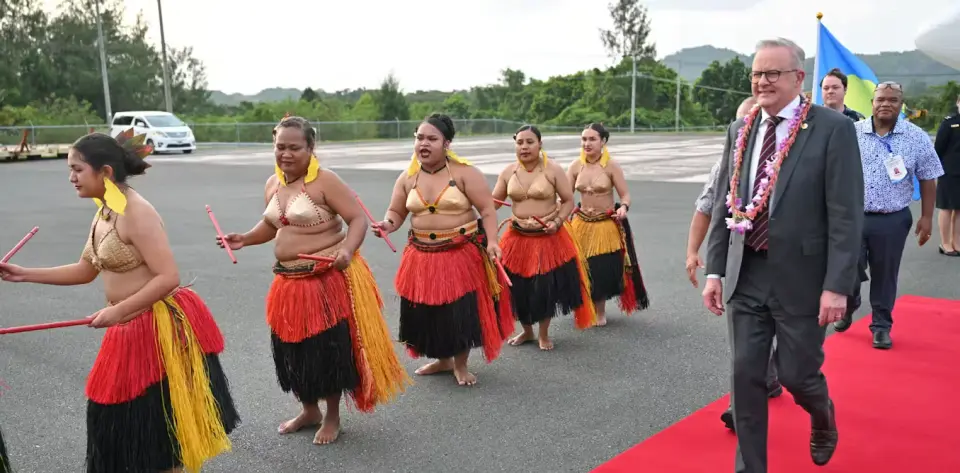
The 55th Pacific Islands Forum in Palau is facing a crisis of legitimacy as five leaders withdrew, citing domestic issues or Chinese pressure. Beijing threatened 'consequences' over Taiwan's participation, while consensus-based decision-making was blocked by Kiribati and Naoero, undermining the forum's ability to address regional security and climate challenges.
Key points
- Five leaders (Kiribati, Fiji, Vanuatu, Samoa, Solomon Islands) did not attend the summit, with Solomon Islands PM Matthew Wale leaving after a no-confidence motion.
- China's special envoy Qian Bo warned of 'consequences' regarding Taiwan's presence, leading to a travel advisory for Palau, which accounts for 40% of its GDP from tourism.
- Kiribati and Naoero blocked a joint condemnation of a Chinese ballistic missile test in July, using the forum's consensus rule as a veto.
- Australia and New Zealand defended the forum's autonomy, with PM Anthony Albanese stating the forum determines its own agenda, not external powers.
- The summit's theme, 'Building Economies: Life. Action. Unity', is being challenged by geopolitical divisions and the absence of key leaders.
Background
The Pacific Islands Forum is the primary regional diplomatic institution for Pacific nations, operating on a consensus model known as the 'Pacific Way.' Recent years have seen increased geopolitical competition between China and Australia for influence in the region, with China using aid and security deals to counter Australian support for Taiwan and regional stability. The forum has previously faced challenges from external pressures, but this year's disruptions are more severe, with leaders absent and consensus blocked on key issues like missile tests and Taiwan's participation.
How outlets are covering it
The Conversation emphasizes the forum's weakened unity and the impact of Chinese assertiveness on regional diplomacy, noting that the 'Pacific Way' is being undermined by external forces. The Guardian highlights the direct confrontation between China and Taiwan, with China's envoy warning of 'consequences' and Australia and New Zealand defending the forum's autonomy. The Diplomat focuses on the structural impact of great power rivalry, arguing that the consensus model is being exploited by China-aligned states to block collective action, such as on missile tests, and that the forum's credibility is being eroded by these divisions. All sources agree on the absence of leaders and the role of China in influencing outcomes, but differ in emphasis: The Conversation on the forum's importance, The Guardian on the immediate diplomatic clash, and The Diplomat on the long-term structural implications for regional governance.
Why it matters
The forum's inability to act as a unified body undermines its role in addressing critical issues like climate change, security, and economic development. The disruption highlights the vulnerability of small states to great power pressure and the potential for external actors to paralyze regional institutions. This could lead to a shift toward bilateral deals, reducing the forum's relevance and weakening the Pacific's collective voice in global affairs.
What to watch
The forum will continue its agenda, including a climate declaration ahead of COP31 and a maritime anti-smuggling initiative, but its ability to reach consensus on key issues is in question. The long-term impact of China's pressure and the forum's response will shape the future of regional diplomacy and the balance of power in the Pacific.
- Leaders missing and China ‘furious’: the Pacific Islands forum off to a decidedly shaky start The Conversation
- China-Taiwan tensions weigh on Pacific leaders meeting Reuters
- China warns of ‘consequences’ over Taiwan presence at Pacific Islands Forum The Guardian
- How Great Power Rivalry Is Fracturing the Pacific Islands Forum thediplomat.com
- Missing leaders won't derail Pacific Islands Forum outcomes, secretariat says RNZ
Want the full story? Read the original reporting
Read on The Conversation