New research indicates that birth order has negligible impact on adult personality, which is instead shaped by genetics, life events, and deliberate effort. While personality stabilizes around age 30, it continues to evolve, particularly in emotional stability, throughout a person's life.
A large study analyzing medical data from about 10 million U.S. siblings found birth order is associated with about 150 health conditions. First-borns showed higher rates of neurodevelopmental and psychiatric diagnoses (autism, ADHD, Tourette’s, OCD) and immune/allergic conditions like food allergies, while second-borns had higher rates of migraines, shingles, substance-use disorders, and gastritis. The study shows correlations at the population level, not causation, and has limitations including reliance on insurance claims and possible differences in diagnosis and healthcare-seeking behavior. Researchers emphasize birth order as a modest risk marker, with mechanisms like parental attention, early microbial exposure, and maternal changes across pregnancies remaining to be proven.
A large study of 10 million American siblings across 569 disease categories finds birth order is associated with about 150 health conditions. First-borns show higher rates of neurodevelopmental and psychiatric disorders (autism, ADHD, Tourette’s, OCD) and several allergies, while second-borns have higher rates of migraines, shingles, substance-use disorders, and gastritis. The authors stress these are population-level correlations, not proof of causation, and note that insurance-claims data (not biology alone) and factors like parental attention, early microbial exposure, and maternal changes between pregnancies may influence the patterns. The work, by researchers at the University of Chicago and Columbia University, appeared in Nature Health and should be interpreted as a modest risk marker rather than a definitive predictor.
A study of 10 million U.S. siblings across 569 diseases found birth-order patterns: first-borns have higher rates of neurodevelopmental/psychiatric conditions (autism, ADHD, Tourette's, OCD) and allergies, while second-borns show more migraines, shingles, GI issues and substance-use disorders. The findings are correlations, not causation, and are limited by insurance-claims data and family dynamics; researchers describe birth order as a modest population-level risk marker rather than a precise predictor.
New research analyzing health data from over five million two-child families finds birth order is linked to different disease risks: first-borns have higher odds of neurodevelopmental conditions (ADHD and autism) and of food allergies and hay fever, while second-borns show higher odds of substance-use disorders and gastrointestinal conditions. A shorter gap between siblings may offer some protective effect for certain neuropsychiatric and allergic conditions. Experts caution these are population-level associations rather than causal links, and birth order is a non-modifiable, relatively weak predictor of individual risk.
A large US study of over 10 million children with at least one sibling analyzed 569 diseases and found birth order is linked to widespread health differences: first-borns have higher risk for neuropsychiatric conditions such as ADHD and autism, while second-borns show higher risk for stomach problems and other digestive issues. About 150 diseases showed birth-order differences, with results consistent across within-family and between-family comparisons; some risks vary with age gaps between siblings, and researchers say mechanisms remain to be clarified.
A large study of over 10 million two-child families links birth order to disease risk across many conditions: first-borns show higher odds of neurodevelopmental issues (autism, ADHD), OCD, Tourette syndrome, allergies and acne, while younger siblings are more prone to substance abuse, gastrointestinal problems, and certain infections such as herpes zoster. The authors suggest immune and microbial exposure differences, plus social factors, with closer age gaps strengthening the microbial-sharing effect.
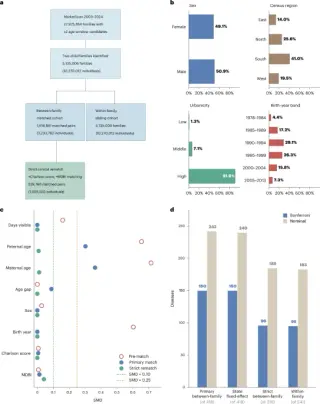
Two designs in over 5 million two‑child families from Merative MarketScan scanned 569 diseases. The primary between‑family matched cohort (1.6 million pairs) and a within‑family sibling comparison (5.1 million families) identified 150 Bonferroni‑significant birth‑order associations among 418 diseases. First‑borns have higher risk for neurodevelopmental and immune/allergic conditions (e.g., other/unspecified PDD, autism, food allergy, allergic rhinitis) while second‑borns show higher odds for substance‑abuse disorders and certain digestive diseases (gastritis/duodenitis). Across designs, effects are broadly concordant (r ≈ 0.66; 74% concordant; 84.7% of Bonferroni hits agree in direction), robust to state fixed effects and full‑sibling restrictions. A phenome‑wide atlas reveals domain‑specific patterns: first‑born excess dominates neuropsychiatric conditions; second‑born excess appears in digestive, musculoskeletal, infectious and some neurological diseases. The study provides a comprehensive, robust map of birth‑order influences on human disease and shows spacing between siblings can modulate several associations.
New research suggests birth order affects life outcomes more through family dynamics and resources than fixed traits. Younger siblings often benefit from parents who are wealthier and more experienced than with their first child, while older siblings can act as mentors and rivals, shaping opportunities and motivation. The piece notes patterns such as more younger siblings in elite athletes and discusses how parents and policymakers can help close gaps by supporting early education, mentoring, and resource access for firstborns and other children.
A large preprint study of over 10 million individuals across more than five million families found firstborns are more likely to be diagnosed with neurodevelopmental conditions such as autism and ADHD, as well as allergies, while second-borns show higher rates of substance-use disorders, shingles, and gastrointestinal issues. Smaller age gaps between siblings appear protective against allergies and asthma, possibly due to increased microbial exposure, per the hygiene hypothesis. Limitations include reliance on insurance claims data and lack of uninsured populations; results have not yet undergone peer review.