
Foam-enabled photolithography achieves ultra-high-resolution biomimetic printing
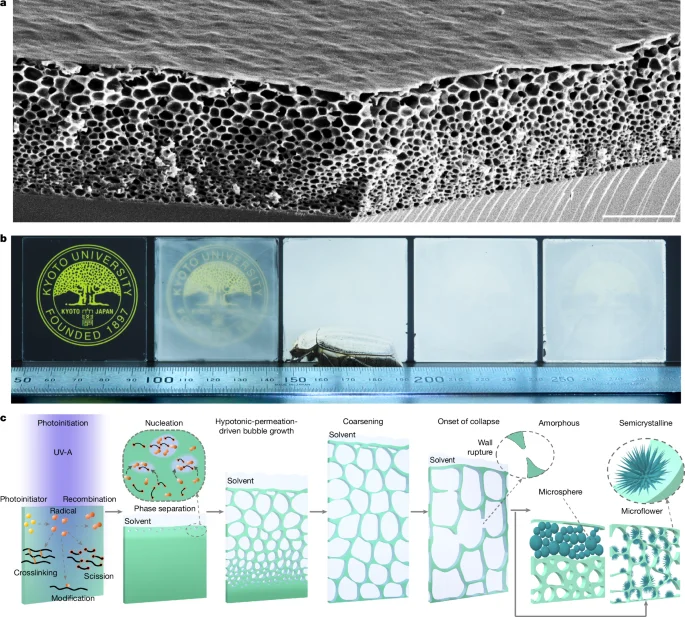
Deep-foam photolithography (DFP) is a light-driven process in which a photosensitized polymer film exposed to UV-A undergoes concurrent scission and crosslinking, and a weak solvent permeation triggers pore nucleation, expansion and controlled collapse to form foam throughout the film or fiber. This enables inkless printing in white/greyscale with diffractive color at ~20,000 dpi and allows mechanically expanded/collapsed foams with high aspect ratios (up to ~20×). Demonstrated across various polymers and photoinitiators, DFP patterns foamability, wettability, optical properties and local thickness, enabling high-resolution printing, microfluidics and selective capture of liquids/colloids on flexible substrates.