
Tag

Mai Cyber 1 Flash

All articles tagged with #mai cyber 1 flash

Microsoft overhauls MDASH with MAI-Cyber-1-Flash, delivering broad cybersecurity AI at half the cost
technology2 months ago

Microsoft overhauls MDASH with MAI-Cyber-1-Flash, delivering broad cybersecurity AI at half the cost

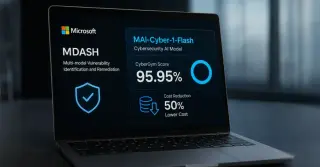
Microsoft announced MAI-Cyber-1-Flash, a cybersecurity-focused model inside MDASH that can handle about 90% of MDASH tasks, with GPT-5.4 tackling the hardest 10%, and claims CyberGym performance of 95.95% at roughly half the cost of the current MDASH model mix. Access is limited to approved MDASH customers via an Azure AI Foundry private preview. MAI-Cyber-1-Flash is a 137-billion-parameter sparse Mixture-of-Experts model with a 256k-token context, designed to replace about 80% of existing MDASH models, and is evaluated in isolated settings with various benchmarks; results may not be directly comparable to public leaderboards. Project Perception will expand the security automation workflows with a public preview planned for August 3.


Microsoft unveils MAI-Cyber-1-Flash, a cost-efficient AI for cybersecurity
technology2 months ago

Microsoft unveils MAI-Cyber-1-Flash, a cost-efficient AI for cybersecurity

Microsoft unveiled its first cybersecurity AI, MAI-Cyber-1-Flash, claiming it outperforms rivals when paired with GPT-5.4 and will power Project Perception’s vulnerability discovery and patching in public preview starting Aug. 3; the move marks a renewed cybersecurity push after leadership changes and emphasizes cost efficiency, with Microsoft suggesting about half the cost of rivals and deeper OpenAI integration.

Microsoft Deploys AI-Driven Cybersecurity Suite
technology2 months ago

Microsoft Deploys AI-Driven Cybersecurity Suite

Microsoft unveiled MAI-Cyber-1-Flash, a cybersecurity-focused AI model, and linked it to Project Perception to orchestrate AI agents that detect and repair network vulnerabilities. The company says it outperforms competitors on security benchmarks, costs about half as much as other top tools, and is designed for rapid, wide deployment, with initial access limited to MDASH-enabled users. The move comes amid rising concerns about AI-enabled threats and ongoing debates about oversight of powerful AI systems.