In Situ Structures Reveal a Lipid-Driven PSII–LHCII Skeleton Shaping Plant Thylakoids
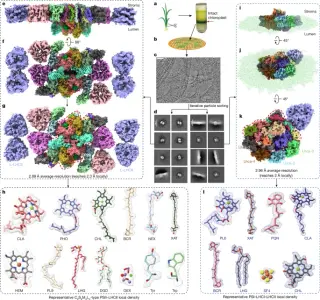
A rice chloroplast in situ cryo-EM study resolves a large PSII–LHCII supercomplex (C2S2M2L4) with four previously unobserved LHCII trimers, plus diverse PSII–LHCII dimers and PSI–LHCI–LHCII/PSI–LHCI complexes. The results reveal a native lipid network that stabilizes interfaces and suggests PSII–LHCII supercomplexes form a tessellated scaffold that shapes thylakoid curvature, grana stacking, and inter-m membrane organization. Energy-transfer calculations show trapping lifetimes matching in vivo measurements, indicating functional relevance and dynamic antenna size regulation via L-LHCII. TL and TS dimers appear more architectural than energy-transfer mediators, while higher-order assemblies likely drive grana morphology. This in situ architecture provides a molecular framework for understanding plant photosynthetic efficiency in its native membrane context.