A maker project called CubeRaman uses a 3D-printed housing and a 532-nm laser to build a low-cost Raman spectrometer; while the design is more accessible, it still relies on an external spectrometer and faces challenges like stray-light suppression and alignment, with early tests successfully detecting Raman shifts in a raw diamond.
As tallies near completion, Raman leads in three eastern districts and Bass dominates South L.A., with Pratt strongest in the West Valley. Overall, Raman is about 34% to Bass’s 31% and Pratt’s 27%, setting up a Raman–Bass runoff. Raman’s strongest districts were CD1, CD13 and CD14 (roughly 38–45%), Bass excelled in South L.A. (CD8 near 62%; CD10 ~45%; CD9 ~42%), and Pratt led in CD12 (39%), CD3 (about 37%), and briefly in CD5 (roughly 30.7% to Raman’s 30.6%). Measure ER also prevailed, adding a countywide sales-tax boost to the political mix.
Elon Musk’s promotion of election-denial rhetoric is highlighted as a factor shaping political discourse, while Los Angeles’ mayoral race sees Raman overtaking Pratt, signaling shifting dynamics that could influence voter perceptions.
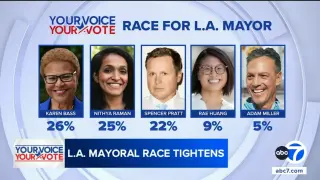
Incumbent mayor Karen Bass leads a tight three‑way race against councilmember Nithya Raman and newcomer Spencer Pratt in the Los Angeles mayoral primary, with late‑May polls showing Bass at about 26%, Raman 25%, and Pratt 22% and undecided voters shrinking from about 40% to roughly 10% as Election Day approaches. California’s top‑two rule means the two highest finishers advance to the November general election unless someone clears 50%. The race, framed by the Palisades Fire, immigration enforcement headlines and residency controversies for Pratt, features Bass touting her record and homelessness progress, Raman pushing housing and shelter reforms, and Pratt running on a nonpartisan, results‑oriented platform and aggressive campaign style.
A UC Berkeley–LA Times poll shows a tight three‑way race for LA mayor: Bass 26%, Raman 25%, Pratt 22% (margin of error 3%), with 10% undecided and minor candidates Rae Huang and Adam Miller siphoning votes. The top two will advance. The governor race also shows competition, with Becerra leading Hilton.
A Berkeley Institute of Governmental Studies poll for the LA Times shows Mayor Karen Bass in a razor-thin primary against Nithya Raman and Spencer Pratt, with Bass at 26%, Raman 25% and Pratt 22% among likely voters. About 63% say Los Angeles is on the wrong track, underscoring Bass’s vulnerability as momentum shifts. Bass’s favorability is 35% favorable to 57% unfavorable, while Raman is 40% favorable and Pratt 25% favorable. Pratt, a reality-TV figure, has channeled anger over homelessness, public safety and wildfire response into a campaign, and Raman—previously Bass’s ally—has framed the race around government dysfunction. Bass’s campaign points to internal polling suggesting stronger numbers. The survey of 1,351 voters conducted May 19–24 has a 3-point margin of error.
A 30-second, union-funded attack ad against Spencer Pratt in the Los Angeles mayoral primary is seen by analysts as a strategic move to boost Pratt with Republican voters and force a Bass–Pratt runoff, rather than harm Raman. The Los Angeles County Federation of Labor says the expenditure is independent of Bass, while Raman and Bass call the tactic cynical in a heavily Democratic race.
In a contentious L.A. mayoral debate, incumbent Karen Bass defended her record, Nithya Raman appeared underprepared and ran over time, and Spencer Pratt used storytelling to stand out, leaving Raman as the perceived weaker performer.