
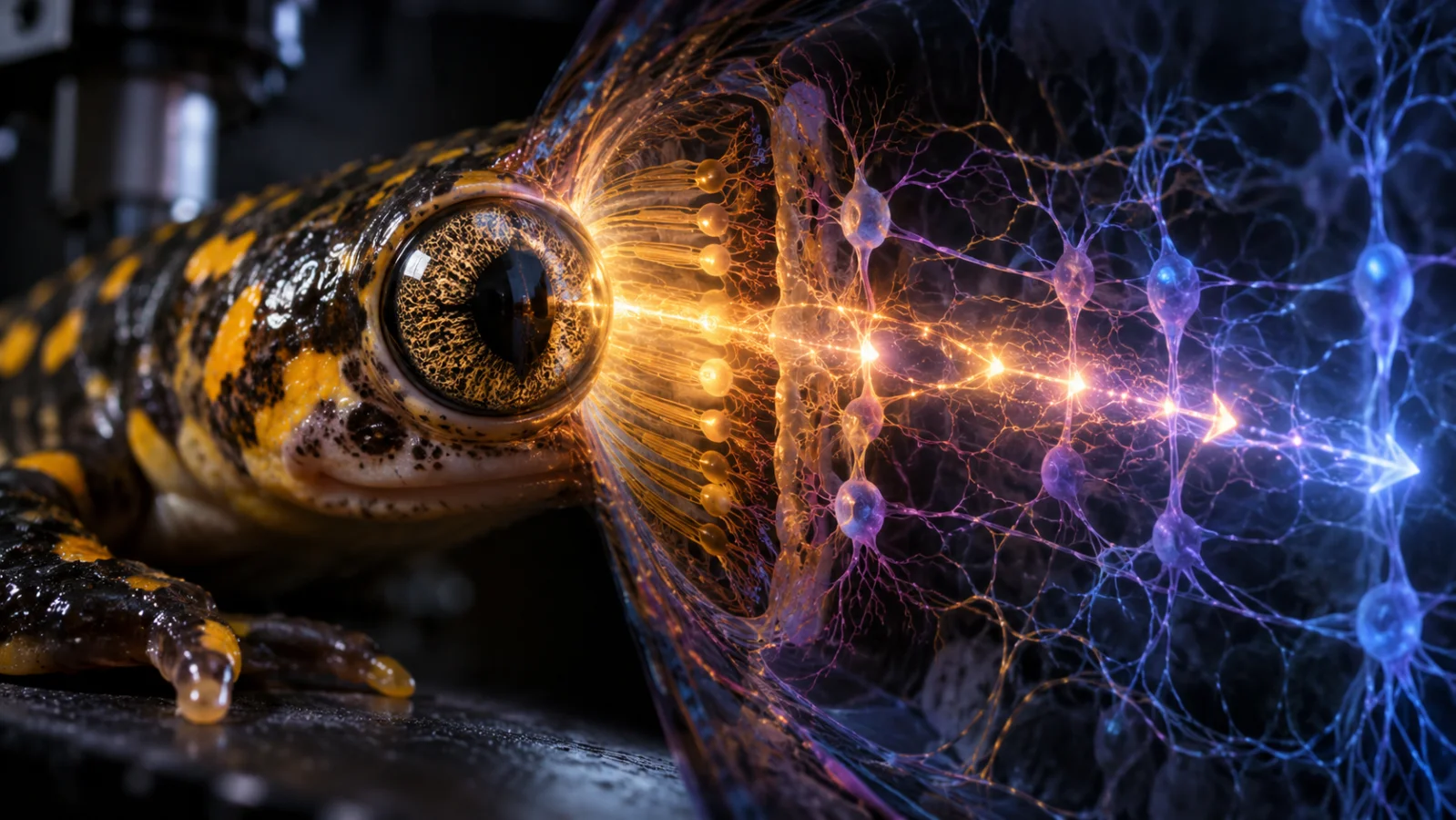
Pairs of retinal neurons drive the brain's arrow of time
Researchers developed an information-theoretic framework to break a system's local arrow of time into contributions from individuals, pairs, triplets and higher-order groups. When applied to 53 salamander retinal neurons, pairwise interactions accounted for about 66–74% of local irreversibility, and the retina showed a stronger arrow of time under a time-reversible Brownian stimulus than under a natural movie, indicating internal neural processing can generate temporal asymmetry independent of the external input. The approach could be applied to other complex nonequilibrium systems to understand how irreversibility emerges from simple components.