
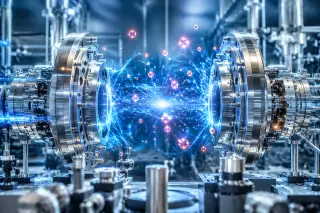
Vacuum’s Hidden Particles Leave Real Traces in Proton Collisions
Brookhaven National Laboratory and Stony Brook University, using RHIC’s STAR detector, observed short-range spin correlations between lambda and anti-lambda hyperons produced in high-energy proton collisions. This implies virtual quark–antiquark pairs from the quantum vacuum can be liberated into real particles and retain a spin imprint, providing direct evidence of vacuum structure and offering a new way to probe quark confinement and the proton spin puzzle.