Tag

Trapped Ions

All articles tagged with #trapped ions

Quantum Simulators Reveal Edge-Driven Mechanism for Particle Creation
science1 month ago

Quantum Simulators Reveal Edge-Driven Mechanism for Particle Creation

A Duke-led team used a trapped-ion quantum simulator to model 'string breaking,' a process where energy creates new particle pairs. Published in Nature Physics, the study reveals that new charges form at the edges of the string before spreading inward, differing from traditional theories. This work joins similar experiments by Google and QuEra, marking a key step in using quantum hardware to simulate high-energy physics.

physics4 months ago

Hidden Synchrony: Two Quantum Clocks Align via Dissipation in Trapped Ions

Physicists demonstrated synchronization between two quantum van der Pol oscillators realized as shared vibrational modes in a trapped-ion pair. The fixed relative phase emerges only in the joint state, not in either oscillator alone, thanks to engineered gain/loss processes and a collective dissipative channel. This hidden synchronization, detected through joint Wigner-function maps, points toward scalable quantum oscillator networks with potential uses in quantum sensors and clocks beyond classical limits.

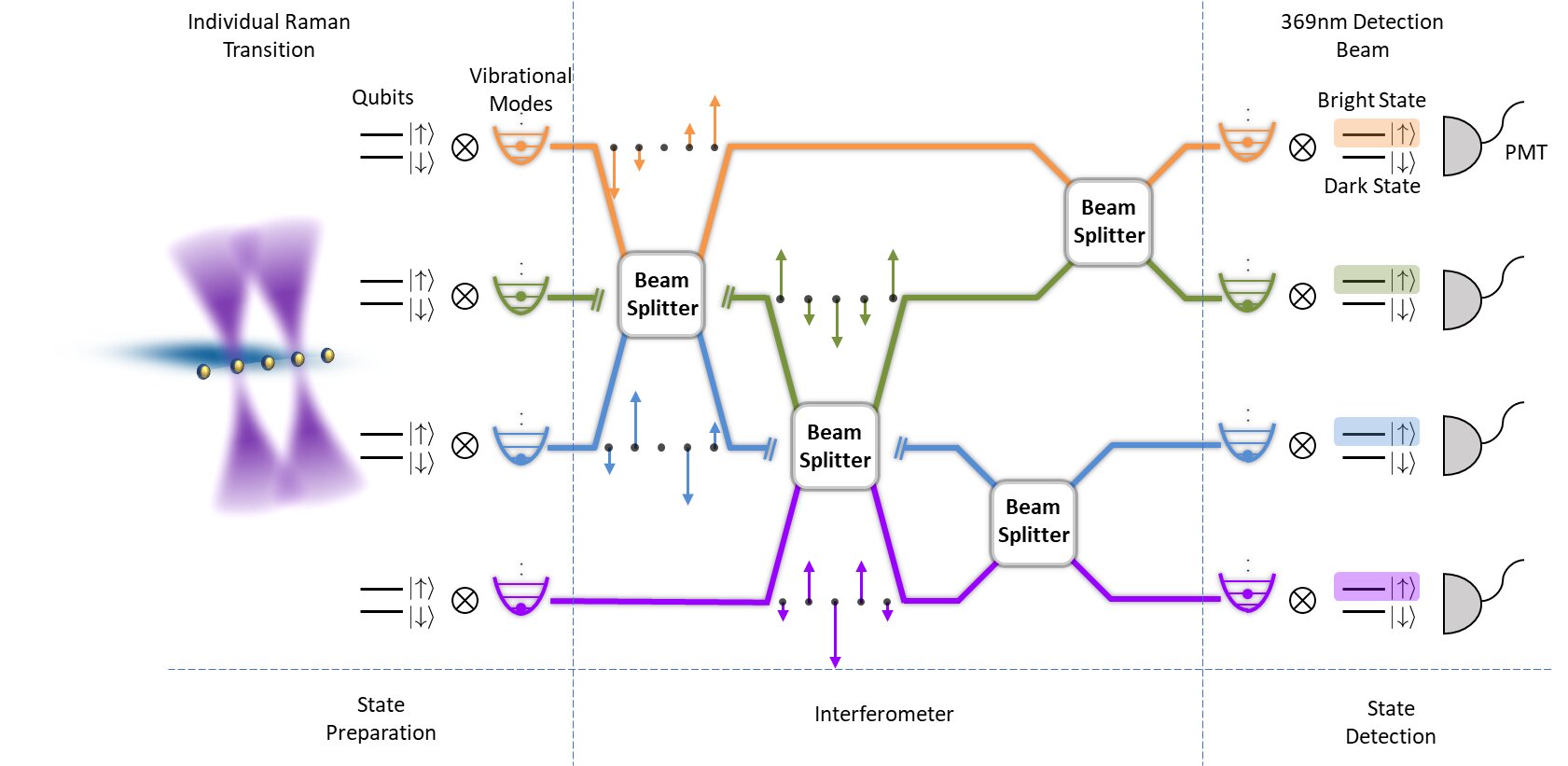
Trapped ion technology enables scalable quantum phononic processor.
quantum-computing3 years ago

Trapped ion technology enables scalable quantum phononic processor.

Researchers at Tsinghua University have developed a scalable and programmable quantum phononic processor with trapped ions that could enable better performances on complex problems. The system is a programmable bosonic network, consisting of a set of bosonic modes connected to each other via controllable beam splitters. The phononic quantum processor has several advantages over previously proposed bosonic networks, including deterministic input and output preparation and minimal loss of phonons over time. The researchers hope to scale up the system to achieve large-scale and programmable boson sampling and demonstrate quantum advantage over classical computing.