
physics21.64 min read
Australian Physicist Claims Gravity Alters Light Speed, Challenging Einstein's Core Principle
11 days ago•Source: zmescience.com

The latest physics stories, each synthesized from multiple sources with added background and context.

Physicists from CERN's ATLAS collaboration have observed strong evidence that quantum entanglement survives the LHC's extreme energies. By studying Higgs boson decays into pairs of Z bosons (which quickly decay into electrons or muons) at 13 TeV, they infer the Z bosons' spins and confirm entanglement in high-energy collider events. This marks one of the highest-energy confirmations of entanglement and extends foundational quantum mechanics tests into violent, laboratory-scale particle collisions; the results are published in Physical Review Letters.
Nature•1 month ago
American Physical Society•1 month ago
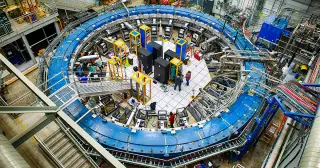
New lattice QCD calculations explain the muon g-2 excess without invoking new particles, aligning with Fermilab’s precise measurement and challenging the older data-driven predictions that relied on electron-positron collision data; at the same time, fresh VEPP-2000 pion-production results and divergent collider measurements renew tensions across experiments, hinting at either unknown particles or overlooked experimental details and underscoring four decades of conflicting data that physicists still need to resolve.
A fiber-ring photonic platform realizes a purely non-Abelian Yang–Mills electric field in a synthetic frequency lattice. Polarization control encodes the vector and scalar potentials, producing Zitterbewegung of a light pulse; detuned modulation activates an Abelian field and induces Bloch oscillations. The two fields interfere, demonstrating programmable non-Abelian dynamics in a tabletop setup with potential on-chip signal processing and quantum photonics applications.

Researchers show that non-Brownian suspensions can simultaneously store directional memory from stirring and amplitude memory from rocking; as rocking intensity increases past a threshold, directional memory is erased and, at higher intensities, a new directional memory is written, illustrating competitive memory dynamics with potential parallels to neuroscience and geophysics.
Physicists demonstrated synchronization between two quantum van der Pol oscillators realized as shared vibrational modes in a trapped-ion pair. The fixed relative phase emerges only in the joint state, not in either oscillator alone, thanks to engineered gain/loss processes and a collective dissipative channel. This hidden synchronization, detected through joint Wigner-function maps, points toward scalable quantum oscillator networks with potential uses in quantum sensors and clocks beyond classical limits.
A bootstrap analysis shows that, under ultrasoft high-energy behavior and the assumption that Regge zeros are the only zeros, the 4- and 5-point scattering amplitudes for identical scalars are uniquely fixed to the string-theory form, implying string dynamics may emerge from fundamental consistency principles rather than being assumed a priori. Built on Lorentz invariance, crossing symmetry, positivity, and analyticity, the result supports string universality but depends on whether these inputs can be independently justified or if other assumptions yield the same outcome.

Physicists simulated slicing a single photon with a shutter and found that the global quantum state becomes a complex mixture spanning zero to infinitely many photons. Locally, measurements on one side can reveal a single-photon state while the other side appears as vacuum, illustrating a paradoxical, nonlocal distribution and raising questions about the nature of particles and causality. The work, reported in Physical Review Letters, could lead to a clearer way to describe particle interactions and extend to other quantum particles like electrons; in realistic setups the infinite case requires an idealized infinitely fast shutter.

Scientists report the first functioning thorium-229 nuclear clock, which uses a low-energy nuclear transition excited by UV lasers and operates continuously in a crystal at room temperature. The clock promises long-term stability that could surpass some optical clocks, enabling tests of fundamental forces beyond the Standard Model and offering a new avenue to search for dark matter, with potential future uses in navigation and communications as the technology matures.

With about two months of data, the Jiangmen Underground Neutrino Observatory (JUNO) measured two key reactor-neutrino oscillation parameters with 1.6× better precision than decades of previous experiments. The results, published in Nature, advance the effort to determine the neutrino mass ordering and shed light on the origin of neutrino masses, using a 20,000‑ton scintillator detector instrumented with 43,000 photomultiplier tubes observing reactor antineutrinos ~53 km away.
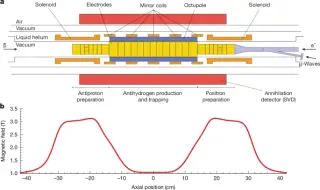
A CERN ALPHA Collaboration study reports a four-parts-per-million measurement of the antihydrogen ground-state hyperfine splitting (a1S/h) using microwave spectroscopy on ~24,000 trapped anti-atoms in a flattened 1 T magnetic trap. By comparing two spin-flip transitions at magnetic minimums in 1.03 T and 1.07 T, the team determines a1S/h = 1,420,404.8 ± 1.1 (stat) ± 5.6 (sys) kHz, consistent with hydrogen and CPT invariance. The result probes the antiproton’s internal structure (Zemach corrections) at ~40 ppm and complements ongoing 1S–2S measurements, with future plans to push precision further (e.g., Sternheim interval, 0.65 T transitions). Achieving this precision relies on improved magnetic-field control, spin-state manipulation, and antihydrogen accumulation, as well as careful handling of magnetic-field drift and lineshape modeling.
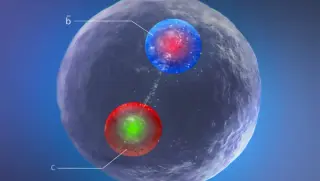
ATLAS physicists at CERN observed the excited Bc*+ meson, a heavy-quark bound state (charm quark with a bottom antiquark), produced in high-energy proton-proton collisions at the LHC. The Bc*+ rapidly decays to a Bc+ meson and a photon, which was identified indirectly when the photon converted into an electron–positron pair in the detector. The measured mass difference between Bc*+ and Bc+ is 64.5 ± 1.4 MeV, consistent with theoretical expectations and providing new data to refine models of heavy-quark dynamics and the strong force. Publication is set for Physical Review Letters.