
China's September Auto Market: EV Share Hits 67% as ICE Sales Plunge 49%
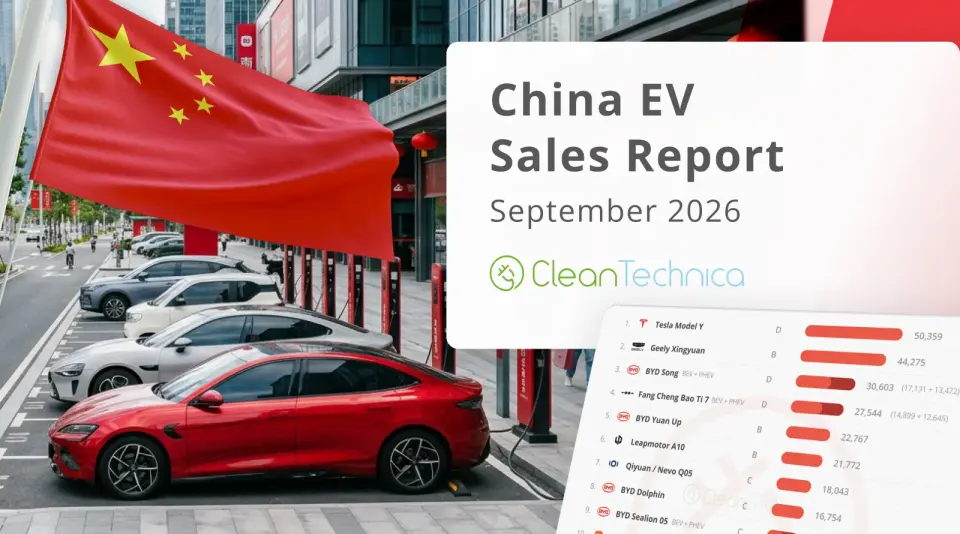
China's September vehicle market saw a record 67% plug-in share as internal combustion engine (ICE) sales crashed 49% year-over-year. While total domestic sales fell 28%, pure electric and hybrid vehicles gained ground, pushing the 2026 cumulative EV share to 58%. Simultaneously, Chinese automakers pivoted to exports, with passenger car exports surging 64% to offset domestic weakness, even as the EU moves to cap hybrid imports.
Key points
- In September 2026, China's overall vehicle sales dropped 28% year-over-year to approximately 1.6 million units, driven by a 49% collapse in pure ICE sales.
- Plug-in vehicles (BEV and PHEV) accounted for 67% of the market in September, a new record, with BEVs holding 45% and PHEVs 22%.
- The 2026 cumulative EV market share reached 58%, already 4 percentage points higher than the full-year 2025 result, with BEVs alone at 39%.
- Chinese passenger car exports surged 64% year-over-year in September to around 919,000 units, with total 2026 exports exceeding 7.1 million.
- The EU has agreed to an interim deal capping Chinese hybrid vehicle imports at 350,000 units annually, starting as early as December 2026.
- BYD maintained the top market share position at 17.2%, while Leapmotor saw a 31% year-over-year sales increase, challenging Geely for the second spot.
Background
This shift in China contrasts sharply with the US market, where EV sales have stalled at roughly 6% share following the expiration of the federal tax credit in 2025. While the US has seen a surge in hybrid sales, China's market is moving rapidly toward full electrification, with analysts projecting 100% BEV adoption before 2035. The divergence highlights how different policy environments are shaping global automotive transitions.
How outlets are covering it
CleanTechnica emphasizes the structural collapse of the ICE segment in China, noting that the record EV share is driven by a 49% drop in ICE sales rather than a surge in EV volume. They highlight the competitive pressure on legacy models like the Tesla Model Y, which saw a 2% decline despite a new variant. U.S. News & World Report focuses on the export dimension, noting that Chinese automakers are aggressively targeting overseas markets to offset domestic weakness. They highlight the EU's new 350,000-unit cap on hybrid imports as a significant trade barrier. While CleanTechnica views the ICE decline as a sign of inevitable market transition, U.S. News frames the export surge as a source of geopolitical tension and trade friction with the EU and US.
Why it matters
The rapid electrification of the world's largest auto market signals a fundamental shift in global automotive supply chains and technology standards. The EU's import cap indicates that trade protectionism is escalating in response to Chinese manufacturing dominance. For global automakers, the divergence between China's EV boom and the US's hybrid pivot suggests that regional market strategies will become increasingly distinct, forcing manufacturers to tailor products and production locations to specific regulatory and consumer environments.
What to watch
Chinese automakers are expected to continue expanding overseas production in regions like Thailand, Indonesia, and Hungary to mitigate tariff risks. The EU is set to begin monitoring hybrid import quotas in December 2026. In China, the market is projected to reach full electrification by 2030, with pure BEVs dominating by 2035. Competitors like Leapmotor and BYD will likely intensify their push for market share as legacy ICE brands continue to lose ground.
- ICE Vehicle Sales Crash 49%(!) While EV Share Jumps to 67%(!) — China EV Sales Report for September CleanTechnica
- Chinese Automakers Focus on International Expansion Despite Limits WSJ
- China home car sales downturn continues, exports retain momentum Reuters
- Chinese global vehicle sales down 8% in September Yahoo Finance
- China's Carmakers Export More as EU Caps Hybrid Vehicle Imports at 350,000 a Year U.S. News & World Report
Want the full story? Read the original reporting
Read on CleanTechnica