
China’s EV Market Shifts from Adoption to Routine Replacement Across Four Distinct Sectors
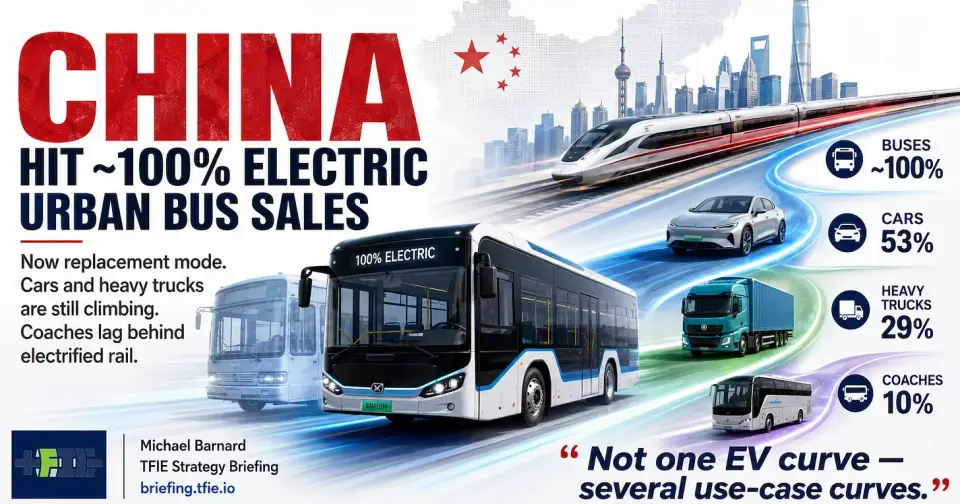
China’s electric vehicle transition is no longer a single national trend but four distinct market cycles. Urban buses have moved from initial adoption to routine replacement, with nearly 70% of the 680,000 electric bus fleet deployed before 2020. Passenger cars now account for over half of new sales, with nearly 70% of battery-electric models priced competitively against conventional vehicles. Heavy trucks are accelerating rapidly, reaching 29% of sales in 2025, driven by high-utilization commercial routes. Conversely, intercity coaches remain at 10% electrification, largely because high-speed rail has captured the majority of long-distance passenger demand.
Key points
- Urban bus procurement has shifted from diesel-to-electric conversion to electric-to-electric replacement, marking the completion of the first adoption cycle.
- China’s 2025 equipment-renewal programme explicitly supports the replacement of new-energy city buses and traction batteries, continuing into 2026.
- Electric passenger cars exceeded 50% of new car sales in 2025, with nearly 700 models available and prices often lower than conventional equivalents.
- Electric heavy trucks doubled their market share to 29% in 2025, driven by predictable routes in ports, mines, and industrial logistics where charging infrastructure is centralized.
- Intercity coach electrification remains low at 10% because high-speed rail, with over 50,000 kilometers of track, has already captured most long-distance passenger mobility.
- Policy focus is shifting from subsidizing initial adoption to supporting renewal within markets where electric propulsion is already the standard technology.
Background
This development follows China’s broader clean energy surge, where solar capacity surpassed coal in 2025 and thermal generation fell for the first time in a decade. While global trade barriers have recently slowed some clean energy transitions, China’s domestic transport sector continues to evolve independently. The current shift from adoption to replacement indicates a maturation of the market, distinct from the earlier phase of rapid initial uptake. This trajectory contrasts with the EU’s recent move to cap Chinese hybrid car imports, highlighting divergent strategies for managing electric vehicle markets globally.
Why it matters
Understanding that different transport segments follow distinct electrification curves is crucial for policymakers and investors. A single national EV adoption rate obscures the varying economics and infrastructure needs of buses, cars, trucks, and coaches. Recognizing that some sectors are in routine replacement while others are still in early adoption allows for more targeted public spending. Governments can prioritize infrastructure for high-utilization commercial fleets and predictable routes, rather than applying uniform subsidies across all vehicle categories. This nuanced approach ensures that public money is allocated where electrification already aligns with operational economics, accelerating the transition more efficiently.
What to watch
The focus for urban buses will remain on routine replacement cycles, supported by ongoing equipment-renewal programmes. For heavy trucks, growth is expected to continue in sectors with centralized charging infrastructure, such as ports and industrial logistics. Passenger car markets will likely see further consolidation as electric models become the standard choice across most price points. Intercity coach electrification may remain limited as high-speed rail continues to dominate long-distance travel. Policymakers outside China may use these distinct trajectories to design targeted incentives, focusing on sectors where operating economics and infrastructure align, rather than attempting to force uniform adoption across all transport categories.
Want the full story? Read the original reporting
Read on CleanTechnica