
NTSB report links Ryanair window blowout to fatigue-cracked engine blade
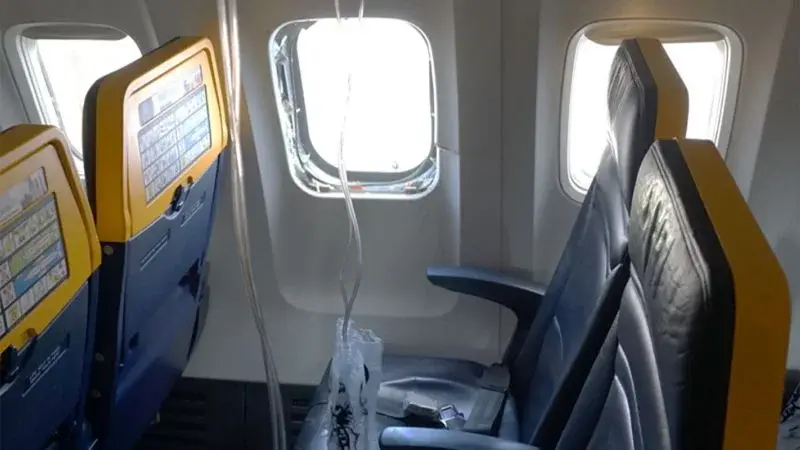
The NTSB has released a preliminary report stating that a fan blade from a CFM56 engine broke free on a Ryanair Boeing 737, shattering a cabin window and partially ejecting a passenger. The incident occurred shortly after takeoff from Thessaloniki, Greece, on July 10. The NTSB identified fatigue cracking on the broken blade as a key factor, contradicting Ryanair CEO Michael O’Leary’s earlier claims that the event was caused by foreign object damage. The NTSB has formally reprimanded O’Leary for commenting on the ongoing investigation, violating international protocols. The passenger, 61-year-old Ljubisa Karovic, was pulled back into the cabin by his wife and a flight attendant after being sucked out up to his shoulders. The aircraft returned to Thessaloniki for an emergency landing. The NTSB will lead the investigation, with Greece participating as an accredited representative. The final report is expected to take one to two years.
Key points
- NTSB preliminary report identifies a separated fan blade from the No. 2 CFM56-7B26 engine as the cause of the window blowout.
- Fatigue cracking was found on the broken blade, indicating gradual fracturing due to repeated stress.
- Ryanair CEO Michael O’Leary was reprimanded by NTSB Chairwoman Jennifer Homendy for publicly suggesting foreign object damage as the cause.
- The incident occurred 7.5 minutes after takeoff from Thessaloniki, Greece, on July 10.
- Passenger Ljubisa Karovic, 61, was partially sucked out of window 11F and pulled back inside by his wife and a flight attendant.
- The NTSB will lead the investigation, with Greece participating as an accredited representative under international rules.
Background
This incident echoes a 2018 Southwest Airlines Boeing 737 accident where a fan blade snapped, shattering a window and ejecting a passenger who later died. The 2018 incident led to stricter inspection rules for CFM56 engines, which were applied to the Ryanair aircraft involved in the July 2026 incident. Previous coverage from our archive detailed the immediate aftermath, including footage of the window blowout, the passenger’s injuries (friction burns and neck injuries), and the emergency return to Thessaloniki. The NTSB’s preliminary report now provides the first official technical assessment of the cause, moving the investigation beyond initial speculation.
How outlets are covering it
CNN and AP News both report the NTSB’s preliminary findings, but CNN provides more detail on the NTSB’s reprimand of Ryanair CEO Michael O’Leary. CNN explicitly quotes NTSB Chairwoman Jennifer Homendy’s letter to O’Leary, stating his comments violated international rules by offering opinions on the investigation. AP News focuses more on the technical findings, such as the fatigue cracking and bird remains, but does not detail the NTSB’s formal reprimand. Both outlets agree on the core facts: the fan blade separation, the window blowout, the passenger’s partial ejection, and the emergency landing. CNN also notes that the CFM56 engine is a joint venture between Safran and GE Aerospace, while AP News does not specify the engine manufacturer. The NTSB’s findings directly contradict O’Leary’s earlier claims that the incident was caused by foreign object damage, a point emphasized by CNN but not explicitly contrasted by AP News.
Why it matters
The NTSB’s preliminary report provides the first official technical assessment of a rare and serious aviation incident, identifying fatigue cracking as a key factor. This finding has significant implications for the safety of the widely used CFM56 engine and the inspection protocols for Boeing 737 aircraft. The NTSB’s reprimand of Ryanair’s CEO highlights the importance of maintaining the integrity of ongoing investigations and the potential consequences of premature public statements. The incident also underscores the critical role of passenger and crew actions in mitigating the effects of a catastrophic event, as the passenger was pulled back into the cabin by his wife and a flight attendant. The final NTSB report, expected in one to two years, will determine the probable cause and any contributing factors, potentially leading to further regulatory changes or safety improvements in the aviation industry.
What to watch
The NTSB will continue its investigation, with Greece participating as an accredited representative. The final report, expected in one to two years, will determine the probable cause and any contributing factors. Ryanair and the engine manufacturers, Safran and GE Aerospace, will likely face scrutiny over maintenance and inspection protocols. The passenger, Ljubisa Karovic, is expected to continue his recovery and may seek compensation. The aviation industry may review and potentially strengthen inspection rules for CFM56 engines, particularly regarding fatigue cracking. The NTSB’s reprimand of Ryanair’s CEO may lead to increased scrutiny of airline executives’ public statements during ongoing investigations.
- A jet engine fan blade cut into a plane and caused a passenger to be partially sucked out of a window, the NTSB says CNN
- Broken engine parts shattered the Ryanair plane window that a passenger's head got sucked into: NTSB AP News
- Bird Remains Found in Engine of Ryanair Plane That Depressurized Over Greece WSJ
- NTSB Finds Bird Remains in Engine After Ryanair Window Blowout Bloomberg.com
- Bird remains found in engine after man nearly sucked out of plane window South China Morning Post
Want the full story? Read the original reporting
Read on CNN